Space, science, and the human mind. Since 1995.
The Daily Orbit
A Space Daily column

The Daily Orbit

News desk

The Daily Orbit is Space Daily's news desk. Launches, mission milestones, agency decisions, and the commercial race to orbit, reported as they happen. Most stories start from primary sources: NASA and ESA releases, operator updates, and launch broadcasts.

Space Travel

In June 2024, a small Chinese spacecraft called Chang’e-6 became the first machine in human history to return samples from the far side of the Moon — drilling and scooping roughly 2 kilograms of lunar soil from a region no spacecraft had ever sampled, and delivering it back to Earth, giving humanity its first physical material from the half of the Moon that has been permanently turned away from our planet since it became tidally locked billions of years ago

For roughly the last three billion years, half of the Moon has been hiding. Earth's gravity caught the Moon early in its existence and slowed its spin until…

Station News

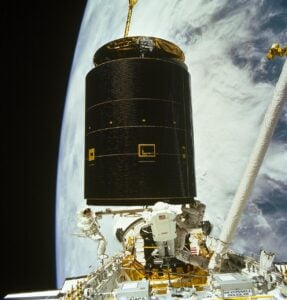
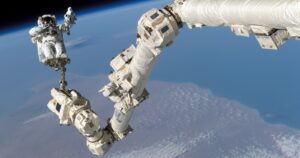
In April 2001, the crew of Shuttle Endeavour bolted a Canadian-built robotic arm to the outside of the International Space Station knowing that pieces of it would eventually wear out, and twenty-five years later, on June 30, 2026, two NASA astronauts will spend six and a half hours replacing the wrist joint that finally did

Canadarm2 has been bolted to the outside of the International Space Station since April 2001, working in shifts measured in years rather than hours.

Space Travel

A small European spacecraft called Philae became the first machine in human history to soft-land on a comet — bouncing twice in near-zero gravity before settling in a shadowed crevice on Comet 67P — after a 10-year, 6.4-billion-kilometre journey across deep space, where it transmitted scientific readings home for roughly 60 hours before its batteries finally died

Imagine throwing a refrigerator at a mountain travelling 135,000 kilometres per hour through deep space, after a ten-year flight, and asking the refrigerator to land softly enough to keep ten scientific instruments intact.

Space Travel

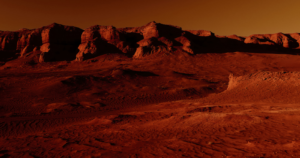
In 2028, China plans to launch the Tianwen-3 mission to the surface of Mars, drill two metres into Martian rock, collect at least 500 grams of soil and stone, and return those samples to Earth by 2031 — meaning if the mission succeeds on schedule, China will become the first nation in human history to bring back physical material from another planet, potentially years ahead of NASA and ESA’s own delayed Mars Sample Return effort

In approximately five years, if everything goes to plan, a small sealed canister containing roughly two pounds of Martian dirt and rock will arrive on Earth —…

Space Travel

Astronauts returning from six-month missions describe a persistent ‘observer’ sensation — the feeling of watching their own lives from a half-step outside the frame, weeks after they’re back on the ground

Astronauts returning from long ISS rotations consistently describe a half-step-outside-themselves sensation that flight surgeons recognize as part of the post-mission readjustment curve — a perceptual cost of spending six months in a body that had to learn a different world.

Space Travel

A Russian cosmonaut named Sergei Krikalev has physically travelled further into the future than almost any other human being in history — across six spaceflights and 803 cumulative days at orbital velocity, Einstein’s theory of special relativity has made him approximately 0.02 seconds younger than other people his age

Einstein's special theory of relativity, published in 1905, made a number of strange predictions about how time and motion interact, several of which sounded…

Space Travel

In 1970, the Soviet Venera 7 probe survived 23 minutes on the surface of Venus before the 475-degree heat and 90-atmosphere pressure crushed it, but in those minutes it became the first human-made object to transmit data from another planet, and engineers only realised they had the signal after rerunning the tape weeks later

{"content":"On 15 December 1970, a 500-kilogram steel sphere about the size of a beach ball slammed into the night side of Venus at roughly 17 metres per second, bounced, rolled, and came to rest o

Space Travel

In June 2025, a 65-year-old former NASA astronaut named Peggy Whitson became the oldest woman ever to orbit Earth — taking off aboard a SpaceX Crew Dragon as commander of the privately funded Axiom Mission 4 — and during her 18-day stay on the International Space Station, she pushed her career total past 695 cumulative days in space, the most of any American astronaut and the most of any woman who has ever lived.

The numbers behind Peggy Whitson's career do not, by themselves, capture the unusual shape of it.

Space Travel

The reason no human being has walked on the Moon in more than half a century is not that humanity lost the capability to get there — it is that humanity lost the reason, in the moment the Cold War goal of beating the Soviet Union to the lunar surface had finally been accomplished and the political momentum behind Apollo evaporated

The popular framing of the question — why has no human walked on the Moon since 1972? — usually proceeds as though there is some technical answer to be found.

Space Travel

The longest continuous spaceflight in history — 437 days aboard the Russian Mir space station, completed by cosmonaut Valeri Polyakov in 1995 — was specifically conducted to prove that a human being could survive a round-trip mission to Mars, in a piece of human endurance that has been waiting unused on a shelf for three decades

The record sits at the top of every list of human spaceflight endurance achievements, has been there since 1995, and is currently held by a man who has been dead for three years.