

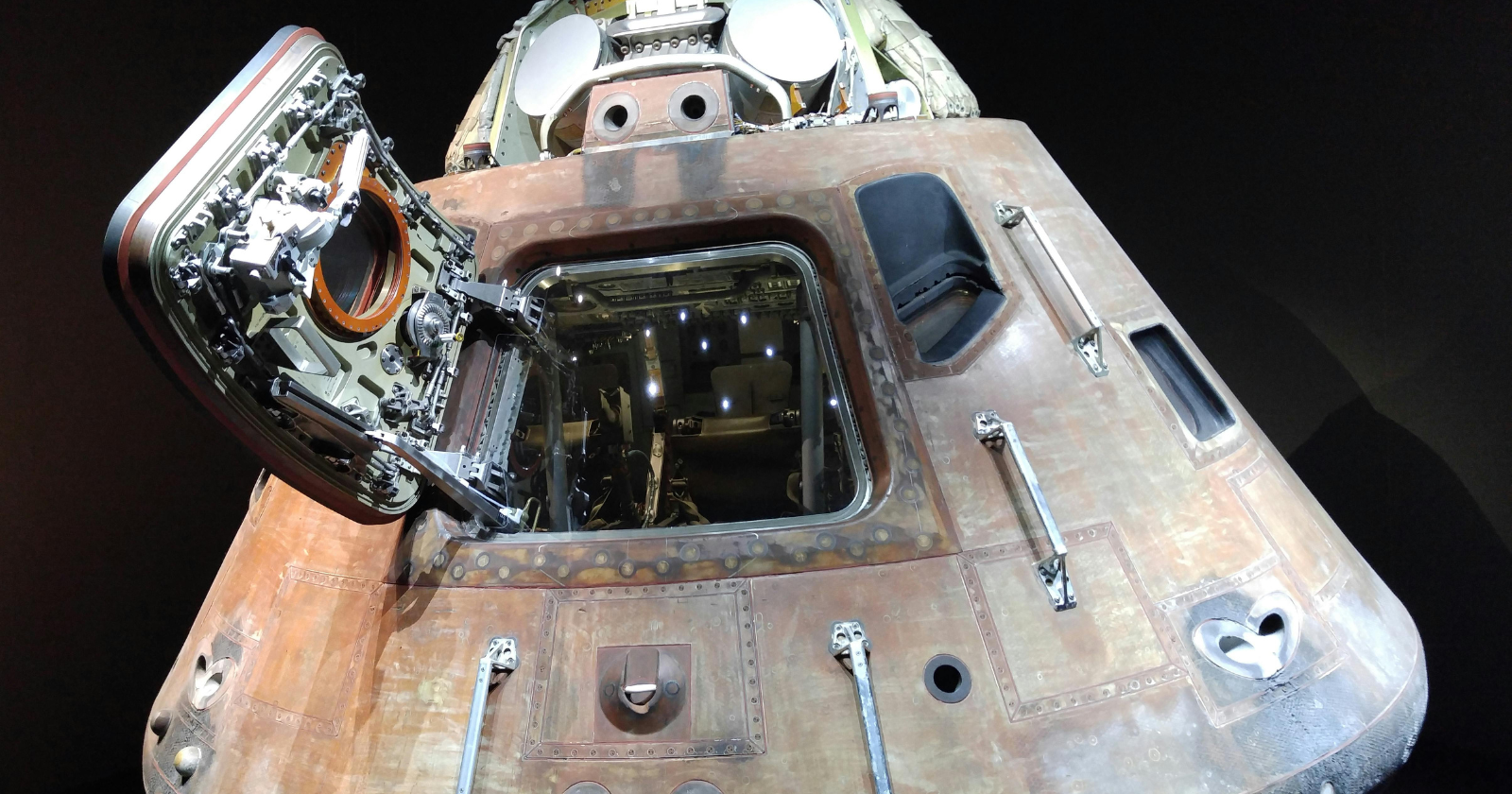
Late on 17 April 1970, Apollo 13 was already close enough to Earth for the planet to fill the lunar module’s alignment sight. The crippled spacecraft still needed one final course correction to place it safely in the atmosphere’s narrow entry corridor. Its main guidance system was powered down, stars were difficult to see through a cloud of vented debris, and conserving electrical power remained essential.
The solution was a short, manually controlled burn. Commander Jim Lovell used the boundary between day and night on Earth as one visual reference, lunar module pilot Fred Haise watched the Sun through a second sight, and command module pilot Jack Swigert called the time. The Apollo 13 technical crew debriefing records the crew’s description in unusual detail.
That manoeuvre is now often compressed into a memorable story: three astronauts, Earth’s glowing edge, a wristwatch and 14 seconds of engine fire. The first part is firmly documented. The final claim in the title, however, needs a qualification. Publicly available NASA records show that later Apollo crews practised manual burns and contingency procedures, but they do not establish that this exact terminator-and-watch exercise was made a named, mandatory drill for every remaining crew.
A correction, not the whole journey home
The burn did not by itself rescue Apollo 13. It was the last in a sequence of manoeuvres after an oxygen tank explosion disabled the command module Odyssey. Earlier burns had restored a free-return path around the Moon and then shortened the voyage home. The manual correction, designated MCC-7 in NASA’s history and performed at about 105 hours 18 minutes mission elapsed time, refined the spacecraft’s approach shortly before the crew prepared for re-entry.
NASA’s account, “Houston, We’ve Had a Problem”, gives the firing time as 14.8 seconds. The crew used the lunar module Aquarius’s descent propulsion system at only 10 per cent thrust. That made the burn relatively insensitive to small errors, an important protection when the astronauts were controlling attitude and engine timing themselves.
The distinction matters because the popular version can make the procedure sound like an improvised replacement for all navigation. Mission Control had calculated the required change in velocity and transmitted the procedure. The astronauts’ task was to establish and hold a usable attitude without the normal guidance platform, then start and stop the engine at the correct times.
Earth supplied two axes and the Sun supplied the third
The phrase “holding the spacecraft steady against the line where day meets night” is broadly accurate, but the actual geometry was more precise. Lovell viewed Earth through the lunar module’s Crewman Optical Alignment Sight. He used the planet’s terminator, the curved boundary between its illuminated and dark hemispheres, to control roll and yaw.
Haise used the Sun in the Alignment Optical Telescope to control pitch. Together, the two observations provided the three-axis attitude normally derived from the inertial guidance system. Once the crew had established the attitude visually, Lovell aligned the Abort Guidance System display and used it to help hold the spacecraft steady during the firing.
The Apollo 13 Flight Journal’s reconstruction of the manual course-correction burn shows that the work was divided among all three astronauts. Haise performed the small thruster firings needed to settle propellant in the descent engine’s tanks and monitored pitch. Lovell started the descent engine and controlled roll. Swigert, working from the command module, kept time and called for shutdown. The journal also notes that the procedure was adapted from an existing contingency checklist rather than invented completely from scratch during the emergency.
What the wristwatch claim rests on
The NASA debrief says that Swigert called the stop time and that the crew set up a timer. It does not identify the timer’s make in the relevant passage. The familiar wristwatch detail comes from crew recollections and from Omega’s historical account of Apollo 13, which says a Speedmaster was used to time the 14-second firing.
There is no reason to dismiss that account, especially because the Speedmaster was standard crew equipment. Still, it is useful to separate two levels of evidence. NASA’s contemporaneous technical record directly confirms timed manual engine control and Swigert’s shutdown call. The identification of a particular wristwatch is supported by later historical and manufacturer accounts.
The “14 seconds” in the retelling is also a rounded figure. Mission documentation gives 14.8 seconds. That difference does not change the feat, but it reveals how a complex engineering procedure becomes a compact story: 14.8 seconds becomes 14, several visual and instrument references become the edge of Earth, and a crew timer becomes a wristwatch.
What later Apollo crews actually trained for
Lovell clearly wanted the technique preserved. In the technical debrief, he said the manual burn using the Abort Guidance System worked and that NASA “ought to think about that kind of burn for the future”. A later NASA engineering review, “Apollo 13 Guidance, Navigation, and Control Challenges”, describes the crew as modifying existing contingency procedures and relying on Earth, Sun and Moon sightings when ordinary star sightings were obstructed.
The surviving training summaries show that Apollo 13’s lessons did feed into later preparation. The Apollo 15 crew training summary, for example, records a follow-on Apollo 13 crew debriefing and later sessions covering manual ascents and burns with both the descent and ascent propulsion systems. Training records for the later missions likewise contain contingency-checklist work, simulator runs and manual control exercises.
What the public archive does not appear to contain is a directive stating that every Apollo 14 through Apollo 17 crew had to repeat the exact Earth-terminator alignment and wristwatch-timed 14.8-second burn as a standalone mandatory exercise. The evidence supports a narrower conclusion: Apollo 13 reinforced the need to train crews for manual, visually referenced and contingency engine manoeuvres, and those capabilities remained part of subsequent mission preparation.
A lesson more durable than the legend
The manual correction succeeded because it combined prior contingency planning, rapid calculation on the ground and disciplined division of work in the spacecraft. It was improvised in its circumstances, but not unsupported by procedure. That balance is one of Apollo 13’s most useful engineering lessons.
Later crews did not need to face the same emergency for its lessons to matter. They trained for failed systems, manual control and propulsion contingencies because Apollo 13 had demonstrated how quickly normal assumptions could disappear. The archival record strongly supports that institutional response. It supports the more cinematic claim of an identical mandatory drill less clearly, and the distinction makes the achievement more instructive, not less.