
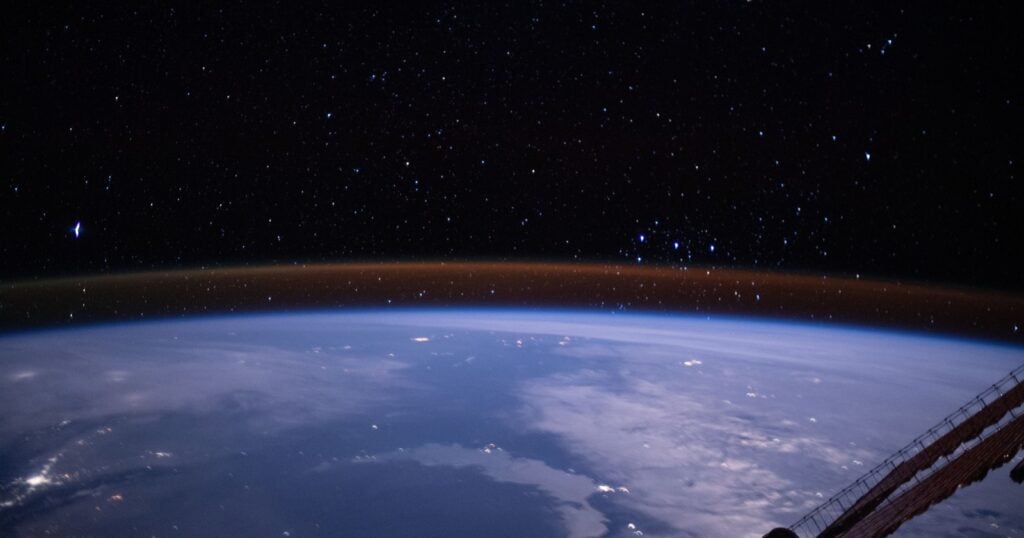
Why do we explore, anyway
When I was twenty-something and working in a corporate job, I started looking at the people who were ten and fifteen years ahead of me on the ladder.
Iridium Communications has agreed to acquire the remaining 61% of Aireon, its satellite-based aircraft-tracking subsidiary, in a $367 million deal that is really a bet on a single proposition: GPS is becoming unreliable enough to create a massive new commercial market for alternatives.

When I was twenty-something and working in a corporate job, I started looking at the people who were ten and fifteen years ahead of me on the ladder.

On 14 April 2025, six women boarded a Blue Origin New Shepard capsule at Launch Site One in West Texas and rode it past the Kármán line for ten minutes and twenty-one seconds.

"Okay, I can't see, but I can hear, I can talk, Scott Parazynski is out here with me.

I’ve been reading lately about how astronauts live, and the thing that has stayed with me isn’t the gear or the spacewalks.

On 17 April 2026, mission engineers at NASA's Jet Propulsion Laboratory in California sent commands to switch off the Low-energy Charged…
What’s up in
Industry news, exploration, and the engineering of getting humans and machines beyond Earth.


What’s up in
The psychology of ambition, isolation, and meaning under extremes — and what frontier life teaches us about being human.


What’s up in
Physics, climate, planetary science, and the research that shapes how we understand the universe.


Space, science, and the human side of the frontier. Since 1995.
Space Daily is an independent publication covering three connected beats: the space industry, the science behind it, and the psychology of ambition, isolation, and meaning under extremes. Founded in Tokyo in 1995, we’ve built a thirty-year archive of rigorous reporting on the people, missions, and ideas pushing humanity outward — and on the human dynamics shaped by frontier life. The same ambitions, pressures, and patterns of mind that drive humanity to the stars also shape how we live on Earth. We employ modern AI technologies to support our editorial workflows; every published piece is editorially directed and reviewed.
More about us →