
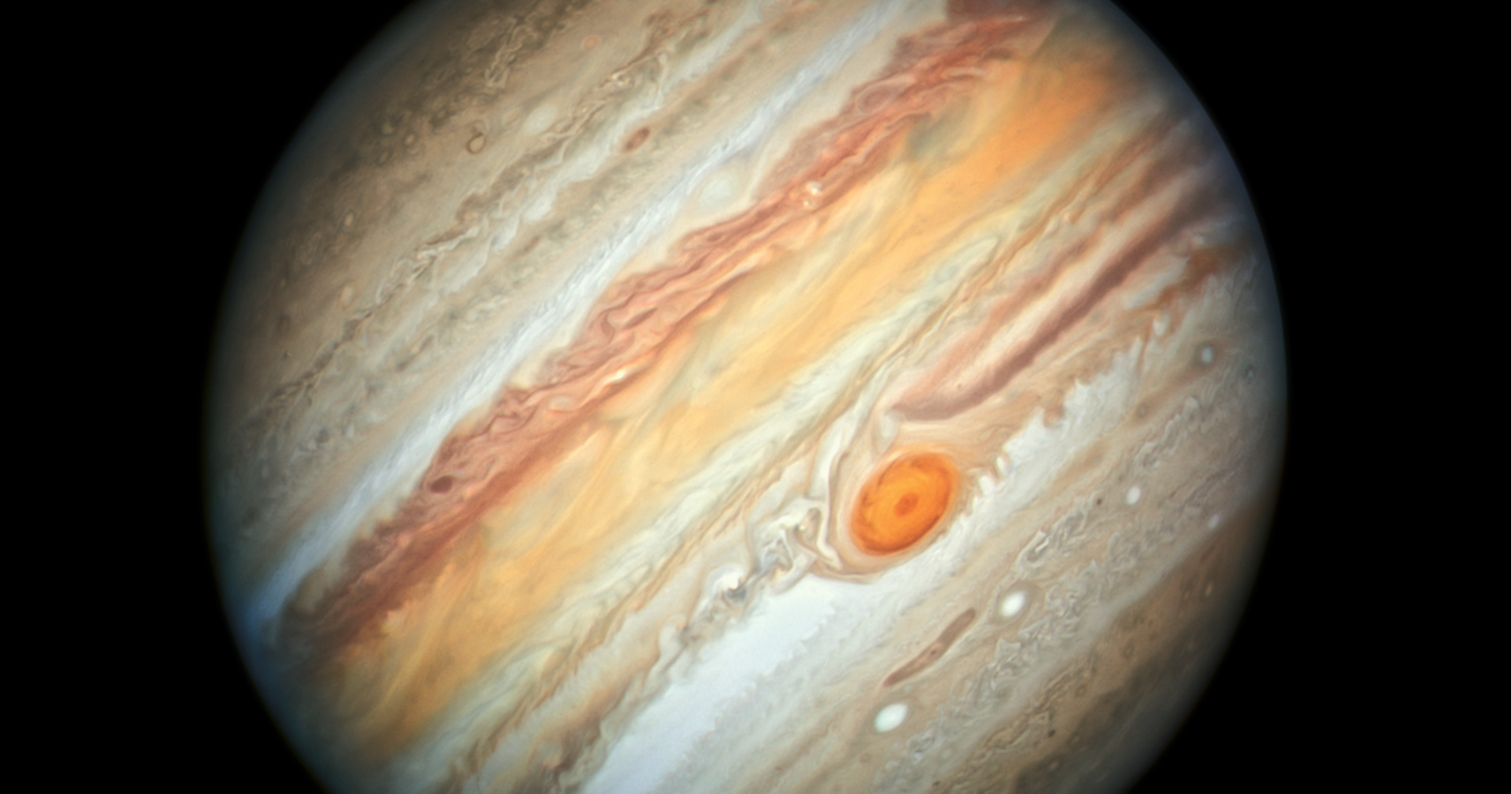
Jupiter’s Great Red Spot is a storm wider than Earth that has been watched, without interruption, for well over a century. It is an anticyclone, a high-pressure vortex turning anticlockwise, and it has been shrinking for more than a hundred years. Once its long axis stretched across two to three Earth widths. Today it is only a little wider than one. Because Jupiter is observed so regularly, astronomers can track that change in size almost decade by decade.
That last point is what makes it useful as well as famous.
A storm you can measure repeatedly across a century and a half is a rare thing in planetary science.
How long it has actually been there
The storm has been observed continuously since 1831, which makes it at least about 190 years old. That is the firm number.
There is an older and more uncertain claim. In 1665 the astronomer Giovanni Domenico Cassini described a dark oval at the same latitude on Jupiter, which he and others called the Permanent Spot and followed until 1713, after which they lost it. For a long time people wondered whether that was the same storm. A 2024 study led by Agustín Sánchez-Lavega of the University of the Basque Country, published in Geophysical Research Letters and summarised by the American Geophysical Union, argues it probably was not. From the way the spots changed in size and drifted, the team concluded that the current Great Red Spot most likely formed in the early 1800s, and that Cassini’s spot had faded sometime before then.
So the safe statement is the conservative one. The Great Red Spot has raged for at least a century and a half, and on the continuous record closer to 190 years. The version that runs all the way back to Cassini, often given as 350 years, is the part that does not hold up well.
The shrinking, measured
The size record is unusually long for a single weather system. In 1879 the spot’s long axis was measured at about 39,000 kilometres. When NASA’s Voyager probes flew past in 1979, it was down to roughly 23,000 kilometres. Recent measurements put it near 14,000 kilometres across, and the shape has grown more circular as it has narrowed, less of a stretched oval and more of a rounded blob.
Set against Earth, that is a fall from a storm two to three Earth widths across to one only slightly wider than our planet. The decline has been followed closely since the 1930s, and is now tracked every year by the Hubble Space Telescope under a programme called Outer Planet Atmospheres Legacy, led by Amy Simon at NASA’s Goddard Space Flight Center, which images the outer planets on a regular schedule. NASA has reported the spot at the smallest size yet measured in that record.
Long-term shrink, short-term wobble
The steady decline is not the only thing the storm does. Its size also varies on much shorter timescales. Hubble monitoring reported in 2024 found the Great Red Spot oscillating in size and brightness over a cycle of about 90 days, expanding and contracting as though it were being squeezed. That short-term jiggle sits on top of the long, slow shrink, and the two should not be confused. A storm getting briefly larger across one season is not evidence that the century-long trend has reversed.
Why it is shrinking, which is not settled
The honest answer to why the spot is shrinking is that nobody is certain. It draws energy from Jupiter’s atmosphere, partly by absorbing smaller storms that drift into it, and it sits wedged between two opposing jet streams that help hold it in place. Why the balance has tipped toward slow contraction over the past century is not established.
Nor is it clear how the shrinking ends. One possibility is that the storm keeps narrowing until it can no longer sustain itself and breaks apart, which is the fate the 2024 study suggests may have befallen Cassini’s Permanent Spot. Another is that it settles at some smaller stable size and lasts a long while yet. The study’s models point to the first as a real risk rather than a certainty.
What to watch
The thing to follow is the annual Hubble measurement. If the long-axis figure keeps falling year on year, the question becomes whether the spot approaches a floor or carries on toward break-up. Some researchers have suggested, cautiously, that people alive today might live to see it go. That is a possibility, not a forecast. For now the Great Red Spot is still there, still wider than Earth, and still the best-documented storm anywhere off this planet.
