
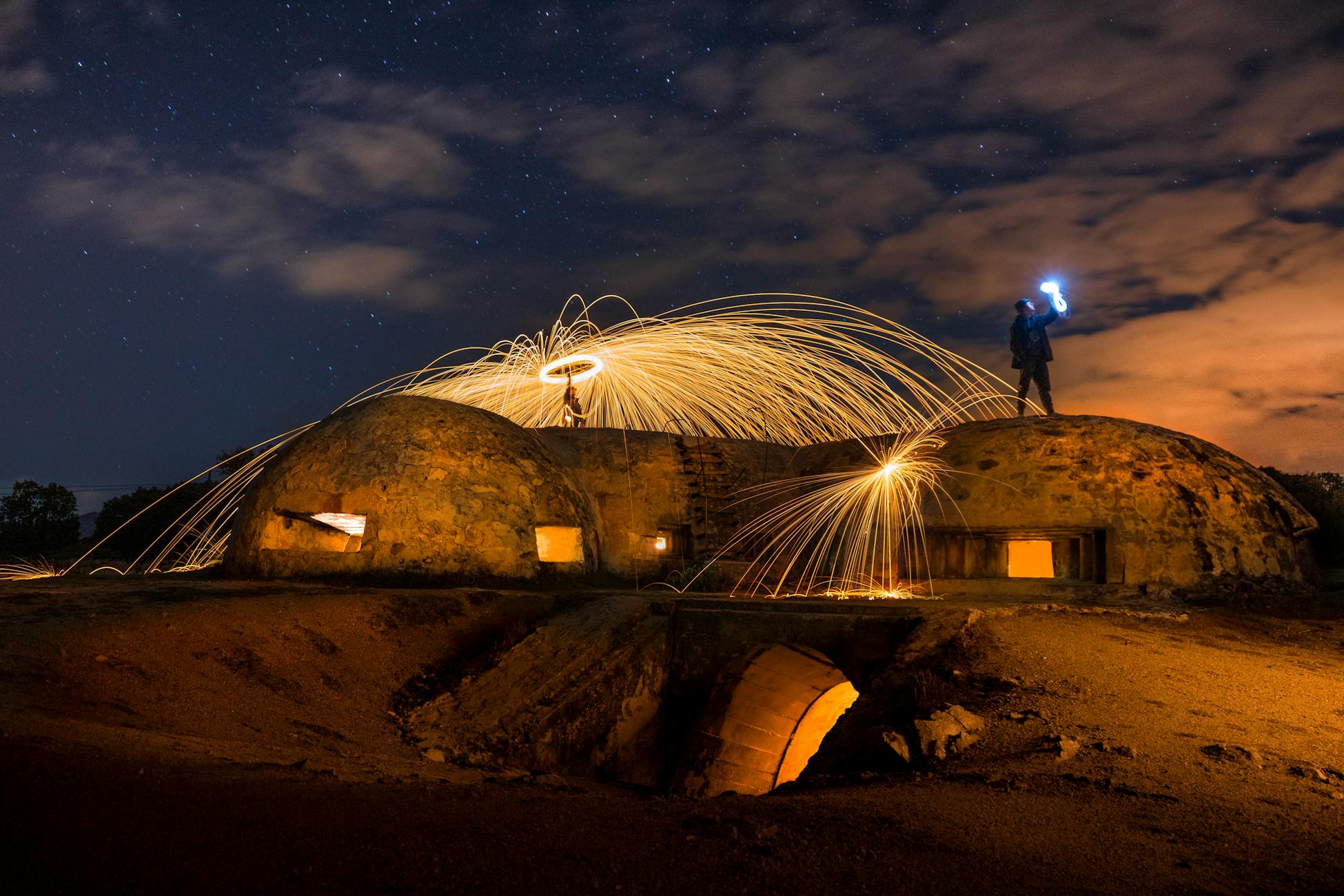
Cheyenne Mountain sits south of Colorado Springs, and inside that mountain the U.S. Army Corps of Engineers and contractors hollowed out a chamber in the early 1960s and floated freestanding steel buildings on coil springs, each weighing roughly 1,000 pounds. The point was simple and strange. If a Soviet warhead detonated nearby, the mountain would shake, but the buildings inside were meant to sway with the shock instead of breaking apart.
The complex went operational in 1966 as the home of the North American Aerospace Defense Command, NORAD, the binational U.S. and Canadian organization watching for incoming bombers and, later, missiles. The blast doors weigh 25 tons each. Behind them, the buildings are not bolted to the granite floor. They rest on the springs, and the springs do the work.
Why a city on springs
The engineering problem was specific. A nuclear ground burst near the mountain would send a compression wave through the rock at thousands of feet per second. Anything rigidly attached to that rock, a server rack, a desk, a steel beam holding up a ceiling, would be accelerated with it and would shear, snap, or tear free.
Coil springs solve this by decoupling the building from the ground motion. The rock moves. The spring compresses. The building above the spring lags behind, then settles, riding out the shock at a much gentler acceleration. The principle is the same one used to isolate sensitive laboratory equipment from floor vibration, only scaled up to protect multi-story buildings full of consoles, cryptographic gear, and command staff.
Each spring at Cheyenne Mountain is designed to carry a heavy share of a building’s weight while allowing horizontal sway in any direction. Multiply the springs under the buildings and the entire complex becomes, in effect, a slow-moving raft sitting on a steel mattress.
The mass-spring-damper logic
Engineers describe this kind of setup as a mass-spring-damper system. The mass is the building. The springs absorb and return energy. Dampers, in Cheyenne Mountain’s case piston-style shock absorbers paired with the spring assemblies, bleed off the bounce so the building doesn’t oscillate for minutes after a shock.
Without damping, a struck spring system rings like a tuning fork. Add damping and the motion dies out within a few cycles. The combination is what lets the complex absorb a sharp impulse and then sit still again, ready to keep operating.
The same family of math turns up wherever engineers need to predict how an isolation system will perform under a sudden load, from machine tools on factory floors to telescopes on hillsides.
Why the wiring mattered
The 1960s Cheyenne Mountain was packed with vacuum-tube computers, miles of copper cabling, magnetic tape drives, paper plotters, and analog phone trunks running up through the access tunnel to the outside world. Solder joints crack. Connectors pull loose. A rigid building snapping even a few inches relative to a flexible cable bundle would sever the data lines the command center needed in the first ninety seconds of a war.
By floating the buildings, the cabling between them could be run in long, slack loops with flexible junctions, so each building could move as a unit and the wires between them would simply flex. Later research on computing equipment under seismic load confirmed what the Cheyenne Mountain designers were betting on in 1961, that local isolation and damping protect electronics better than trying to harden the rack itself.
The chamber itself
To make room for the spring-mounted city, miners removed granite from inside the mountain in the early 1960s. The chamber consists of tunnels and caverns excavated using drill-and-blast techniques, the same method used in hard-rock mining. Crews then bolted the walls with rock anchors to keep slabs from spalling off during a future shock.
The buildings inside are ordinary multi-story steel structures, the kind you might see in a small office park, except they are sitting under a mountain and resting on springs. Workers walk between them on flexible bridges. Pipes for water, fuel, and air feed each building through movable couplings.

Blast doors, filters, and a reservoir
The main blast doors are massive and weigh 25 tons each, hinged so they can swing shut and seal against a steel frame. They are designed to withstand the overpressure from a nearby detonation and to lock out fallout and chemical agents. Behind them, a system of louvers and filters scrubs incoming air.
The complex also holds diesel generators, fuel for weeks of independent operation, and reservoirs containing water carved into the rock floor. The reservoirs do double duty as ballast and as drinking and cooling supply.
None of this matters if the buildings inside the chamber crumple. The springs are the load-bearing decision that makes the rest of the design coherent.
What the mountain was watching for
When Cheyenne Mountain opened in 1966, the threat model was Soviet long-range bombers and the first generation of intercontinental ballistic missiles. Radar feeds from the Distant Early Warning Line in the Arctic, the BMEWS sites in Alaska, Greenland, and the UK, and later from satellites in geosynchronous orbit, all converged on consoles inside the spring-mounted buildings.
The mission expanded over the decades to include space surveillance, tracking thousands of objects in orbit, and missile warning for North America. The Cheyenne Mountain Air Force Station remains an alternate command center today, with primary NORAD operations having moved to nearby Peterson Air Force Base in the 2000s, though the mountain stayed staffed and ready. Later organizational changes saw upgrades to its satellite tracking picture and continuing investment in the underground complex.
How the springs behave in a shock
If a multi-megaton weapon detonated within a few miles of the mountain, the granite would transmit a compressive pulse through the chamber walls. The floor of the chamber would jolt upward and then settle back, possibly several times.
Each spring would compress at the instant of the jolt, storing the energy. The building above would begin to move a fraction of a second later, more slowly, with a softer peak acceleration. The dampers would bleed off the rebound. The building’s occupants would feel a strong heave, but the consoles would stay bolted to their desks and the cable runs between buildings would flex without tearing.
The mountain itself would absorb the rest. The thick granite cover is an excellent shock attenuator.
The same physics, smaller stakes
The principle scales down. Power utilities use weighted dampers on transmission lines to suppress wind-driven oscillations that can spark wildfires or fatigue conductors. Skyscraper tuned mass dampers, like the steel ball inside Taipei 101, work on the same logic, a heavy object on flexible mounts that lags behind the building’s sway and cancels it out.
Hospitals in earthquake zones now sit on rubber and lead base isolators that do exactly what the Cheyenne Mountain springs do, decouple the structure from the ground motion. Surviving a nuclear blast at close range is a different problem from surviving an earthquake, but the engineering instinct, isolate the thing you care about, is identical.
What it cost
The Cheyenne Mountain Complex was expensive to build, a major Cold War infrastructure project. The springs themselves were a small line item compared to the excavation and the buildings, but they were the design feature that justified the rest of the spending. Without them, the buildings would have had to be poured concrete monoliths bolted to the rock, far heavier, far less serviceable, and far more likely to fail in the exact scenario the complex was built for.
The decision to float the city was made by engineers who understood that rigid strength is brittle. Flexible suspension lets a structure survive forces that would shatter a stiffer one.
What it feels like inside
Visitors who have toured the complex describe the spring suspension as nearly invisible. The buildings look like buildings. The floors feel solid. Only at the base, where a steel column meets a spring assembly, does the design announce itself.
Walk between two buildings and the flexible bridge gives slightly underfoot. Look at the cable trays overhead and they sag in deliberate loops between anchor points. Everything is built to move without breaking.
Sixty years on, the springs are still there, still loaded, still waiting for a shock that has not come. They were inspected and recoated periodically through the Cold War and into the present, and the complex remains certified for operation. The springs sit in their wells under the buildings, compressed by the weight above them, holding a small underground city off the granite floor, ready to sway.
