

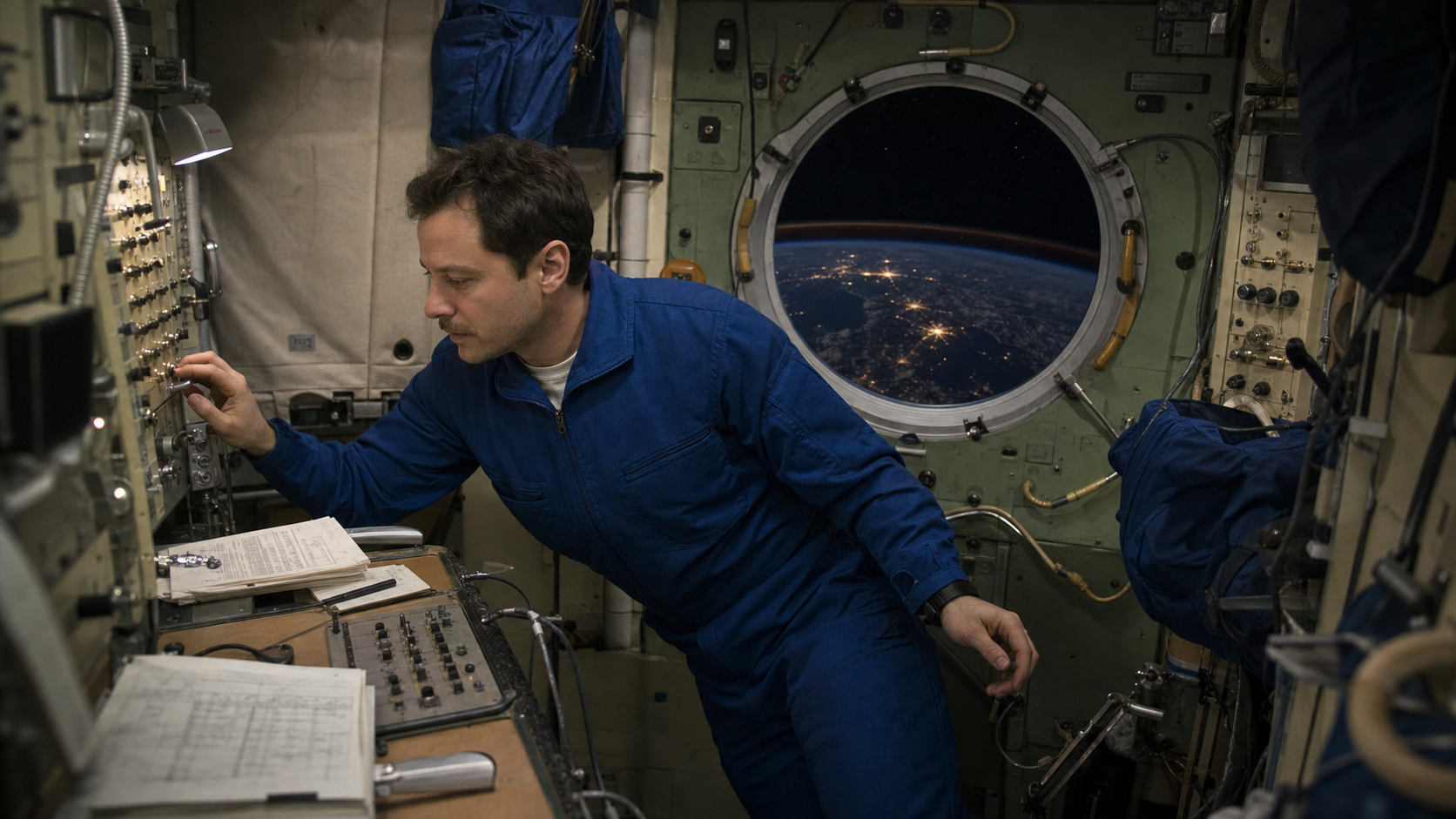
Sergei Krikalev left Earth as a citizen of the Soviet Union on 18 May 1991. When he returned 311 days and 20 hours later, the Soviet Union no longer existed.
The facts are extraordinary without the usual claim that he was forgotten or abandoned in orbit. Krikalev agreed to remain aboard Mir after two planned crew flights were combined into one. A Soyuz return craft, mission control and a functioning space programme remained behind him. What changed was the state responsible for all of them.
His mission became an unusual test of continuity. Ground controllers, engineers and cosmonauts kept operating a complex orbital station while budgets contracted, republics declared independence and the launch site at Baikonur suddenly stood inside a new country.
A five-month mission became two expeditions
Krikalev launched aboard Soyuz TM-12 with commander Anatoli Artsebarsky and British astronaut Helen Sharman. They docked with Mir two days later. Sharman returned after a short visit, leaving Artsebarsky and Krikalev as the station’s ninth principal expedition.
The original plan would have brought both men home in October 1991. Financial pressure forced planners to reduce the next two Soyuz flights to one. The replacement flight also needed seats for Austrian researcher Franz Viehböck and Kazakh cosmonaut Toktar Aubakirov. That left room for a commander, Alexander Volkov, but not a new flight engineer.
In July, Krikalev agreed to remain as flight engineer for the following expedition. Soyuz TM-13 arrived in October with Volkov and the two visiting researchers. Artsebarsky returned to Earth with Aubakirov and Viehböck, while Krikalev transferred into a second consecutive Mir crew.
This was a mission extension made under pressure, not a disappearance from the schedule. It still required Krikalev to reset his expectations in orbit. In a later NASA interview, he described learning to pace himself differently once he realised the distance he had to run had become much longer.
The coup reached Mir by broadcast
In August 1991, hard-line Soviet officials attempted to remove Mikhail Gorbachev from power. The coup failed after three days, accelerating the breakup it had been intended to prevent.
The political crisis did not stop Mir. NASA’s detailed Mir Hardware Heritage chronology records that Progress M-9 launched on 21 August as the coup attempt collapsed. Mission control relayed both pro-coup Soviet television and anti-coup Russian radio broadcasts to the crew. The same account says there were no plans to abandon the station.
That detail changes the character of the story. Krikalev was isolated by altitude, not by silence. He and Artsebarsky could follow events through the communications system, even as their ability to influence them was almost nonexistent.
Below them, the political sequence accelerated. Soviet republics declared independence after the failed coup. Gorbachev resigned on 25 December, and the hammer-and-sickle flag was lowered from the Kremlin. The US State Department’s historical account describes the transition from one union into multiple independent states, with Russia assuming much of the former central government’s role.
The hardware outlasted the flag
Mir still needed daily work regardless of which flag flew over mission control. Krikalev and Volkov maintained life-support and station systems, exercised to limit the effects of microgravity, ran experiments and monitored visiting Progress cargo vehicles. Their workload was technical and repetitive, which may have been precisely what made continuity possible.
The station was never an autonomous refuge. Its orbit depended on ground tracking, commands, replacement equipment and launches. Those functions did not vanish with the Soviet government because the organisations and people performing them continued under new Russian structures.
On 20 February 1992, Krikalev and Volkov carried out a four-hour, 12-minute spacewalk for maintenance and experiment retrieval. A NASA chronology of extravehicular activity notes that Volkov’s spacesuit cooling system developed a problem, leaving Krikalev to complete much of the work while his commander remained near the airlock.
By then, even the national description of the mission had changed. Soyuz TM-14, launched on 17 March with the relief crew, was identified in a later NASA flight summary as the first crewed mission of the Commonwealth of Independent States era. It docked with Mir two days later, finally providing Krikalev and Volkov with replacements.
He landed in a different political map
Krikalev and Volkov undocked in Soyuz TM-13 on 25 March 1992 and landed northeast of Arkalyk in independent Kazakhstan. The mission record gives Krikalev a total of 311 days, 20 hours and 4,934 orbits across the two linked expeditions.
He had launched from the Soviet republic of Kazakhstan as a Soviet cosmonaut. He returned to the same physical steppe through a Russian-led programme, after Kazakhstan had become sovereign and Russia had inherited the central institutions of the old space system.
The “cosmonaut without a country” label followed him, but it hides the institutional achievement. Krikalev was able to come home because the people who built, supplied and controlled Soviet human spaceflight kept cooperating through an abrupt transfer of political authority.
That continuity soon became international. In 1994, Krikalev flew on STS-60 as the first Russian cosmonaut aboard a US Space Shuttle, an early operational step in the Shuttle-Mir partnership. He later helped assemble the International Space Station and served on its first resident crew. NASA’s account of STS-60 places his flight at the beginning of the cooperation that followed the Cold War.
His long Mir mission is remembered because a country disappeared beneath him. Its deeper lesson is that a space programme is not only a state emblem. It is a network of professional obligations, and in 1991 that network held together long enough to outlive the state that created it.