

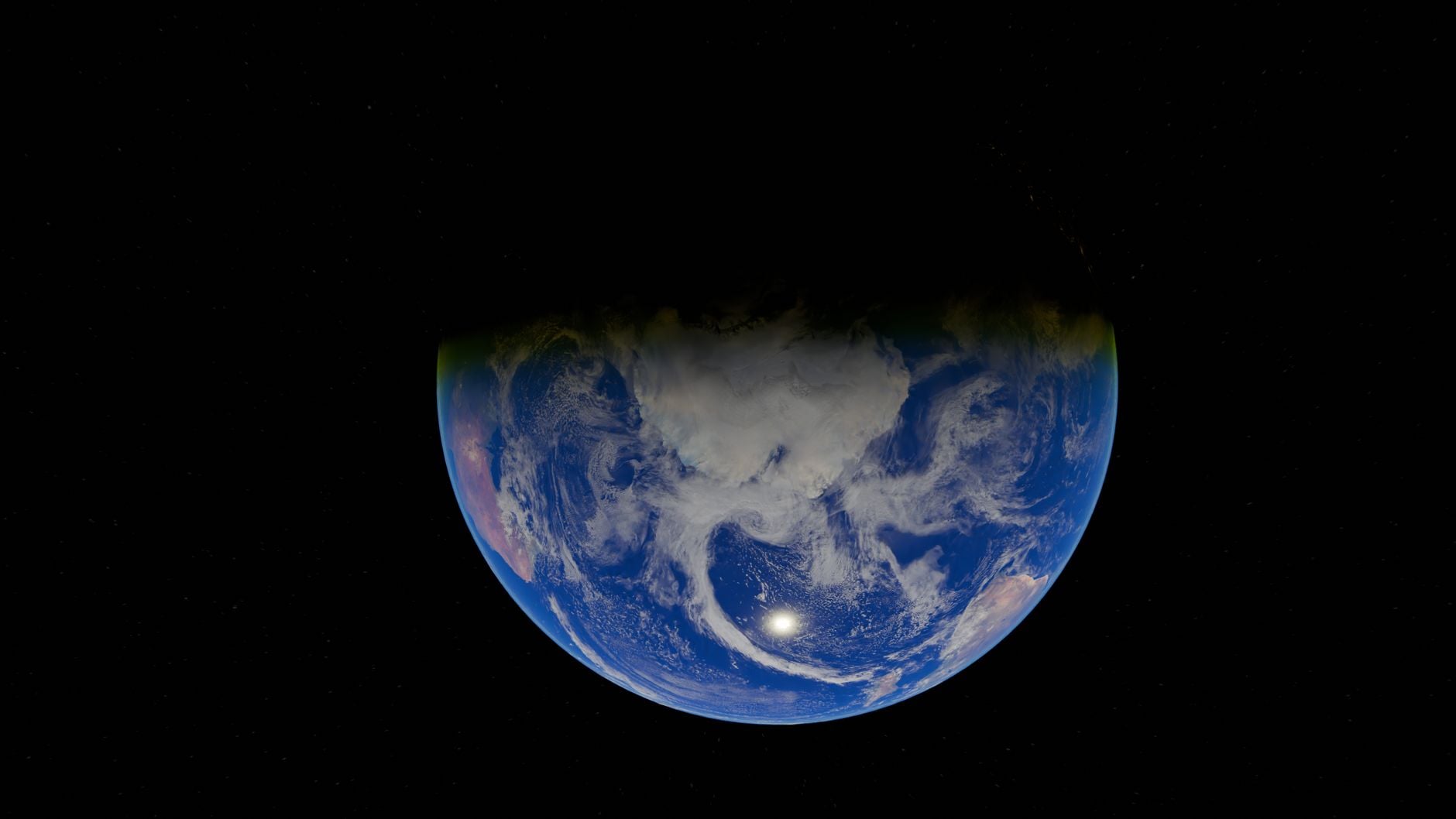
The International Space Station circles Earth about once every 90 minutes. That orbital rhythm gives its crew roughly 16 sunrises and 16 sunsets in every 24-hour day, each one arriving and disappearing in seconds.
The number is memorable. The view is harder to carry home. In astronaut accounts, one detail returns with striking regularity: from orbit, the atmosphere does not resemble a limitless sky. It becomes a narrow blue band around the planet, visibly slight beside the darkness beyond it.
Calling it a line that could almost be rubbed out with a thumb is a metaphor, not a measurement. Yet it is close to the visual scale astronauts describe. NASA astronaut Ed Lu estimated that the atmospheric limb at the horizon appeared about one degree wide, roughly comparable to an index finger held at arm’s length.
Sixteen days compressed into one
According to NASA’s station facts, the ISS travels at about 28,000 kilometres an hour and completes 16 orbits a day. At that speed, sunrise or sunset comes around approximately every 45 minutes.
That does not mean the crew live through 16 workdays. Station life is organised around a 24-hour schedule, with sleep, meals, maintenance and research planned against Coordinated Universal Time. The rapid alternation of light and darkness is an orbital backdrop, not a practical clock. Crews use carefully managed lighting because their bodies still need a recognisable day and night.
Seen from the ground, dawn appears to unfold across a broad sky. Seen from the station, the spacecraft is moving so quickly through the boundary between Earth’s shadow and sunlight that the colour bands change in moments. Former NASA astronaut Joseph Allen described orbital sunrises and sunsets as lasting only seconds. Photographs can make them seem serene and suspended; the lived view is fast.
Why the atmosphere becomes a line
The atmosphere does not end at a hard boundary. It becomes progressively thinner with altitude, with stray particles extending far beyond the layers where aircraft fly or weather occurs. Looking towards Earth’s horizon, however, means looking edge-on through those layers over a long path. Sunlight scattering through that path makes the atmospheric limb visible as bands of colour.
Blue light is scattered efficiently by molecules in the atmosphere, which helps produce the blue band seen in daylight. Near sunrise and sunset, sunlight takes a longer route through the lower atmosphere. More of the shorter wavelengths are scattered out of the direct beam, leaving oranges and reds along the horizon. Dust, aerosols and clouds can alter the precise colours and structure from one orbit to the next.
A NASA Earth Observatory explanation of an orbital sunset identifies the orange-red layer nearest Earth as the troposphere. Its thickness varies from roughly six kilometres near the poles to about 20 kilometres near the equator, yet it contains more than 80 per cent of the atmosphere’s mass and almost all of its water vapour, clouds and weather.
The stratosphere reaches to around 50 kilometres. The ISS normally flies roughly 400 kilometres above Earth, with its exact altitude changing over time. Those numbers are not directly equivalent to the apparent width of the blue line, but together they explain the visual shock. The region holding nearly every breath, cloud and storm occupies a small fraction of the distance between the surface and the station.
The atmosphere has no drawn edge
Lu’s one-degree estimate is useful precisely because it comes with a warning. In his account of watching Earth from the station, he noted that the band is fuzzy rather than sharply bounded. There is no altitude at which the atmosphere simply stops and empty space begins. Definitions such as the 100-kilometre Kármán line are practical conventions, not walls in the sky.
The apparent thinness is also shaped by perspective. A viewer in orbit is looking at an enormous curved planet from hundreds of kilometres away. Holding up a thumb can cover large features in the field of view, just as a thumb on Earth can hide the Moon. The gesture does not tell us the atmosphere’s physical depth, but it communicates the startling ratio between the coloured limb, the planet beneath it and the black space beyond.
That distinction matters because the familiar photograph can otherwise become misleading. Earth’s atmosphere is not literally a blue membrane, and the dark background is not pressing against it at a crisp border. The line is an optical view through a continuous gradient of gases. Its fragility, however, is not merely optical. NASA notes that the atmosphere’s mass is about one-millionth of the mass of Earth itself.
Different astronauts, a recurring comparison
The title’s “many say” should not be read as a statistic. There is no single questionnaire proving that every astronaut finds the atmosphere the hardest part of spaceflight to describe. What exists instead is a recurring set of named accounts across missions and agencies.
ESA astronaut Alexander Gerst put it bluntly beside a photograph from orbit: “Look at how thin our atmosphere is. This is all there is between humankind and deadly space.” NASA astronaut Scott Kelly later described it as a fragile, thin film. Christina Koch has recalled a thin blue line on Earth’s day side and a thin green line on its night side, encompassing everyone below.
In NASA’s collection of astronaut perspectives after 25 years of continuous ISS habitation, Mike Foreman said the atmosphere looked so thin and fragile that it changed how he thought about conservation. Nicole Stott described a related change in scale: Florida, once the place she treated as home, became one special part of the larger home visible through the window.
These are personal recollections, not controlled evidence that spaceflight produces one universal state of mind. Astronauts bring different histories to the view and describe it in different terms. The common thread is more modest and more defensible: a feature that is effectively invisible from beneath it becomes one of the planet’s clearest features when viewed from above.
What orbit makes legible
Spaceflight writers often call the broader shift in perception the overview effect. The phrase can become sentimental when it is detached from the physical view. The atmospheric limb gives it a concrete basis. It shows a boundary that is not political and is not drawn on any map, but which contains nearly every landscape, city and human argument.
On the surface, the atmosphere feels immense. Weather crosses continents, clouds fill the horizon and the sky supplies no obvious upper edge. Orbit changes the geometry. Air becomes a coloured skin around a sphere, while the station repeatedly passes from sunlight into shadow and back again.
Sixteen sunrises and sixteen sunsets make a fine piece of orbital arithmetic. The thin blue line supplies the harder thought behind it. What looks endless from inside can look alarmingly slight from outside, and the same layer that colours every dawn is also the narrow habitat within which almost all human life has taken place.