

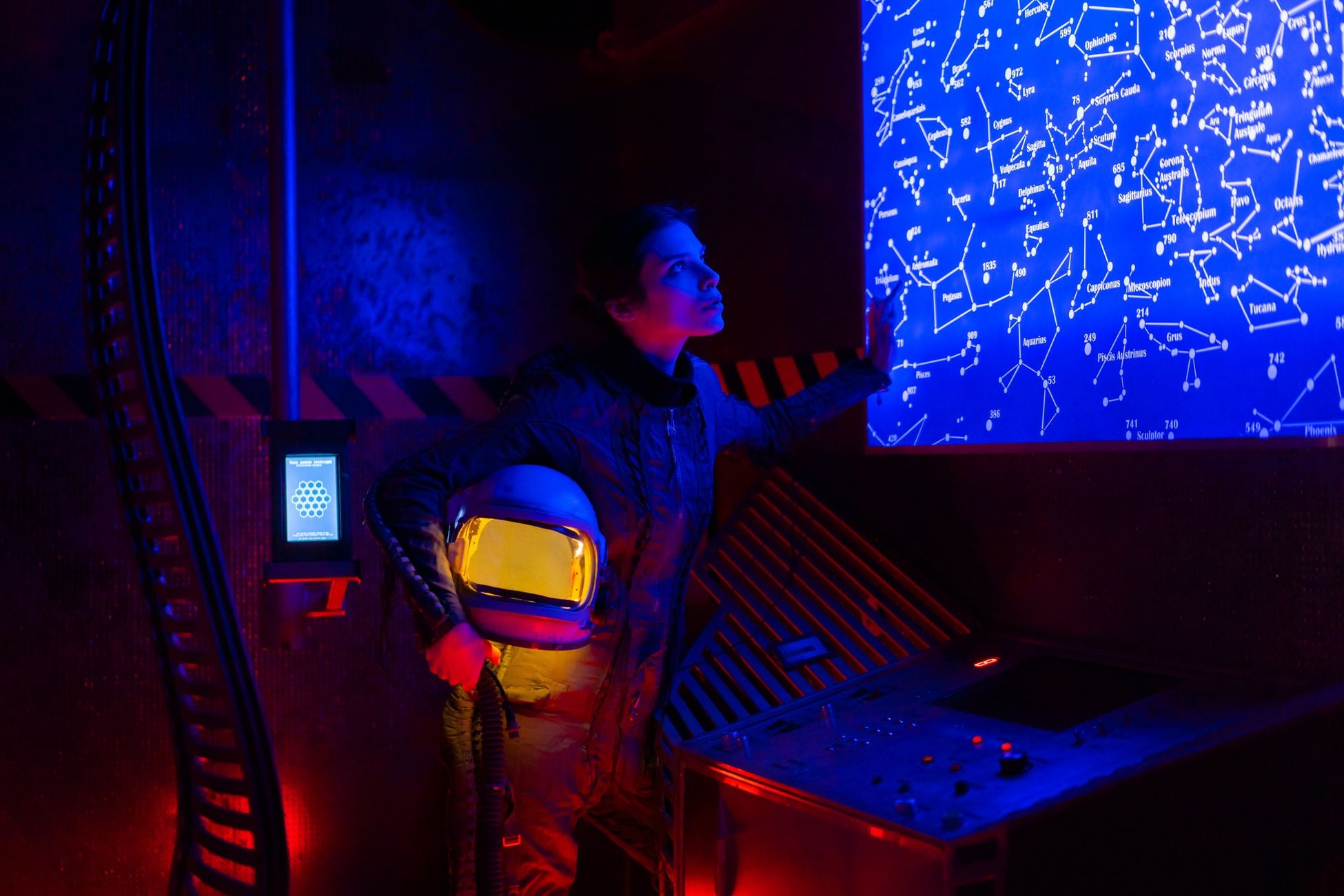
Don Pettit, floating in the darkened lab of the International Space Station, closed his eyes and watched streaks of light cross his vision — the same phenomenon Buzz Aldrin, Neil Armstrong, and every Apollo crew after them reported witnessing in space. He wasn’t hallucinating. He was seeing cosmic rays punching through the walls of the spacecraft, through his skull, and through the wet jelly of his eyeballs, each one leaving a brief flash of light on his retina.
The flashes are still happening. They are happening right now, above your head, to every astronaut on the ISS as it passes over your city tonight.
The first crews to see them
The story starts on Apollo 11. During the coast to the Moon, crew members mentioned to mission control that they were seeing occasional pinpricks of light with their eyes closed. Nobody on the ground knew what to make of it.
By Apollo 12, NASA was paying attention. And by later Apollo missions, astronauts were running formal experiments on the return leg, sitting in darkness with blindfolds and calling out each flash they saw, its shape, and where in their visual field it appeared.
The pattern was consistent. Streaks. Points. Sometimes little comets with tails. One every few minutes on average, though the rate varied. Every Apollo crew from 11 onward reported them.
What is actually hitting the astronauts
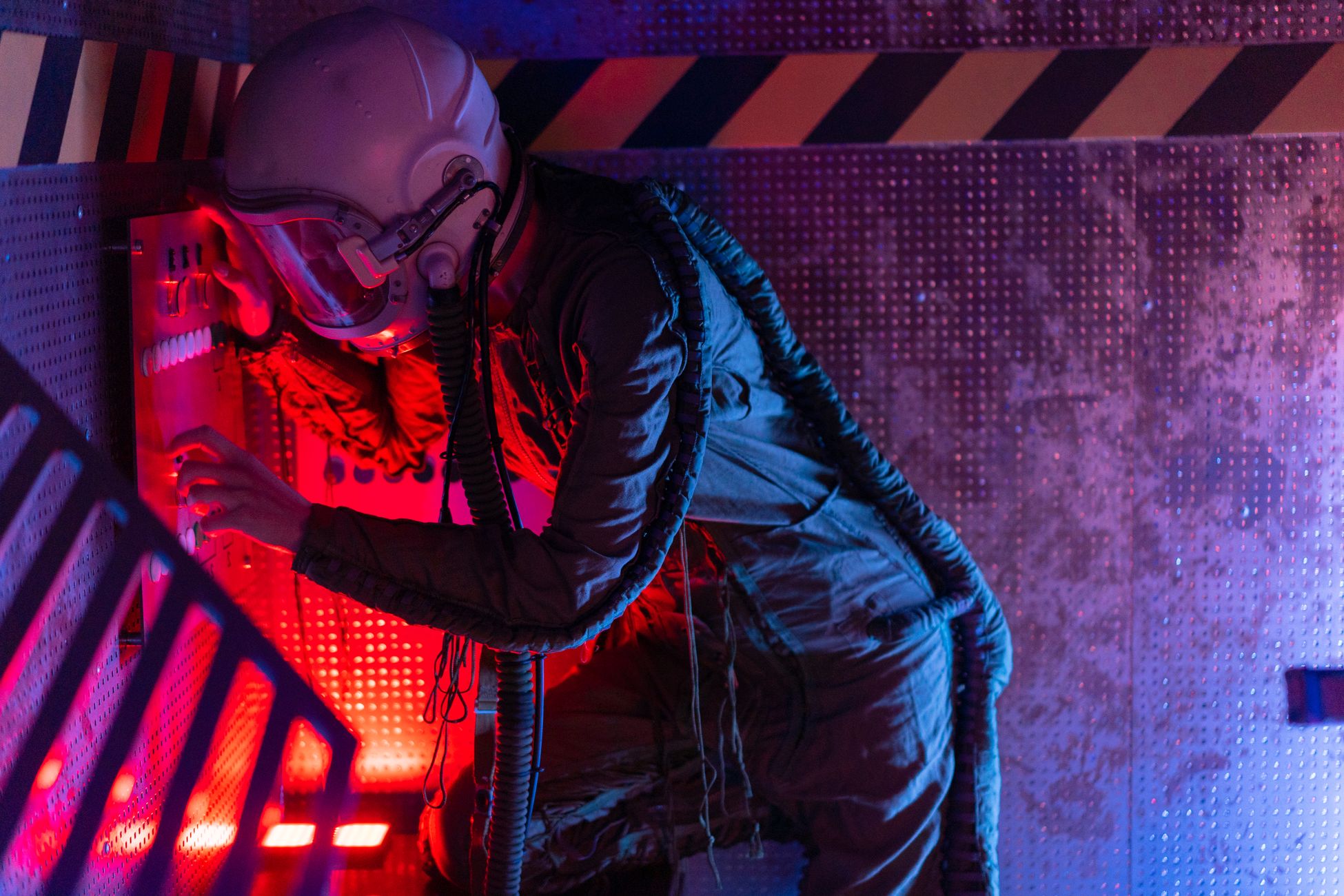
The particles doing this are galactic cosmic rays — mostly the nuclei of atoms, stripped of their electrons, accelerated to close to the speed of light by supernova shockwaves in distant parts of the galaxy. The vast majority are protons and helium nuclei, with a small percentage being heavier nuclei, including iron, and it is those heavy ones that do the most visible damage as they plow through tissue.
On Earth, the atmosphere absorbs almost all of them. A cosmic ray hitting the top of the atmosphere sets off a shower of secondary particles that mostly fizzles out before it reaches sea level. That is why you can walk around outside without seeing flashes.
In a spacecraft, there is no such shield. The aluminum hull of the ISS is thin, and the heavy iron nuclei sail straight through it, then straight through the astronaut inside. National Geographic has a good primer on what these particles do to human tissue over long exposures.
How a particle turns into a flash
There are two main mechanisms, and researchers still argue about the balance between them.
The first is direct ionization. A cosmic ray plows through the retina and strips electrons off molecules along its path. The retinal photoreceptors interpret the ionization the same way they interpret a photon of light. The brain sees a flash.
The second is Cherenkov radiation — when a charged particle travels through the vitreous humor of the eye faster than light travels through that same medium, it emits a faint cone of blue light, the same glow that makes the water in nuclear reactors shine. That light then hits the retina normally. Some of the flashes Apollo astronauts described as bluish streaks fit this profile.
The shape astronauts report depends on the angle. A particle passing straight along the line of sight looks like a point. A particle crossing sideways draws a streak. A particle that fragments inside the eye can leave a little starburst.
Pettit’s fairies
Don Pettit, who flew multiple long-duration missions on the ISS and became something of an unofficial poet laureate of orbit, described the experience more vividly than most. In his crew logs and later talks, he described the flashes as resembling luminous dancing fairies. He noted that they came more often when the station was passing through the South Atlantic Anomaly, a region where the Earth’s magnetic field dips low and lets more charged particles reach ISS altitude.
Astronauts who bunk near the hull of the station see more flashes than those sleeping deeper inside. The shielding of a few centimeters of equipment and stowed cargo makes a measurable difference.
The experiments that pinned it down
The Italian Space Agency (ASI) ran an international program called ALTEA on the ISS, in which astronauts wore a helmet fitted with silicon particle detectors around the head while they reported flashes verbally. When a flash was reported, the detectors could confirm whether a heavy ion had passed through the head at that moment, and from what direction.
The correlation was strong. Most reported flashes matched a detected particle. The rate on the ISS came out to roughly one flash every few minutes for a dark-adapted astronaut, and it varied with orbital position, climbing at higher latitudes where the geomagnetic shielding is weakest.
Apollo crews, farther from Earth and outside the protection of the magnetosphere for much of their trip, saw them more often.
Why this matters for going back to the Moon and on to Mars
The flashes themselves are harmless. The particles causing them are not.
Each heavy iron nucleus that passes through an astronaut’s brain leaves a track of damaged cells behind it — a microscopic tunnel of broken DNA and disrupted membranes. Over extended missions, an astronaut’s brain is hit by these tracks many thousands of times, and the effects accumulate.
Astronauts have shown elevated rates of cataracts and other health concerns, with cosmic ray exposure being a leading suspect.
Artemis program planners are working on this problem. Astronomy magazine has covered the layered approach — polyethylene-lined sleep stations, storm shelters for solar events, and mission architectures that minimize deep-space transit time. Recent work has also mapped a radiation cavity near the Moon that briefly lowers exposure during parts of the lunar orbit, a finding that could shape where future habitats are placed.
The Apollo audio the Pentagon released
Some of the flashes Apollo astronauts saw got mixed up in a different story. In a batch of files declassified in 2026, the Pentagon released audio from Apollo 12’s post-mission medical debrief in which the crew described unexplained streaks of light seen in the cabin. The audio has been folded into ongoing UFO disclosure discussions, including a related file about Apollo 17.
The streaks Apollo 12 described in the medical debrief, though, are the same phenomenon the ALTEA experiment later confirmed with particle detectors on the ISS. They are cosmic rays crossing human eyes. The astronauts noted them because in 1969 nobody had yet figured out what they were.
What the astronauts see when they close their eyes tonight
The ISS is passing overhead at roughly 400 kilometers altitude, traveling at high speed, circling the Earth approximately every 90 minutes. Astronauts are on board. Some of them are asleep in padded sleep pods bolted to the walls of the crew quarters. Some are working.
The ones who are asleep, with the lights off and their eyes closed, are being hit by the same particles Aldrin reported to Houston in July 1969. About once every few minutes, a heavy nucleus born in a supernova hundreds of light-years away crosses one of their retinas and paints a brief streak on the inside of their vision.
They stopped calling them fairies after Pettit came home. But the flashes kept coming. They will keep coming for every crew that follows, and for every crew that eventually goes back to the Moon, and for the first crew that flies to Mars. The rate will climb the further from Earth they go.
The particles themselves have been in flight for thousands of years, sometimes millions, before they arrived at that specific eye at that specific instant. Some of them were accelerated by the shockwave of a star that exploded before humans existed. They spent the intervening time drifting through the galaxy, and their journey ended with a two-tenths-of-a-second flash inside the head of a sleeping astronaut who may or may not remember it in the morning.
Look up. The station will be over your horizon in a few hours. The fairies are already dancing.