

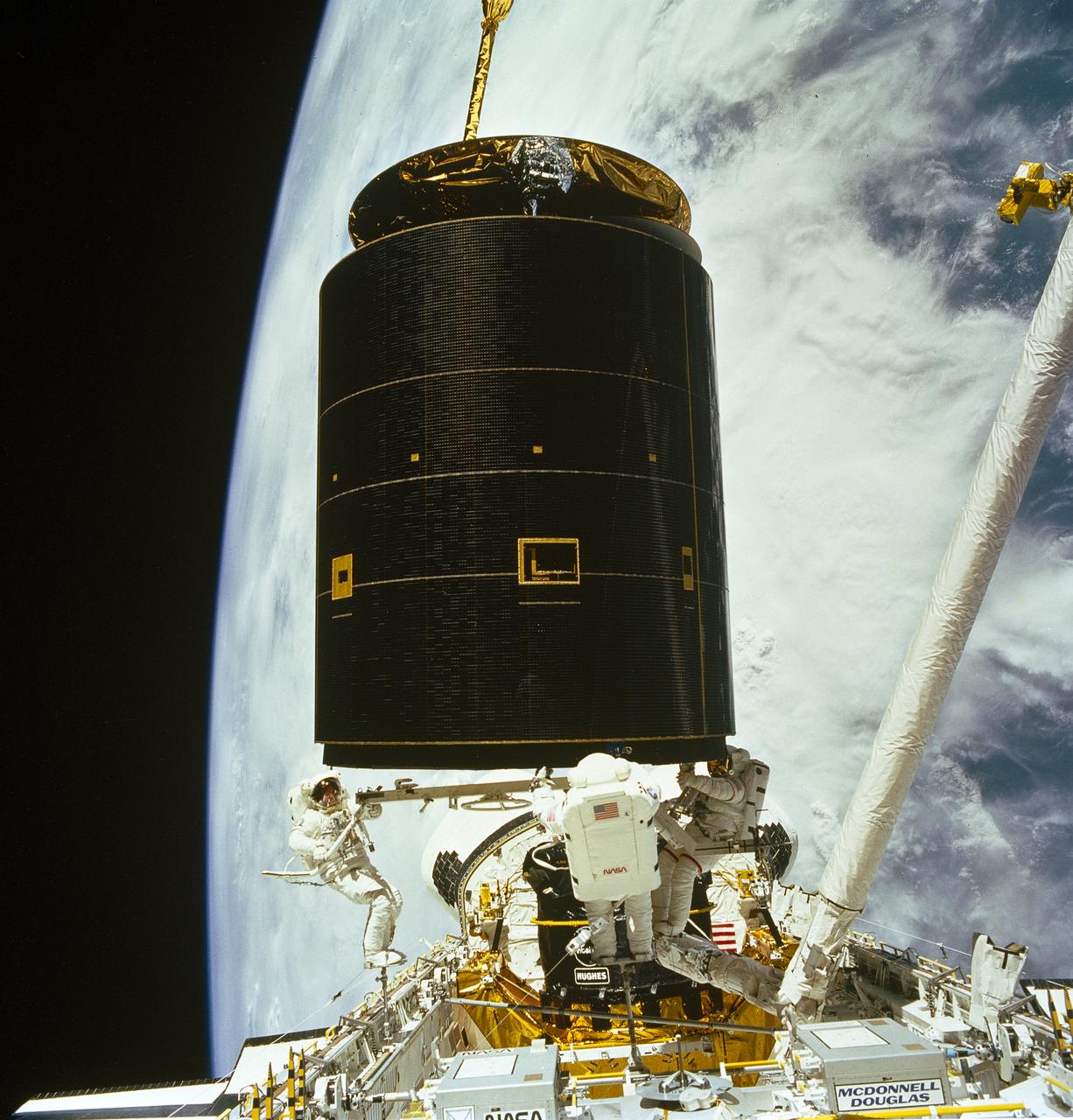
The moment people remember from STS-49 looks almost improvised: three astronauts in white suits, fixed to foot restraints and handholds around a huge black communications satellite, reaching for hardware that was not supposed to be grabbed that way. It was improvised, but not careless. By the time Pierre Thuot, Richard Hieb and Thomas Akers went outside Endeavour together in May 1992, NASA had already watched two careful attempts fail. The choice left was not between procedure and instinct. It was between a tool that could not finish the job and a crew willing to become the tool.
STS-49 was the first flight of Space Shuttle Endeavour, the orbiter built after the loss of Challenger. NASA’s mission archive records that Endeavour launched on 7 May 1992 and landed on 16 May after a mission lasting 8 days, 21 hours and 17 minutes. Its primary job was to recover Intelsat VI F-3, a communications satellite left stranded in an unusable orbit after its March 1990 launch aboard a Titan vehicle. The plan was ambitious but clear: capture the satellite, attach a new perigee kick motor, release it, and let the motor place the spacecraft on the path toward geosynchronous orbit.
The satellite itself was not a small target. It was a large cylindrical machine, massive enough that nobody wanted it drifting near the shuttle with uncertainty in the motion. NASA describes the target as a 4.5 ton communications satellite, and the Intelsat VI series was built for service in geostationary orbit, not for easy handling by suited astronauts in low Earth orbit. It had no convenient human grip points. The rescue therefore depended on a purpose-built capture bar, a piece of hardware designed to give the astronauts a way to secure the satellite and bring it under control.
The first attempt used the plan as written. Thuot and Hieb went outside Endeavour while the shuttle’s remote manipulator system, better known as the Canadarm, positioned Thuot close to the satellite. He tried to attach the capture bar from that moving, constrained position. It did not take. NASA’s archive says the planned EVA by Thuot and Hieb failed to attach the capture bar to the satellite from a position on the RMS. The job had been rehearsed, but orbital mechanics and real hardware have a way of exposing the difference between a workable design and a workable operation.
A second attempt followed the next day. This one was unscheduled but essentially repeated the same method, because the underlying logic still seemed sound: get close, use the bar, make the capture. Again the satellite was not secured. From the outside, the two failed attempts can sound like simple misses. From the crew’s point of view, they were a warning that the satellite’s motion, the arm’s positioning, the tool geometry and the limits of pressure-suit work were not combining in the way the plan required.
That is what makes the third spacewalk so different. NASA says the capture ultimately required three EVAs, ending with an unscheduled hand capture by Thuot, Hieb and Akers while commander Daniel Brandenstein manoeuvred Endeavour to within a few feet of the 4.5 ton satellite. The phrase hand capture is almost too tidy. It means that three astronauts outside the orbiter arranged themselves around a free-flying commercial spacecraft and physically restrained it long enough for the rescue hardware to be attached.
This was not a movie version of strength overcoming mass. In orbit, the problem was not weight in the usual ground sense, but inertia, relative motion and control. A large satellite moving slowly can still be difficult to stop cleanly. A gloved hand can push too hard, too late or in the wrong direction. A body locked into a foot restraint can apply force, but only through a suit that resists bending, with limited field of view and radio calls standing in for ordinary human proximity. The astronauts were not catching a falling object. They were matching motion with a machine that could become dangerous if the relative geometry went wrong.
The three-person arrangement mattered because no two-person setup had given the crew enough control. With Akers outside as the third spacewalker, the astronauts could position themselves around the satellite and stabilise it from multiple points. The shuttle itself also became part of the operation. Brandenstein had to bring Endeavour close enough for the astronauts to reach the target while preserving the tiny margins that keep two spacecraft from becoming one accident.
Once the satellite was held, the operation did not end. The crew still had to bring Intelsat into the payload bay, secure it, attach the new rocket motor and prepare it for release. NASA records that the satellite was equipped with a new perigee kick motor, then released, with the motor firing to put it into a geosynchronous orbit for operational use. That last clause is the practical measure of success. The rescue was not only a dramatic EVA. It returned a stranded commercial satellite to the job it had been built to do.
STS-49 also became a mission of records because the rescue kept expanding. NASA lists several firsts from the flight, including the first EVA involving three astronauts, the first shuttle mission with four EVAs, the first shuttle mission requiring three rendezvous with an orbiting spacecraft, and the first attachment of a live rocket motor to an orbiting satellite. Those records are not trivia. They show how quickly a planned satellite repair became a test of the shuttle’s flexibility as a worksite.
The timing of the third EVA helps explain why it still stands apart. Standard spacewalk teams are almost always two people, partly because suits, airlock capacity, timeline control, crew support and safety management all become harder as the number outside increases. A three-person EVA adds complexity to every ordinary problem: tethers, translation paths, sight lines, tool handoffs, radio discipline and emergency return. STS-49 accepted that added burden because the alternative had already failed twice.
Historical spacewalk listings still treat the 13 to 14 May 1992 excursion as singular. The catalogue entry for STS-49’s third EVA lists Thuot, Hieb and Akers beginning the spacewalk at 21:17 UTC on 13 May, ending at 05:46 UTC on 14 May, and capturing Intelsat VI with their hands during what it identifies as the first and only three-person spacewalk in history. NASA’s current mission page is more restrained, calling it the first EVA involving three astronauts, but the wider record has not produced another like it.
There is a useful restraint in how the story should be remembered. The lesson is not that tools failed and human hands solved everything. The capture bar was still needed after the manual hold. The shuttle arm, the foot restraints, the ASEM structure in the payload bay, the rendezvous planning and the commander’s precise flying all mattered. What changed on the third attempt was the geometry of the operation. Instead of asking one astronaut at the end of a robotic arm to make a difficult attachment to a free-flying satellite, NASA put three suited people around the problem at once.
That is why the image endures. It shows a type of spaceflight that is neither launch nor landing, neither science observation nor exploration in the usual language. It is repair work in vacuum, carried out at the edge of what the shuttle system could safely support. The satellite is huge. The astronauts look almost small against it. Yet the whole operation depends on their hands, their feet, their voices and their discipline in a place where even a modest unwanted motion can become consequential.
Endeavour’s first mission could have been remembered simply as a maiden flight. Instead it became one of the clearest demonstrations of the shuttle as an orbital workshop. It did not make satellite rescue routine. Nothing about STS-49 was routine. But for one long EVA in May 1992, after the planned tool had failed twice, three astronauts turned a free-flying communications satellite into something human hands could hold, and then gave it back to orbit with a new motor attached.