

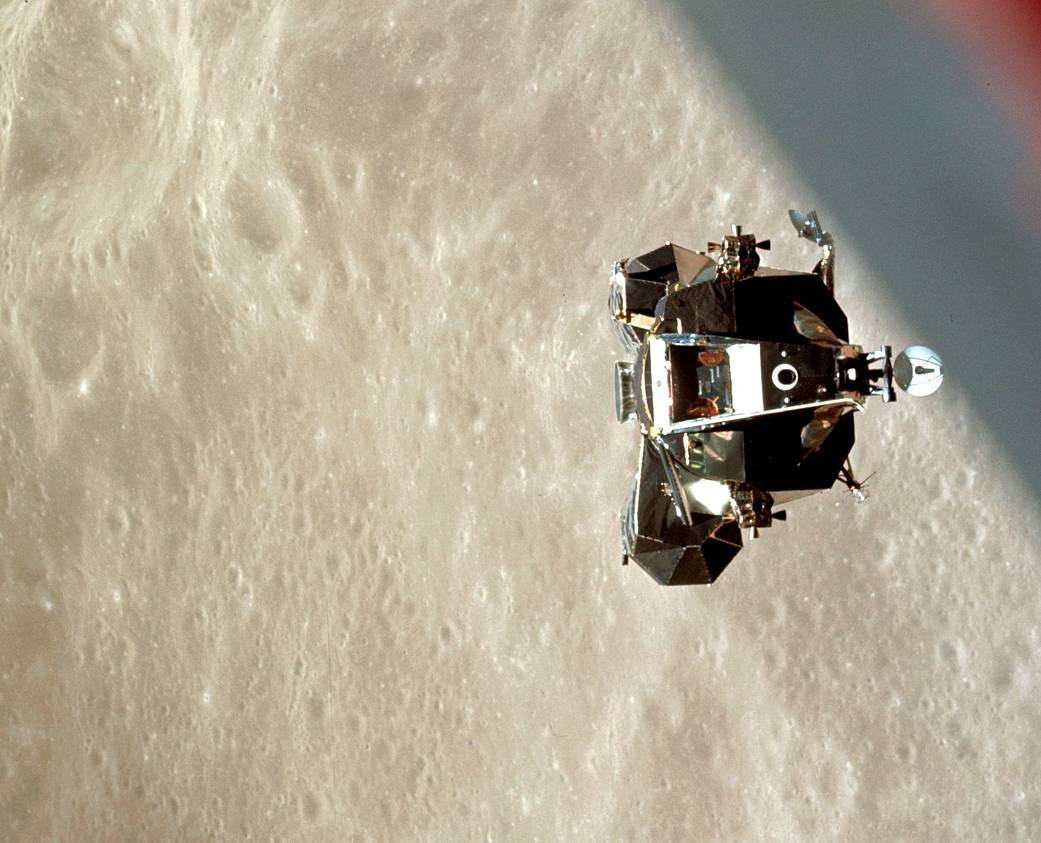
The Apollo 10 lunar module was never meant to land. That was the point. In May 1969, NASA sent a crew almost all the way through a lunar landing profile, held back the final descent, and used the mission as a full rehearsal for Apollo 11. The command module was called Charlie Brown. The lunar module was called Snoopy. One of them came home. The other, after carrying two astronauts above the Moon, was deliberately sent away from lunar orbit and into the long bookkeeping problem of the inner Solar System.
The mission launched on 18 May 1969 with Thomas Stafford as commander, John Young as command module pilot and Eugene Cernan as lunar module pilot. NASA describes Apollo 10 as a lunar landing preparation mission whose objective encompassed all aspects of an actual crewed lunar landing except the landing itself. That made it more than a ceremonial last test. It was a check of navigation, communication, rendezvous, radar, crew timing and trust, conducted close enough to the lunar surface that the next mission could reasonably try the thing Apollo 10 had been ordered not to do.
The names helped make the mission memorable, but they can also make it sound lighter than it was. Charlie Brown and Snoopy were not mascots on a simple trip around the Moon. They were the two working spacecraft in a rehearsal that had very little margin for casual error. Young stayed in the command and service module, the vehicle that would carry the crew back to Earth. Stafford and Cernan moved into Snoopy, undocked from Charlie Brown and flew the lunar module through the kind of manoeuvres that Apollo 11 would soon need in order to land and then return from the surface.
The low pass is the number that gives the story its force. NASA’s Apollo 10 mission material says the lunar module descended to 47,400 feet above the Moon before returning toward the command module, with Stafford and Cernan aboard Snoopy and Young waiting in Charlie Brown. That is about 14.4 kilometres, close enough that the surface was no longer an abstract destination. It was below them, measured by instruments and watched through windows, while the mission still had to behave like a test rather than an attempt.
There was a disciplined reason for stopping there. Apollo 10 carried out the descent-orbit insertion burn, tested the landing radar and demonstrated the phasing and rendezvous steps that would matter after a real lunar liftoff. But NASA had no intention of allowing this crew to make an unscheduled landing attempt. The mission was designed to leave enough undone that Apollo 11 would remain the landing mission, while proving that the chain of operations could hold together in lunar orbit.
The rehearsal was not completely smooth. In NASA’s account of Charlie Brown and Snoopy in lunar orbit, Stafford and Cernan separated in the lunar module, dropped the low point of Snoopy’s path to about 50,000 feet, later calculated at about 47,000 feet, and then performed the burns needed to return to the command module. During staging, when the descent stage was jettisoned and the ascent stage became the active spacecraft, the crew briefly experienced unexpected motion before recovering control. The episode was short, but it was exactly the kind of thing a rehearsal was supposed to expose before a landing crew had the Moon under them and no second spacecraft attached.
After the scare, the mission did what it had been sent to do. Snoopy’s ascent stage fired, coasted, manoeuvred and returned toward Charlie Brown. Stafford and Cernan completed rendezvous and docking with Young, transferring back into the command module after about eight hours of independent lunar module flight. That part matters because Snoopy was not only hardware. It had been a crewed spacecraft in lunar orbit, occupied by two men, operated through a low pass over another world, then emptied once its job was done.
What happened next is stranger than the usual ending of a test flight. The descent stage had already been discarded. The ascent stage, the part that had carried Stafford and Cernan, was no longer needed after docking. NASA says that after the crew closed the hatches, residual air pressure caused Snoopy to depart faster than expected, and the spacecraft later fired its ascent propulsion system engine to fuel depletion. The purpose was not drama. It was disposal. The burn sent Snoopy safely out of lunar orbit and into an orbit around the Sun.
That technical phrase, to fuel depletion, is colder and more exact than saying the engine was fired until the fuel ran out. But the practical meaning is much the same. Controllers used the remaining propellant to remove the ascent stage from the lunar operating environment. In doing so, they created an unusual relic: a spacecraft that had carried human beings, stripped of its crew and immediate purpose, left to continue as an artificial object in heliocentric orbit.
It is tempting to treat that as a lost-spacecraft story, and to some extent it is. Snoopy was not recovered, preserved in a museum or left as a known object on the lunar surface. It became a moving target in solar orbit, with its later position dependent on the details of its disposal burn and subsequent orbital evolution. The important historical point is simpler and firmer: unlike Charlie Brown, Snoopy did not return to Earth, and unlike many lunar module parts, it was not deliberately crashed into the Moon. It was sent into the space between planetary orbits after completing one of the most important rehearsals in the Apollo programme.
Charlie Brown, by contrast, had to do the ordinary miraculous thing of bringing the crew home. Apollo 10 remained in lunar orbit for 31 orbits over 61 hours and 37 minutes, and NASA’s history account notes that Stafford and Cernan flew Snoopy within 47,000 feet of the lunar surface while Young remained aboard Charlie Brown. After trans-Earth injection, the crew returned across the distance they had just spent days crossing in the other direction.
The safe return was not an afterthought. NASA records that Apollo 10 splashed down on 26 May 1969 about 460 miles east of American Samoa and 3.3 miles from the recovery ship USS Princeton, after a flight lasting 192 hours and 3 minutes. The crew came home with the operational confidence Apollo 11 needed. The command module eventually became an artifact people could stand in front of and photograph. Snoopy became something else, an artifact without a room around it.
That contrast is why the Apollo 10 lunar module still holds attention. Apollo history is usually told through landings, flags, footprints and the heavy fact of Apollo 11. Apollo 10 was a mission of restraint. It went close enough to make the Moon feel operationally real, then obeyed the boundary that had been drawn for it. The crew did not land. Snoopy did not come home. The mission succeeded partly because everyone accepted those limits.
There is a quiet engineering honesty in that ending. Spacecraft are built for tasks, not for sentiment. Once Snoopy had proved the lunar module could separate, descend, stage, rendezvous and dock, it became a hazard to be managed. Sending it into solar orbit was a practical answer to a practical problem. Yet the result has an afterlife that is hard to ignore. Somewhere beyond the usual museum geography of Apollo, there is the former ascent stage of a lunar module named Snoopy, a machine that once held Stafford and Cernan above the Moon and then kept going without them.
In that sense, Apollo 10 left two kinds of evidence. One returned with the crew, in mission data, photographs, procedures and the command module that survived re-entry. The other was released into a larger orbit, not as a message and not as a monument, but as the remainder of a job done well. The men came back. The rehearsal worked. And one small spacecraft that had almost touched the Moon became part of the Sun’s inventory.