

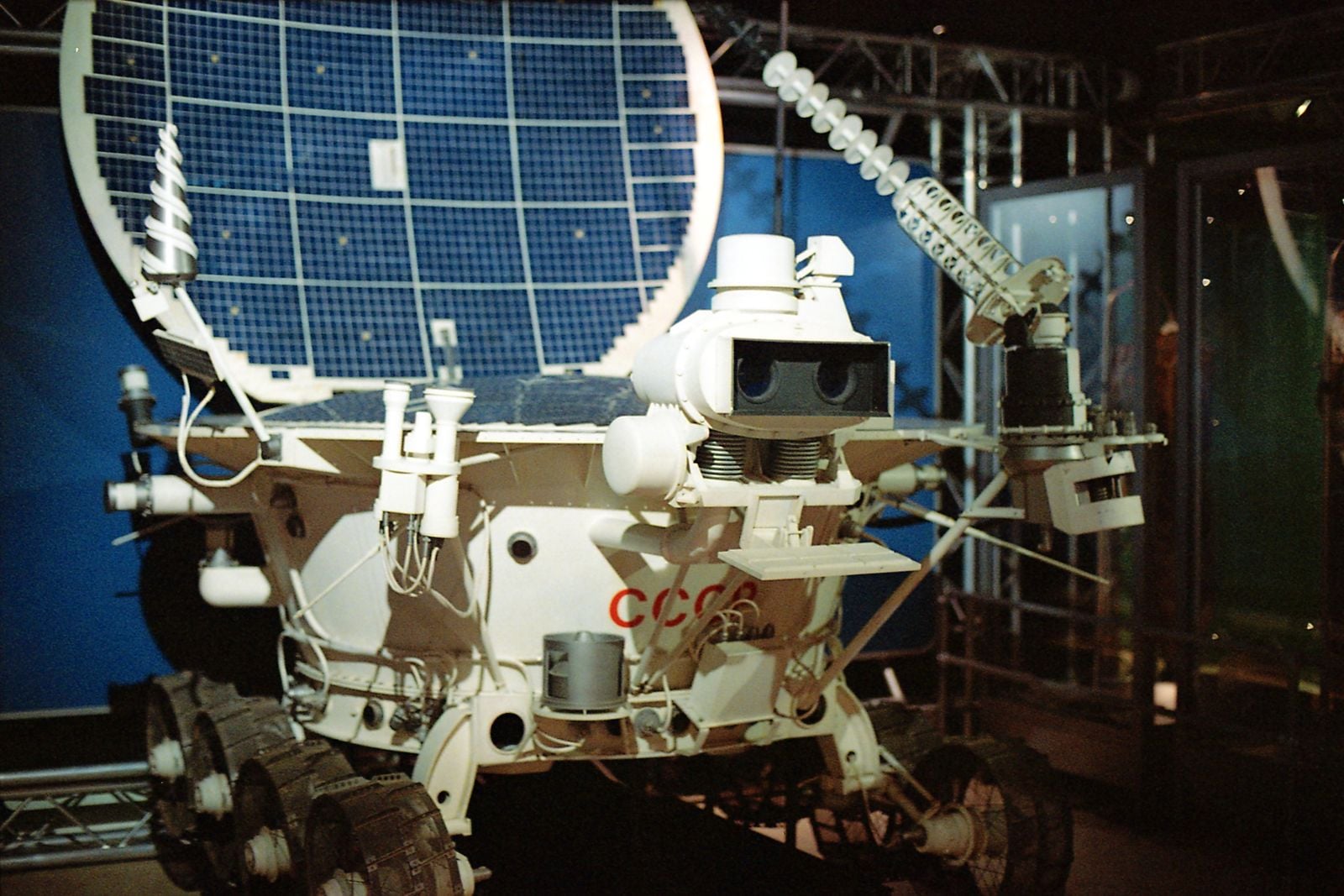
On 17 November 1970, a Soviet spacecraft called Luna 17 touched down on the western edge of Mare Imbrium, the dark lava plain that Renaissance astronomers named the Sea of Rains. A pair of ramps unfolded from the lander like the sides of a shallow boat. Down them rolled a squat, eight-wheeled machine roughly the size of a bathtub, weighing 756 kilograms, with a hinged lid on its back that opened to the sun like a clamshell. It was called Lunokhod 1, and it was the first vehicle in history to drive on another world, according to a survey of the most consequential planetary rovers.
It moved at about 100 metres per hour. Slower than a toddler.
And every command sent to steer it — every nudge of a joystick in a control room on Earth — took about 1.25 seconds to reach the Moon at the speed of light, and another 1.25 seconds for the video feedback to return. Roughly 2.5 seconds of round-trip delay between the impulse to turn and any visible confirmation that the wheels had listened. It is the same Earth–Moon light-time gap the Artemis II crew worked through on their flight around the Moon in April 2026, half a century later.
A bathtub on eight wheels
Lunokhod 1 did not look like a rover in the modern sense. There was no rocker-bogie suspension, no sleek robotic arm, no nuclear battery humming under an aluminium deck. It looked closer to a soup pot on a wagon. The pressurised body was a magnesium alloy tub, sealed against vacuum, filled with nitrogen at about atmospheric pressure. On the outside, eight independently powered wheels, each with its own electric motor and torsion-bar suspension, so that losing one or two would not strand the machine.
The lid, when open, exposed an array of solar cells to charge the batteries during the two-week lunar day. At night, the lid closed, sealing in heat from a small polonium-210 radioisotope heater that kept the electronics from freezing solid in the −150°C darkness. This was the trick that kept it alive: bake by day, hibernate by night, and try not to die of thermal shock in between.
On the front of the machine sat two low-resolution television cameras, angled slightly downward, with a 50-degree field of view. Four panoramic telephotometers were mounted around the body to shoot high-resolution stills. There was an X-ray spectrometer for measuring soil composition, a cosmic-ray detector, a penetrometer that could press a cone into the regolith to test how hard it was, and — critically for what came later — a French-built laser retroreflector strapped to the top like a hood ornament.
The men in the bunker at Simferopol
The control team sat in a low building on the outskirts of Simferopol, in Crimea, at what the Soviets called the Deep Space Communications Centre. None of them had been to the Moon. None of them would ever go. They were driving blind through a keyhole.
A crew of operators — driver, commander, navigator, radio operator, flight engineer — took shifts in front of a bank of screens showing the slow, jerky television feed from the rover’s forward cameras. The images refreshed roughly every 3 to 20 seconds, depending on the mode. That is not a video feed. That is a slideshow. And laid over that slideshow was the 2.5-second delay between any command and any visible response.
To picture the problem, imagine trying to parallel park with your eyes closed, opening them for one frame every ten seconds, and being told the steering wheel you’re turning right now will actually influence the car three seconds from the moment you see the next frame. Now imagine the car costs a decade of national budget and the road is 384,000 kilometres away.
The drivers learned to creep. They would order a short burst of forward motion, wait, watch the frame update, watch the wheels settle, and only then commit to the next micro-instruction. In 11 lunar days of driving, spread across nearly a year, the rover covered around 10.5 kilometres — a distance that placed it firmly among the top-performing rovers of the twentieth century.
Why the Sea of Rains
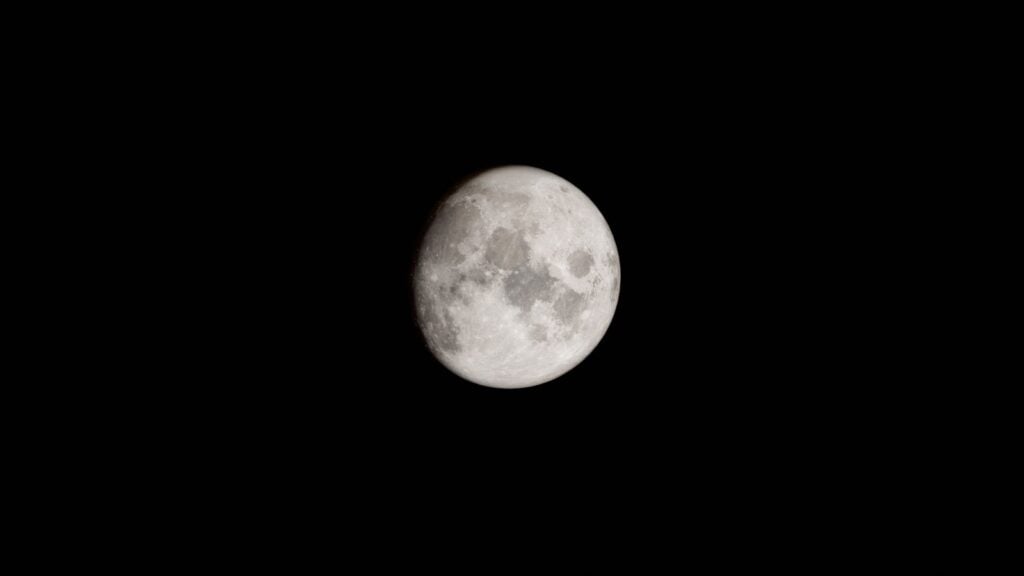
Mare Imbrium is a bruise. A vast impact basin roughly 1,145 kilometres across, gouged out of the Moon’s near side about 3.9 billion years ago and later flooded with dark basaltic lava. From Earth it reads as one of the largest smooth grey patches on the lunar face — the left eye of the Man in the Moon, if you’re inclined to see one.
For a rover, smooth is the point. Mare Imbrium is one of the flattest and most tractable regions on the near side, which mattered when the Soviets needed a landing zone visible from Simferopol, unobstructed enough for reliable radio contact, and gentle enough that a low-clearance vehicle with a 2.5-second control lag would not immediately fall into a crater it couldn’t see.
Ten and a half kilometres, one frame at a time
The mission was planned for three lunar days. It lasted eleven. Between November 1970 and September 1971, Lunokhod 1 examined roughly 80,000 square metres of terrain, ran hundreds of soil-mechanics tests, and returned about 20,000 television images and 200 panoramas, according to the Interesting Engineering survey of iconic rovers cited above.
It could manage two speeds: about 0.8 kilometres per hour and about 2 kilometres per hour. In practice it almost never ran flat out. The drivers, watching a stuttering black-and-white feed with a delay long enough to spill coffee in, kept the throttle low. A rock the size of a football, invisible in one frame, could high-centre the whole vehicle in the next.
When Lunokhod 2 followed in January 1973 aboard Luna 21, the Soviet team applied everything they had learned. That successor covered around 39 kilometres in less than five months — a distance record for off-world driving that stood until NASA’s Opportunity finally passed it on Mars in July 2014.
The 2.5-second problem
Every crewed and uncrewed mission to the Moon has had to reckon with the same physical fact: light takes about 1.28 seconds to cross the average Earth–Moon distance. Radio signals, being light, take the same time. Send a command up, and the answer cannot arrive back in less than roughly 2.5 seconds. There is no engineering trick that shaves this. It is a property of the vacuum.
For Apollo astronauts, the delay was a nuisance layered on top of already tense conversations with Houston. For Artemis II, whose crew looped around the Moon in April 2026, the same lag shaped how mission controllers spoke to a crew flying farther from Earth than any humans in more than half a century.
You could not react to what you saw. You could only react to what you had seen 2.5 seconds ago, hoping the terrain 2.5 seconds from now still resembled it. The drivers essentially played a form of chess against the lunar surface, where each move was committed before the board updated.
The reflector that outlived the rover
In September 1971, after roughly 322 Earth days on the surface, Lunokhod 1 went quiet. The polonium heater had decayed. The radios stopped answering. Soviet controllers marked the mission complete and moved on.
Then, for nearly forty years, the rover simply sat there in the dust of Mare Imbrium, with its French-built corner-cube retroreflector still pointing more or less at Earth. Astronomers occasionally aimed lasers at its last known coordinates. They got nothing back. The rover, it seemed, was lost.
In 2010, using new imagery from NASA’s Lunar Reconnaissance Orbiter, a team at the University of California San Diego pinned down its actual resting position, several kilometres from where anyone had been looking. They aimed a laser. A pulse came back, sharp and bright, as though the reflector had been waiting the whole time.
The reflector’s brightness turned out to be greater than that of any other retroreflector on the Moon, precisely because Lunokhod 1’s array had been sitting unused, unblasted by decades of laser fire, and free of the thin dust film that has slowly dimmed the ones left by Apollo.
What the numbers actually feel like
It is easy to skim past 100 metres per hour as a specification. Try it another way. A brisk human walk is about 5 kilometres per hour, or roughly 1.4 metres per second. Lunokhod 1’s top cruising speed was about 0.55 metres per second. The rover, at full tilt, would have lost a footrace to almost any adult on Earth. And the drivers, hunched in Simferopol, almost never let it move at full tilt.
Then there is the 756-kilogram mass. That is heavier than a Fiat 500. Delivered to the lunar surface in one piece by a booster developed under Sergei Korolev’s design lineage. Landed intact. Rolled off two ramps. Driven, at walking pace, for the better part of a year, by five men taking shifts at a joystick.
And the whole system worked while communicating through a radio pipe narrow enough that a single panoramic image could take dozens of minutes to transmit line by line.
Slow, and still ahead of its time
By 1970, the American approach to lunar exploration had settled on crewed missions. Apollo 11 had already happened. Apollo 12 had already happened. Apollo 14, 15, 16, and 17 were being prepared, and Apollo 15 would later carry the first crewed Lunar Roving Vehicle — a battery-powered dune buggy driven directly by astronauts on the surface, capable of about 11 miles per hour and covering, across three missions, more than 90 kilometres in total.
The Soviet answer was different. No cosmonaut ever walked on the Moon. Instead, the USSR sent robots — Luna sample-return probes, and the two Lunokhod rovers — driven remotely, patiently, from the ground. It was a slower answer, but it was also, in a sense, a more modern one. Every rover that has since crawled across Mars, from Sojourner’s 25-pound frame in 1997 to the 1,025-kilogram Perseverance chassis grinding through Jezero Crater today, is a descendant of the driving problem the Simferopol crew solved first: how to steer a vehicle you cannot see, on a surface you cannot touch, across a delay you cannot shorten.
The rover is still there
Lunokhod 1 has not moved since September 1971. Its wheels are still on the regolith where the drivers left them. The lid is closed. The polonium is long spent. The magnesium tub, in the thin dust, has not corroded — there is no oxygen and no water to corrode it. Micrometeorite impacts have gently sandblasted it, year by year, but the shape is unchanged.
Every so often, a laser from a mountaintop observatory in California or the French Alps flashes across a quarter of a million miles of empty space, hits the corner cubes bolted to the rover’s back, and returns as a faint, unmistakable pip in a detector on Earth. The rover is dead, but its reflector still answers. The Sea of Rains keeps its bathtub.
And if you stand in a suburban driveway on a clear night and look up at the dark left eye of the Man in the Moon, you are looking, more or less, at the place where five men once drove a machine the size of a bathtub, at walking pace, through a 2.5-second delay, and got 10.5 kilometres out of it before the heater died.