Space, science, and the human mind. Since 1995.
Deep Field
A Space Daily column

Deep Field

Astronomy and cosmology

Deep Field covers astronomy and cosmology. Telescopes and what they find, planets near and far, and the strange physics of the deep universe, traced back to the journal papers and observatory data behind the headlines.

Deep Space

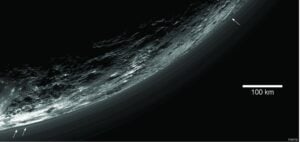
When the New Horizons spacecraft flew past Pluto in July of 2015 after a nine-and-a-half-year journey from Earth, it was traveling so fast — roughly 32,000 miles per hour — that it had less than 30 minutes to photograph the entire dwarf planet, and the images it sent back revealed a heart-shaped nitrogen ice sheet the size of Texas

At 7:49 a.m. Eastern Daylight Time on Tuesday, 14 July 2015, the piano-sized robotic spacecraft New Horizons flew past the dwarf planet Pluto at roughly 32,000 miles per hour, at a closest approach distance of 7,800 miles above the surface.

Constellations

James Webb has found evidence for thick water-ice clouds on Epsilon Indi Ab, one of the closest Jupiter-like worlds we can study directly — a discovery that didn’t overturn every atmospheric model, but exposed how many of them had been leaving out the very thing now shaping the planet’s sky.

The James Webb Space Telescope has found evidence for thick water-ice clouds high in the atmosphere of Epsilon Indi Ab, one of the closest Jupiter-like worlds we can study directly.

Deep Space

We tend to think of Earth as almost impossibly rare, but a University of British Columbia study using Kepler data estimated that the Milky Way could contain as many as six billion rocky, roughly Earth-sized planets orbiting in the habitable zones of stars like our Sun — not proven Earth twins, but billions of worlds with at least the basic size, star, and distance that make Earth possible.

Earth can feel like an exception so complete that no statistic should be able to touch it.

Constellations

A galaxy confirmed this January formed just 290 million years after the Big Bang, and the part astronomers cannot explain is that it is far too large, far too soon, as if the early universe was building things it was not supposed to be able to build yet.

Light from a galaxy called JADES-GS-z14-0 left on its way to us when the universe was only about 290 million years old, and the James Webb Space Telescope has confirmed both how far away it sits and how oddly grown-up it already looks.

Constellations

On April 1 this year, four astronauts left Earth on humanity’s first crewed lunar mission since 1972, and by April 6 they had flown farther from home than any humans in history — returning with the strange perspective astronauts have described for decades, where Earth stops looking like a place and starts looking like something impossibly fragile.

On 1 April 2026, Artemis II lifted off from Kennedy Space Center with four people aboard Orion, beginning the first crewed lunar mission since Apollo 17 in 1972. By 6 April, the mission had moved beyond the familiar scale of low Earth orbit.

Space Scopes

In 1966, the Soviet chief designer who had beaten America to every space milestone died on an operating table in Moscow, and only then was his name printed in a newspaper — Sergei Korolev, whose identity had been a state secret so tight that even Yuri Gagarin only knew him as ‘the Chief Designer’.

On 14 January 1966, Soviet chief designer Sergei Korolev died during surgery in Moscow at 59 — and two days later, Pravda printed his name and photograph for the first time. Until that obituary, the man who launched Sputnik and put Gagarin in orbit was known publicly only as the Chief Designer.

Time And Space

A self-taught Yorkshire carpenter’s son spent forty years building four increasingly precise sea clocks to solve a navigation problem that was killing sailors by the thousands, and won a £20,000 prize from Parliament equivalent to approximately £4 million today, but had to be personally supported by King George III before the astronomers who dominated the prize committee would agree to pay him

The problem was longitude. For most of the age of sail, mariners could determine their latitude, or north-south position, straightforwardly enough by measuring the height of the noonday sun above the horizon.

Constellation

Astronomers have found a planet where it rains diamonds, a Jupiter-mass world orbiting a dead star whose carbon atmosphere grows soot clouds that harden into diamond deep inside, and whose composition rules out every known way a planet can form.

Astronomers using the James Webb Space Telescope have found a Jupiter-mass world orbiting a dead star, with an atmosphere so strange that its clouds appear to be soot condensing into diamond, and a composition that fits no known way of building a planet.