
Cloud-9 does not look like the remains of a galaxy after its stars died. It looks more like a galaxy whose stars never began.
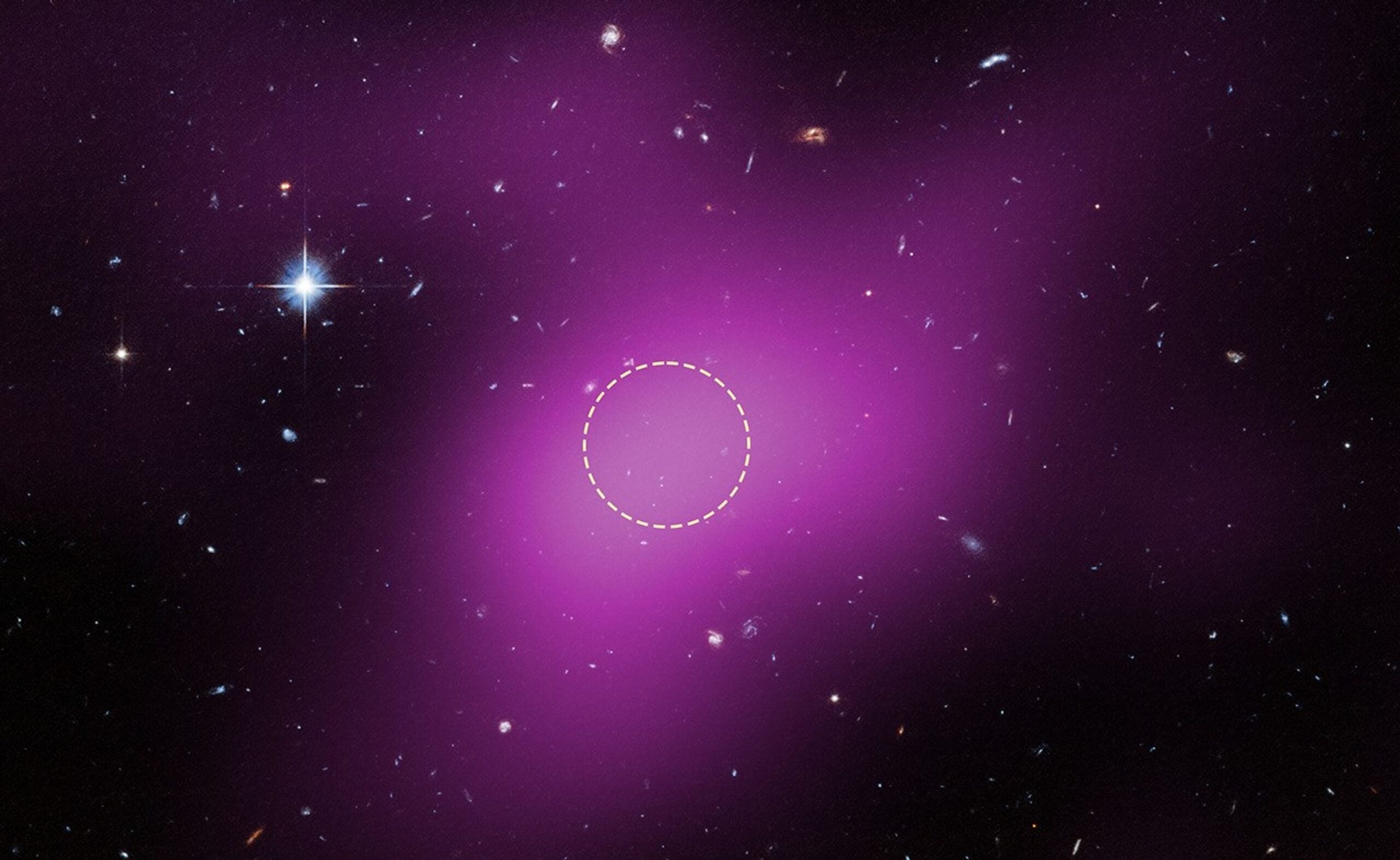
Radio telescopes detect a compact reservoir containing roughly one million solar masses of neutral hydrogen near the spiral galaxy Messier 94. Yet when the Hubble Space Telescope stared deeply at the radio position, it found no associated stellar population. The visible points and smudges within the marked field were foreground stars or galaxies much farther behind it.
The combination has made Cloud-9 the strongest known candidate for a Reionization-Limited H I Cloud, shortened to RELHIC. This is a predicted class of dark matter halo that managed to retain a small core of gas after the early universe was reionised, but never became massive enough to compress that gas into stars.
Under the main interpretation, the hydrogen is only a tracer. The structure holding it together is a dark matter halo with a total mass of several billion Suns, commonly quoted as about five billion. That makes the object roughly 5,000 times more massive than its detectable neutral gas alone would suggest.
There is an important distinction inside that sentence. Radio observations measure the hydrogen. Hubble constrains the stars. The dark matter mass is inferred through a physical model of how gas pressure balances gravity. Cloud-9 is an unusually persuasive candidate, but no telescope has photographed a five-billion-solar-mass dark halo directly.
A radio survey found the cloud before Hubble found the absence
Cloud-9 first emerged from observations made with China’s Five-hundred-meter Aperture Spherical Telescope, or FAST. The telescope was mapping neutral hydrogen around M94, a nearby spiral galaxy about 14 million light-years from Earth, when it found a series of gas clouds. Cloud-9 was simply the ninth in that sequence.
The name was therefore less poetic than it sounds. What mattered was that the cloud had no obvious optical counterpart. Follow-up observations with the Green Bank Telescope and the Karl G. Jansky Very Large Array confirmed the 21-centimetre radio emission produced by neutral atomic hydrogen.
The gas shares approximately the recession velocity of M94, supporting a location at roughly the same distance, around 4.4 megaparsecs. It is compact, does not show the ordered rotation expected from a settled gas disk and has a narrow line width of about 12 kilometres per second. Those properties made it a plausible starless-halo candidate, but they did not initially rule out an exceptionally faint dwarf galaxy.
A pre-Hubble Very Large Array analysis set out the ambiguity clearly. Cloud-9 could be a dark matter halo containing gas but no stars, or it could resemble the tiny Local Group dwarf Leo T, placed far enough away that its sparse stars fell below the ground-based detection limit.
Hubble’s result was a carefully measured non-detection
The decisive follow-up used Hubble’s Advanced Camera for Surveys. At M94’s distance, Hubble can resolve the brighter members of an old stellar population rather than depending only on a faint, blended glow.
The team searched the colour-magnitude diagram for the organised pattern that stars in a dwarf galaxy would produce. In the published Astrophysical Journal Letters study, the researchers visually ruled out a dwarf containing more than about 103.5 solar masses in stars, a little over 3,000 Suns. A statistical analysis conservatively ruled out a 10,000-solar-mass stellar counterpart with 99.5 per cent confidence, although the uncertainty around that confidence is asymmetric.
That is more precise than saying Hubble proved there are literally zero stars. An observation always has a sensitivity limit. There could be a handful of stars too faint, too sparse or too confused with the background to identify. What Hubble excludes is the coherent stellar population needed to make Cloud-9 an ordinary faint dwarf galaxy.
The released image can also mislead without its caption. The diffuse magenta is Very Large Array radio data tracing hydrogen, not dark matter and not visible light from the cloud. The dashed circle marks the peak of that radio emission. Hubble supplied the deep optical field in which no matching stellar system appeared.
One million Suns of hydrogen cannot explain the cloud’s size
Radio brightness gives Cloud-9 a neutral-hydrogen mass near one million solar masses. That sounds large, but spread across a cloud thousands of light-years wide it is not enough gravity to confine gas with the measured temperature and velocity width.
If the gas is close to hydrostatic equilibrium, its outward pressure must be balanced by a much deeper gravitational potential. Modellers can ask what kind of dark matter halo would hold the observed hydrogen distribution in place. The answer lands in the neighbourhood of four to five billion solar masses, with five billion becoming the headline value in the January 2026 NASA announcement.
This is why “weighing five billion Suns” should be read as a model inference, not a direct scale reading. The estimate depends on the cloud’s temperature, ionisation state, geometry and degree of equilibrium. It also depends on the assumed distribution of dark matter inside the halo.
Cloud-9 is not perfectly round. Radio maps show compression on one side and a tail-like extension on the other, features that may come from ram pressure as it moves through diffuse gas associated with M94. If its environment is disturbing it, the simplest isolated equilibrium model cannot capture every detail.
Reionization left low-mass halos on the wrong side of a threshold
In the standard Lambda cold dark matter picture, dark matter began gathering into halos before ordinary matter assembled into luminous galaxies. The number of predicted low-mass halos rises steeply, far beyond the number of dwarf galaxies astronomers actually see.
That mismatch is not necessarily a failure of the model. A dark matter halo is not automatically a galaxy. It needs to collect gas, compress it, cool it and push some of that material past the density required for stars to form.
The epoch of reionization made that harder. Radiation from the first stars, galaxies and accreting black holes ionised and heated intergalactic gas. Shallow gravitational wells could no longer capture or retain much of that hot material. Halos that had not already made stars could remain dark.
The smallest halos lost almost all of their gas and became effectively invisible. Larger ones accumulated enough material for cooling and star formation. RELHICs occupy the narrow territory between those outcomes: massive enough to hold a pressure-supported hydrogen core, but not massive enough to make it collapse.
Theoretical work places the present-day transition near a few billion solar masses, with one influential model giving approximately 109.7 solar masses, almost exactly five billion. The threshold is not a universal switch fixed for all cosmic time. It changes with redshift, radiation background, gas history and environment. Cloud-9 appears to sit close to the boundary today.
Why astronomers call it a primordial fossil
Cloud-9 is about 14 million light-years away, so astronomers are seeing it in the nearby universe rather than looking back to the first billion years after the Big Bang. “Primordial” describes the proposed origin of its structure, not the age of the light now reaching Hubble.
If the RELHIC interpretation is right, the object preserves a stage that successful galaxies passed through. A dark halo assembled, captured gas and then stalled before forming a luminous component. It is a surviving building block rather than a snapshot taken during galaxy formation itself.
The word fossil can also imply that nothing has happened since. That is too strong. Cloud-9 has lived through the later history of the universe, remains exposed to the cosmic ultraviolet background and may be interacting with material around M94. Ram pressure could strip its gas; additional accretion might change its fate. The ancient feature is the failure to cross into sustained star formation.
Its proximity to M94 is both useful and awkward. The shared velocity helps establish a distance, which is essential for calculating mass. The same environment may distort the hydrogen profile and make the object less like the clean, isolated RELHIC used in idealised models.
A starless halo could be an unusually clean dark matter laboratory
Dark matter is normally inferred through what gravity does to luminous matter. On enormous scales, a recent Deep Field report on Webb’s COSMOS map described how weak distortions in hundreds of thousands of background galaxies expose dark matter filaments and clumps.
Cloud-9 offers almost the opposite experiment. Instead of averaging gravitational lensing across a vast field, astronomers can use the shape and pressure of one cold gas cloud to probe a sub-galactic halo.
Ordinary dwarf galaxies are difficult dark matter laboratories because stars complicate the centre. Supernovae drive gas outward, repeated bursts of star formation reshape the gravitational potential, and baryonic matter can flatten or steepen the inferred density profile. A truly starless halo avoids most of that feedback.
That does not make the interpretation effortless. Researchers still need the three-dimensional gas distribution, temperature, ionising radiation field and environmental pressure. The absence of stars removes one set of complications while making distance and equilibrium assumptions more important.
The latest models do not yet select one kind of dark matter
In August 2026, a new modelling preprint compared Cloud-9 with both standard cold dark matter and self-interacting dark matter halos. Both frameworks could reproduce the observed hydrogen column-density profile.
The cold-dark-matter fit required a halo with an exceptionally low central concentration, about seven standard deviations below the usual concentration-mass relation in that analysis. A self-interacting model produced a diffuse core with less tension, though still around three standard deviations from the cosmological median for favoured solutions.
Those numbers should not be treated as a detection of dark matter self-interaction. The work is a preprint, the halo mass is only weakly constrained in some fits, and gas physics or environmental disturbance can imitate changes attributed to the underlying density profile. The useful result is that Cloud-9 may be sensitive to dark matter structure if its gas state can be pinned down.
The strongest candidate is not the same as a finished identification
The case for Cloud-9 rests on a striking conjunction: a compact neutral-hydrogen cloud, no detectable stellar population and a gas profile requiring far more gravity than the hydrogen supplies. No other known compact H I cloud matches the predicted RELHIC picture as closely.
Still, each part has a boundary. Hubble sets a very low upper limit on stars rather than proving an absolute zero. The five-billion-solar-mass halo follows from hydrostatic modelling rather than direct detection. Cloud-9’s association with M94 is strongly supported by velocity, but its exact three-dimensional position and interaction history remain uncertain.
That is why “strongest known candidate” is the most durable phrasing. NASA and ESA described the January result more definitively in public releases, while the paper itself retained a question mark in its title and called Cloud-9 the leading RELHIC candidate.
Finding a population would turn one curiosity into a test
Cloud-9 matters partly because theory predicts that starless halos should greatly outnumber luminous dwarf galaxies. Most are almost impossible to find: halos too small to keep neutral gas emit neither starlight nor the 21-centimetre radio signal that revealed Cloud-9.
Future wide radio surveys can search for more compact H I sources, while Hubble, Webb and large ground telescopes test them for hidden stars. A sample would show whether Cloud-9 is typical of a real population, an environmentally altered exception or a system caught at a temporary stage.
For now, its apparent emptiness is the measurement. A million solar masses of hydrogen reveal where to look. Hubble removes the ordinary dwarf galaxy. The remaining gas then outlines a gravitational structure thousands of times more massive than the matter we can see, poised almost exactly where models say a galaxy may either begin or fail.