

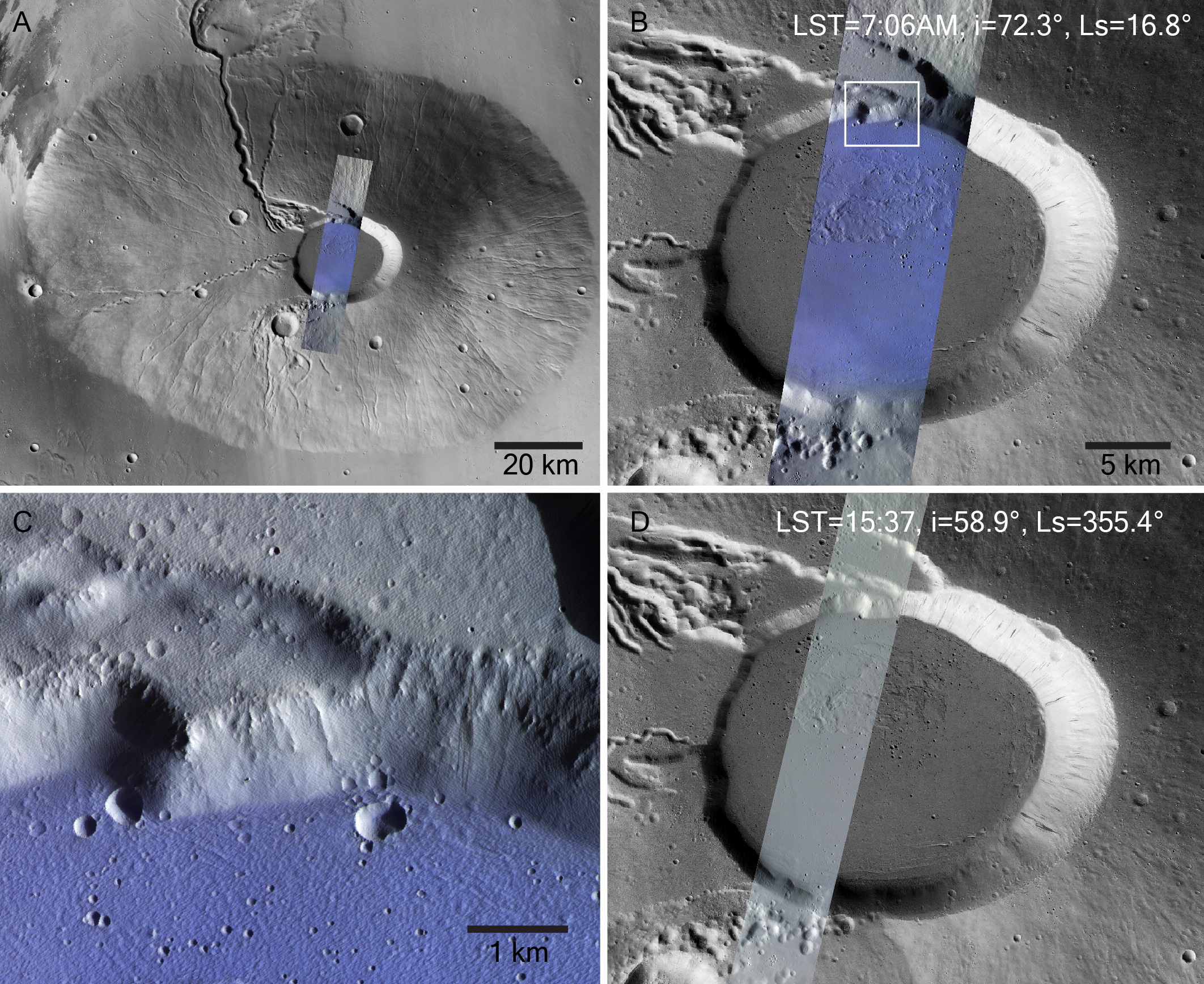
The feature image contains the discovery in miniature. In an early-morning view of Ceraunius Tholus, pale blue material covers part of the volcano’s summit hollow. In a later image of the same terrain, the coating has disappeared.
Blue is not the frost’s natural colour. It comes from the way the Colour and Stereo Surface Imaging System, or CaSSIS, combines near-infrared, panchromatic and blue channels. The meaningful change is not the particular hue but its timing, location and absence in comparison images.
In a 2024 paper in Nature Geoscience, planetary scientist Adomas Valantinas and colleagues reported 13 detections of transient morning water frost across four giant Martian volcanoes. The deposit is probably only about 0.01 millimetres thick and lasts a few hours, yet the team estimated that approximately 150,000 tonnes of water can pass between the atmosphere and surface each cold-season day.
The result is less a story about a hidden cache of ice than about scale. A layer almost too thin to imagine becomes a large quantity when it covers an enormous area. It also gives researchers a tracer for circulation over some of the largest mountains in the Solar System.
Four volcanoes, seen at the right hour
The frost appeared on Olympus Mons, Arsia Mons, Ascraeus Mons and Ceraunius Tholus. These volcanoes occupy the Tharsis region near the equator, and the largest rise many kilometres above the surrounding plains. Olympus Mons alone is about 600 kilometres across.
Within those huge landforms, the detections were concentrated around summit calderas. A caldera is the broad hollow left when a volcano’s underlying magma system drains and the ground above it collapses. Floors, rims and shadowed sections can develop temperatures and airflows different from the open slopes around them.
The team did not report comparable frost on Pavonis Mons, the middle member of the three aligned Tharsis Montes. A non-detection does not show that frost never occurs there. The available images may simply have missed the right season and hour. Still, the contrast gives future models a useful test of which topographic and atmospheric conditions matter.
At Olympus Mons, detections clustered around 7:00 to 7:30 in the morning near northern spring. At Arsia Mons, they came between roughly 7:00 and 8:30 during southern winter. After sunrise, the surface warms and the ice returns directly to vapour.
Why the frost remained hidden
Mars has been photographed for decades, but an orbiter cannot see every location at every local time. Many cameras fly in Sun-synchronous orbits designed to provide consistent afternoon lighting. That is useful for mapping, but it is too late for a deposit that vanishes during the morning.
Season narrows the window again. The frost was associated with colder parts of the Martian year, so a suitable camera had to pass a particular summit early in the day during the right season. A bright patch seen once would not have been enough.
Valantinas began searching CaSSIS images in 2018. According to Brown University’s account of the work, the team ultimately examined more than 30,000 images, filtering them by place, season and local solar time. That laborious selection turned a fleeting visual detail into a repeatable pattern.
CaSSIS aboard ESA’s ExoMars Trace Gas Orbiter made the initial detections. The researchers then used the orbiter’s NOMAD spectrometer and the High Resolution Stereo Camera aboard Mars Express as independent checks. Images of the same ground without frost helped show that the patches were not merely a lighting effect or an artefact of one camera.
Water ice rather than carbon dioxide
Mars can place two familiar atmospheric gases onto its surface as frost. Water vapour freezes as water ice. Carbon dioxide, which dominates the Martian atmosphere, also condenses seasonally in sufficiently cold conditions, especially around the poles.
The blue-toned CaSSIS images alone cannot establish which ice is present. NOMAD detected an ice-related absorption near 2.7 micrometres, but the relevant spectral feature can be difficult to interpret cleanly. The team therefore combined the spectral evidence with the location, season and modelled surface temperature.
Carbon-dioxide frost generally requires temperatures around 140 kelvin under Martian pressures. In the paper’s large-scale climate model, the surfaces were about 150 kelvin at Olympus Mons and 185 kelvin at Arsia Mons at the relevant times. Higher-resolution simulations also kept them above the local carbon-dioxide frost point, particularly at Arsia.
Those calculations supported water ice as the better explanation. This remains a remote-sensing inference, not the result of a lander scraping the deposit into an instrument. Its strength comes from several observations and models converging on the same interpretation.
A tropical mountain is not automatically cold
On Earth, a higher summit usually means colder air because pressure falls and rising air expands. It is tempting to assume that frost on a Martian mountaintop needs no further explanation. Mars does not make the comparison so simple.
The atmosphere is extremely thin, and the ground receives and loses heat radiatively. High Martian terrain is not necessarily colder than the plains in the familiar terrestrial way. Near the equator, strong daytime sunlight had helped make surface frost on these summits seem improbable.
The researchers instead propose a local circulation. Winds move relatively moist air upslope. As that air reaches the summit calderas, it encounters colder surfaces and sheltered or shadowed ground where water can condense. The enormous topography effectively builds a temporary morning microclimate.
The European Space Agency’s report on the discovery compares the mechanism with other upslope-cloud processes on Mars, including the elongated cloud that forms near Arsia Mons. In both cases, the volcano is not just scenery. It redirects the atmosphere moving across it.
How 0.01 millimetres becomes 150,000 tonnes
A thickness of 0.01 millimetres is 10 micrometres. A typical human hair is several times thicker, although hair diameters vary widely. No deep drift is required, and an astronaut standing beside it would not see anything resembling a terrestrial snowbank.
The arithmetic changes when that depth is multiplied by area. Water with a mass of 150,000 tonnes occupies roughly 150,000 cubic metres. Spread in a layer 0.00001 metres deep, that volume would cover around 15 billion square metres, or 15,000 square kilometres.
That simplified calculation shows why the estimate is plausible without making the film thick. It also shows where the uncertainty enters. The total depends on inferred thickness and the area actually covered, neither of which was measured by walking a grid across the calderas.
The swimming-pool comparison uses a nominal Olympic pool volume of about 2,500 cubic metres. Sixty such pools equal 150,000 cubic metres, close to 150,000 tonnes for liquid water. It is an analogy for volume, not a suggestion that liquid pools exist on the summits.
A cycle, not an accumulating reservoir
The wording “exchanged daily” is important. The estimate describes water condensing from the atmosphere and then sublimating back into it during the cold seasons. It does not mean Mars acquires 150,000 new tonnes of water every dawn, nor that this amount remains stored on the volcanoes.
Sublimation is the direct transition from solid ice to vapour. Under the low pressures and cold, dry conditions at the surface, the frost can vanish without passing through a stable liquid phase. A disappearing white or blue patch is therefore evidence of movement through the water cycle, not a morning melt.
That distinction also separates this result from SpaceDaily’s earlier examination of Viking 2 frost and a narrow theoretical window for perchlorate brine. The Viking analysis required suitable salts, temperature and humidity even to make microscopic liquid films plausible. The Tharsis paper reports solid frost and vapour.
The observed frost is not a practical water source for a crew. It is too thin, too dispersed and too transient. Collecting it would mean processing a huge area during a short seasonal and daily window, probably for less water than the machinery itself would justify.
What this says about water on Mars
Mars stores and moves water on radically different scales. Polar ice caps and buried glaciers hold long-lived reservoirs. Minerals preserve chemical evidence of ancient water. Atmospheric vapour, clouds and frost participate in a much smaller present-day cycle.
SpaceDaily has separately covered an InSight-based interpretation placing possible liquid water 11.5 to 20 kilometres inside the Martian crust. That claim depends on seismic modelling and concerns an inaccessible deep reservoir. It should not be merged with a directly imaged film of surface ice that survives for hours.
The volcano frost matters because models of Mars’s water cycle must account for where vapour goes, even when the amount at any point is small. If summit calderas remove moisture from the air at dawn and release it after sunrise, they form a recurrent exchange that global models may need to resolve more carefully.
Repeated observations could establish how much the coverage varies from year to year, whether Pavonis Mons truly behaves differently, and how winds distribute the returned vapour. Earlier and later images across the same morning would also constrain how quickly frost forms and sublimates.
A small signal with a precise meaning
The most defensible reading of the result is narrow. Four giant equatorial volcanoes can host seasonal morning water frost. The layer is probably around 10 micrometres thick, disappears within hours and may exchange about 150,000 tonnes of water with the atmosphere on a cold-season day.
It does not reveal liquid lakes, a permanent summit ice cap or an easy resource. Nor does it show that every Tharsis volcano behaves identically. The mass is an estimate assembled from remote sensing and modelled coverage, and the physical mechanism remains a proposal to be tested.
What the observation does provide is a well-timed glimpse of Mars in motion. For most of the day, the caldera looks dry. Just after dawn, a film thinner than many human hairs makes atmospheric circulation visible across thousands of square kilometres. By the time a typical afternoon camera arrives, the evidence has returned to the air.