

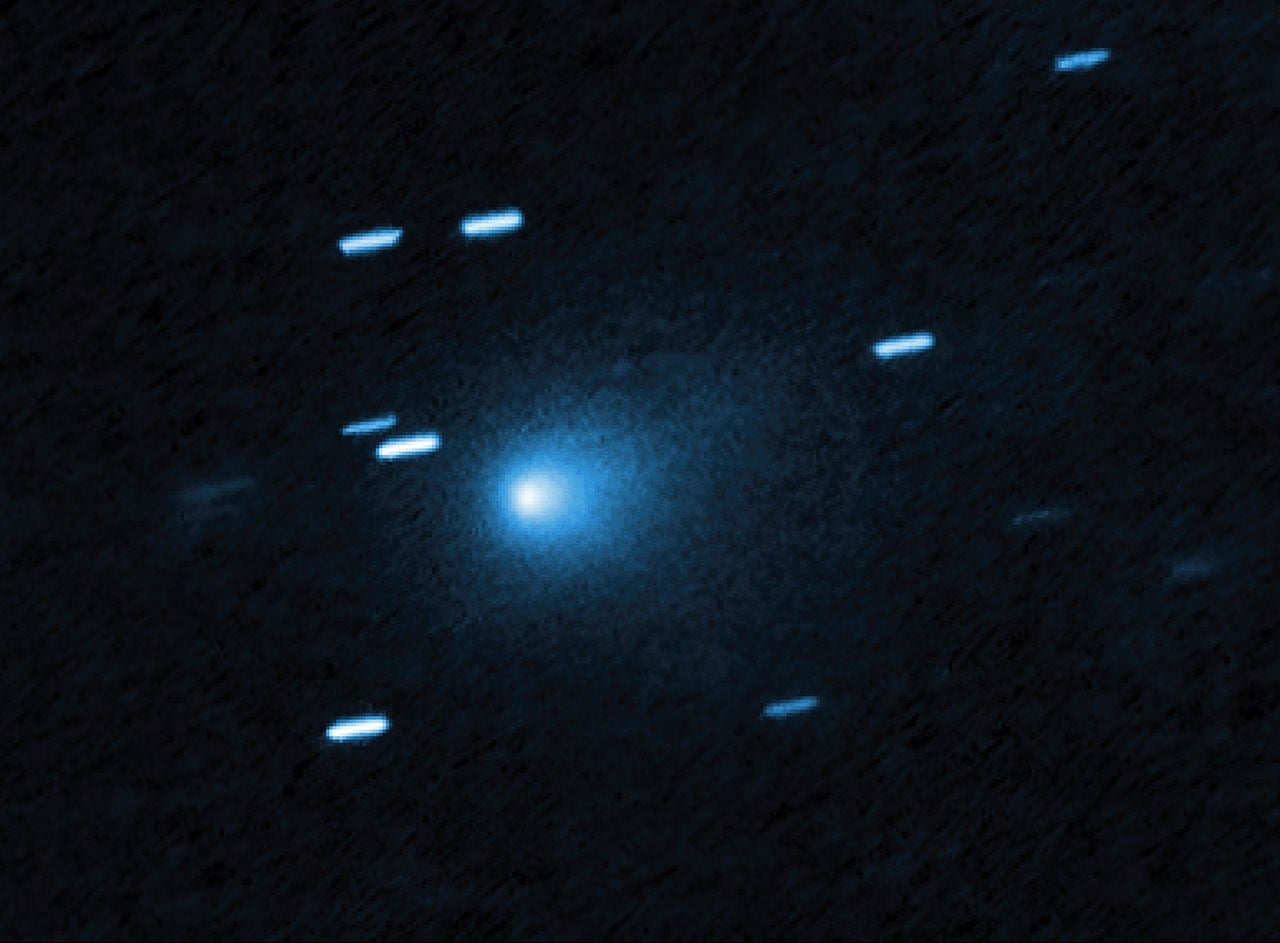
Interstellar comet 3I/ATLAS is doing something no ordinary long-period comet does. It is leaving the Solar System without entering an orbit that will ever carry it back.
The Sun is slowing it now, just as the Sun accelerated it on the way in. Yet even after that gravitational accounting is complete, 3I/ATLAS will retain close to 58 kilometres per second of speed relative to the Sun. Its trajectory remains open, its orbital energy positive and its departure permanent.
That is the simple meaning of the hyperbola astronomers measured. There is no distant turnaround point and no return date to place in a calendar. Barring an extraordinary encounter far beyond the planetary system, 3I/ATLAS has made its only passage through our neighbourhood.
The numbers attached to that passage can sound contradictory at first. The comet arrived at roughly 208,600 kilometres per hour, was moving at about 221,000 kilometres per hour when astronomers discovered it, and accelerated to approximately 246,000 kilometres per hour near the Sun. All three can be correct because they describe different places along the same path.
Sagittarius tells us which way it came from, not where it was born
Astronomers can extend the inbound orbit backwards until the Sun’s gravity becomes negligible. In the discovery team’s preliminary characterisation, that incoming asymptote pointed towards right ascension of about 295 degrees and declination near minus 19 degrees. On Earth’s sky, that lies in Sagittarius, not far from the direction of the Milky Way’s centre.
It is tempting to turn that line into a birthplace. The comet came “from Sagittarius”, so perhaps it came from a star in Sagittarius. That is not what the measurement establishes.
Constellations are two-dimensional patches on our sky, not physical containers. Stars that appear close together in Sagittarius can sit at very different distances. The Sun, those stars and 3I/ATLAS have also been moving around the Galaxy throughout the comet’s journey.
Projecting a fast object’s orbit back for millions of years magnifies tiny uncertainties in position and velocity. Encounters with stars and the Galaxy’s gravitational field further complicate the calculation. Searches using Gaia star motions have found past encounters, but no convincing parent system. The arrival direction is secure; the comet’s home address is not.
The fairest speed comparison is made far from the Sun
An object speeds up as it falls into the Sun’s gravitational field. That means a speed measured near Mars’s orbit cannot be compared cleanly with one measured much closer to the Sun. The useful common quantity is hyperbolic excess speed, usually written as v-infinity.
This is the speed an unbound object approaches far from the Sun, after the local gravitational acceleration has been removed from the comparison. For 3I/ATLAS, the original discovery analysis found an incoming value of 57.942 kilometres per second, with a formal uncertainty of 0.049 kilometres per second. That is about 208,600 kilometres per hour.
For context, 1I/’Oumuamua entered with a hyperbolic excess speed near 26 kilometres per second. Comet 2I/Borisov arrived near 32 kilometres per second. 3I/ATLAS therefore had by far the highest incoming speed of the three confirmed interstellar visitors.
Only three is a very small sample. The record tells us which detected object was fastest, not the full velocity distribution of the unseen population crossing the Solar System. Fast objects also spend less time within telescope range, which can make them harder to discover.
Discovery caught the comet after gravity had already added speed
The NASA-funded ATLAS telescope at Rio Hurtado in Chile reported 3I/ATLAS to the Minor Planet Center on 1 July 2025. At the time, it was within Jupiter’s orbit, about 670 million kilometres from the Sun.
By then the comet was no longer moving at its far-away incoming speed. It had fallen into the Sun’s gravitational well and accelerated to about 221,000 kilometres per hour. That is the figure often reported for its discovery velocity in NASA’s current 3I/ATLAS summary.
As a previous SpaceDaily account of Hubble’s first sharp view explained, the moving telescope target made the background stars streak while the comet’s coma remained centred. The image revealed a teardrop-shaped cloud of dust, but the solid nucleus was still hidden inside it.
Those observations constrained the nucleus to somewhere between about 440 metres and 5.6 kilometres across. The range remained broad because a bright coma can make a small nucleus look much larger than it is.
Near perihelion, the speed approached 250,000 kilometres per hour
3I/ATLAS reached its closest point to the Sun on 29 or 30 October 2025, depending on the time standard used to state the event. It stayed about 1.36 astronomical units from the Sun, roughly 203 million kilometres and just inside Mars’s average orbital distance.
At perihelion, its speed relative to the Sun reached about 68.3 kilometres per second. That is approximately 246,000 kilometres per hour, which NASA rounds to 153,000 miles per hour and the European Space Agency describes as roughly 250,000 kilometres per hour.
The Sun did not give the comet its interstellar status. Its orbit was already unbound before it entered the planetary region. Solar gravity merely converted some gravitational potential energy into kinetic energy as the comet fell inward.
That distinction also explains what is happening now. As 3I/ATLAS climbs away, the Sun pulls backwards on it and the comet slows. In the distant limit, its speed relative to the Sun approaches the same 57.94 kilometres per second it brought in. The perihelion boost was temporary.
Why a hyperbolic path cannot close around the Sun
Most comets seen from Earth are gravitationally bound. Their elongated elliptical orbits may take years, centuries or far longer to complete, but they possess negative orbital energy and eventually turn back towards the Sun.
A parabola marks the ideal boundary between capture and escape. A hyperbola lies beyond it. An object on a hyperbolic orbit has positive energy relative to the central body, so its speed never falls to zero as it recedes.
Orbital eccentricity expresses the same distinction geometrically. A circle has eccentricity zero, an ellipse lies between zero and one, and the parabolic boundary is one. The incoming barycentric solution for 3I/ATLAS had an eccentricity near 6.14. This was not a local comet nudged just over the line by a planet. Its orbit was emphatically open.
The word barycentric matters because astronomers want to judge the orbit relative to the Solar System’s centre of mass, and before close passage through the planetary region. That reduces the chance of confusing a temporary planet-induced trajectory with a genuinely interstellar one.
None of the planets supplied the speed needed to eject 3I/ATLAS from the Solar System. Its incoming direction and energy show that it arrived unbound. The same energy now carries it out.
Never returning does not mean the Sun has stopped affecting it
The Solar System has no hard outer wall. The Sun’s gravity extends indefinitely, weakening with the square of distance. Saying that 3I/ATLAS is leaving means its path is unbound, not that it crosses a painted boundary and instantly becomes immune to the Sun.
For a long time the comet will continue to decelerate, though by smaller amounts as the distance grows. Its path will bend less and less until it becomes almost a straight line through interstellar space.
In principle, a future close stellar encounter could redirect it somewhere else. That is different from the Sun bringing it back. There is no aphelion, the far point of a bound orbit, because this orbit has no far point.
Cometary outgassing adds tiny non-gravitational accelerations as sunlight turns ice into gas. Measurements found perturbations consistent with that familiar process. They are small beside the energy that makes the comet unbound and do not create a route home.
The fast passage never created a danger to Earth
Speed alone does not make an impact threat. Position and trajectory matter. Earth was on the opposite side of the Sun around 3I/ATLAS’s perihelion, and the comet came no closer to our planet than about 270 million kilometres on 19 December 2025. That is roughly 1.8 times the average Earth-Sun distance.
The object was discovered by a planetary-defence survey, but it was not a near-Earth object in the risk sense. ATLAS found it because a system built to detect moving hazards is also exceptionally useful for finding rare natural visitors.
Its direction, speed and activity were consistent with an interstellar comet. The coma, dust tail and small outgassing forces all behaved like sunlight acting on natural ice. What was foreign was its origin, not the basic physics it displayed here.
The comet leaves, but its measurements stay
The hyperbolic orbit gave astronomers only one observing season, but it became a remarkably distributed campaign. Ground observatories followed the comet before and after perihelion. Hubble, Webb, SPHEREx, TESS and several spacecraft travelling elsewhere in the Solar System added different wavelengths and viewing angles.
That wider work has already complicated the simple story of an icy body. As SpaceDaily reported from later Webb and ALMA measurements, the water in 3I/ATLAS carried an extreme enrichment in heavy hydrogen, evidence that its ice formed under very cold conditions unlike those recorded by familiar Solar System comets.
Its speed may also contain a broad clue to age and Galactic population, but speed cannot identify one parent star. Nor does coming from the direction of Sagittarius prove that the comet began near the Galactic centre. The clean orbital conclusion should not be stretched into a false precision about origin.
3I/ATLAS will never come back for better observations. Future interstellar visitors will have to enlarge the sample instead. The practical hope is that the next one will be found farther out, giving astronomers more time to organise telescopes and perhaps, one day, place a spacecraft in its path.
For this visitor, the geometry is settled. The Sun borrowed speed to 3I/ATLAS on the inbound leg and is taking that loan back as the comet departs. What remains is still enough: nearly 58 kilometres per second at infinity, an open trajectory and a one-way passage from one stellar system into the dark between others.