

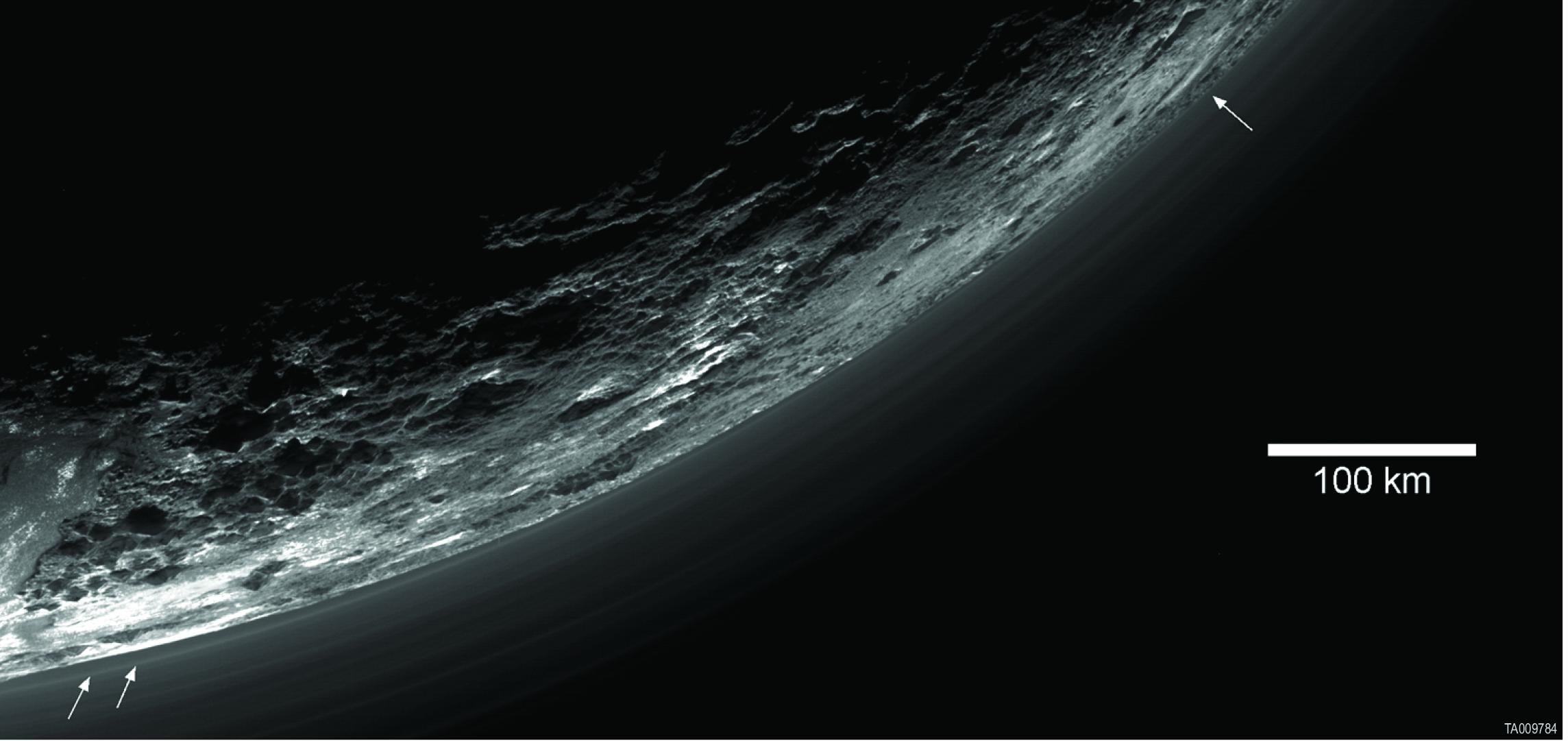
Pluto may be losing part of its sky to the ground beneath it.
A 2026 study in The Planetary Science Journal reports that the dwarf planet’s atmospheric pressure appears to have begun falling after a plateau that lasted from the New Horizons flyby in 2015 until roughly 2021. In the team’s haze-inclusive model, the post-2021 pressure was 16 per cent lower.
The likely destination of that missing gas is not deep space. Much of it may be condensing as nitrogen frost on Pluto’s surface as the world continues its slow retreat from the Sun.
That sounds like the beginning of an ending. It is better understood as a change of state in a planetary system that has probably traded nitrogen between surface and atmosphere for millions of years.
A distant star became the pressure gauge
No spacecraft is orbiting Pluto. New Horizons crossed the system once on 14 July 2015, returned its extraordinary measurements and kept travelling into the Kuiper Belt. Astronomers now monitor the atmosphere largely through stellar occultations.
An occultation occurs when Pluto passes in front of a distant star as seen from Earth. An airless body would make the star wink out sharply. Pluto’s atmosphere refracts and absorbs some of the light first, creating a gradual dip whose shape carries information about pressure, temperature and atmospheric structure.
The new analysis brings together ten occultations from August 2017 to 17 July 2023. Four events were recorded along several paths, or chords, across Pluto’s shadow. Six came from single sites, making their geometry more difficult to disentangle from the atmosphere itself.
The technique is indirect, but it has history. Stellar occultations revealed Pluto’s atmosphere in 1988, nearly three decades before a spacecraft saw its layered haze at close range.
What the 16 per cent measures
The largest reported decline came from models that include haze in Pluto’s lower atmosphere. At a reference radius of 1,215 kilometres from Pluto’s centre, the weighted pressure fell from 6.17 microbars in the 2015-to-2021 group to 5.20 microbars after 2021. The calculated change was 16 per cent, with an uncertainty of 2 percentage points.
A second method gives a more restrained answer. When the researchers fitted only the clearer upper atmosphere and calculated pressure at a 1,275-kilometre radius, they found a decline of 7 per cent with an uncertainty of 6 percentage points.
Those reference radii are not arbitrary decorations. Most occultation light curves do not reach Pluto’s surface. Researchers fit the atmosphere at heights the starlight actually samples, then use an atmospheric profile if they want to infer conditions lower down. If the atmosphere’s structure is changing, the conversion to surface pressure can change with it.
The dates need similar care. The observing campaign runs from the August 2021 event to a final event in July 2023, but the formal 16 per cent estimate is a weighted comparison of the 2015-to-2021 plateau with post-2021 haze fits, driven most strongly by the better 2022 multi-chord observations. The July 2023 event was a low-signal, single-chord dataset with large uncertainties.
In other words, mid-2021 to July 2023 is the window in which the decline became visible, not a pair of direct pressure readings taken on those exact dates.
Pluto moved away while its atmosphere grew
Pluto passed perihelion, its closest point to the Sun, in 1989. It has been moving outward ever since. The obvious prediction would be that its atmosphere began shrinking immediately.
Instead, occultations showed the pressure roughly doubling from 1988 to 2002, pausing around 2006 and 2007, then continuing upward until about 2015. It remained broadly level through 2021.
The delay is a lesson in planetary seasons. Pluto has an axial tilt near 122 degrees, an eccentric orbit and a subsurface able to store heat. Its climate responds not just to how far it is from the Sun, but to where sunlight falls, where volatile ice is available and how slowly stored warmth leaks back out.
Distance sets the broad direction. Thermal inertia and geography decide the timing.
The surface and sky form one nitrogen system
Pluto’s atmosphere is mainly molecular nitrogen, with smaller amounts of methane, carbon monoxide and trace hydrocarbons. Its surface also contains vast nitrogen-ice reservoirs, most visibly in Sputnik Planitia, the bright western lobe of the heart-shaped Tombaugh Regio.
As Space Daily has previously explored, that plain is not a static frost patch. Nitrogen ice convects, flows and renews the surface. It also supplies the atmosphere above it.
At Pluto’s temperatures, the border between ground and air is mobile. Nitrogen ice sublimates directly into gas when it warms. When it cools, nitrogen gas condenses directly back into frost. Atmospheric pressure is therefore tied to the vapour pressure of surface ice and can respond steeply to a small temperature change.
New Horizons supplied the visual counterpart. Its look-back images showed Pluto rimmed by many atmospheric layers. Our earlier account of that blue twilight described how organic particles scatter sunlight even though the gas itself is almost unimaginably thin.
The new study found that the upper atmosphere’s basic shape remained consistent within the measurement errors from 2017 to 2023. The lower light curves changed. The authors say that is compatible with altered thermal gradients, changing haze, or both.
For haze particles between about 0.2 micrometres and 10 nanometres across, estimated settling times run from roughly 10 to 400 days. A shallower recent light-curve slope may therefore carry the imprint of haze descending as the atmosphere contracts.
“Atmospheric collapse” does not mean annihilation
Planetary scientists sometimes call a large condensation-driven pressure loss an atmospheric collapse. The phrase is technically useful but emotionally misleading. Nothing falls in like a roof.
On Pluto, much of the nitrogen would simply change phase and join the ice reservoir. It is not necessarily lost from the dwarf planet. Under warmer conditions in another part of the seasonal cycle, some of that frost can sublimate and become atmosphere again.
Models disagree about how far the pressure will fall. Older scenarios allowed most of the atmosphere to freeze out around the colder parts of Pluto’s orbit. More recent volatile-transport models often maintain at least a tenuous global atmosphere throughout the 248-year circuit because Sputnik Planitia contains so much nitrogen and the subsurface has substantial thermal inertia.
The difference matters. A thinner global atmosphere, a temporarily local atmosphere and a near-total seasonal collapse are not the same outcome. The current observations are not yet precise enough to say which is right.
How an atmosphere can persist for millions of years
Nobody has watched Pluto’s atmosphere across geological time: humans detected it only in 1988. The case that it has persisted in some form rests on inference from the volatile inventory, the surface record, atmospheric escape estimates and climate modelling.
A long-timescale nitrogen-cycle model has followed Pluto’s volatile transport across millions of years, including shifts in obliquity and orbital geometry. Its simulations move nitrogen between Sputnik Planitia and other regions, build and erode deposits, and explore surface pressures over the past 30 million years.
This is the deeper sense in which Pluto’s atmosphere can endure. The individual nitrogen molecule need not remain gaseous. The atmosphere can contract, frost can migrate and the global pressure can swing dramatically while the coupled reservoir continues.
That does not mean Pluto has kept today’s pressure, or a continuous global haze, for millions of years. What has probably operated over many long climate cycles is the machinery capable of rebuilding a nitrogen atmosphere.
Why 2114 is not an expiration date
According to NASA’s Pluto overview, the dwarf planet ranges from about 30 to 49.3 astronomical units from the Sun. It is expected to reach aphelion, the farthest point in its orbit, around 2114.
That year is not a countdown to the final molecule of air. Seasonal geometry, nitrogen-ice distribution and subsurface heat can shift a pressure maximum or minimum away from perihelion and aphelion. Pluto has already demonstrated the lag by thickening for decades after it began moving away from the Sun.
Pluto has not completed one orbit since its 1930 discovery, so modern astronomy has observed less than two-fifths of one Plutonian year. The atmosphere itself has been measured for only a fraction of that fraction.
The model that most closely resembles the new decline begins decaying around the present era, roughly 2025. Other models predict a fall that occultations of ordinary quality may not reveal until the late 2020s. They do not all produce the same minimum pressure.
The evidence is promising, not final
The 2026 paper is careful about its own evidence. Signal-to-noise across the ten new events ranged from 2 to 158. Single-chord observations create a degeneracy between Pluto’s atmospheric size and the path taken through its shadow. Different treatments of haze also yield different pressure changes.
That is why the authors say their results suggest the pressure has started to drop. They do not claim to have mapped the atmosphere’s future.
The 16 per cent haze-inclusive result is the strongest sign so far that the long plateau may be ending. The 7±6 per cent clear-atmosphere result, the uncertain 2023 observation and the stable upper structure are reasons to keep the conclusion provisional.
Future occultations will do what no single spacecraft flyby can: sample Pluto repeatedly as the season changes. Each event lasts minutes and may be visible only along a narrow path on Earth, but together they can trace a climate whose meaningful timescale exceeds a human life.
Pluto’s sky is not simply disappearing. Nitrogen is moving from gas to frost, from atmosphere to glacier, and perhaps one distant season from now, back into the sky again.