

The bright plain on the image-left side of Pluto’s heart is Sputnik Planitia, a basin roughly 1,000 kilometres across filled mainly with nitrogen ice. Across all of the terrain New Horizons could inspect, no impact crater has been confirmed within it.
Any crater large and old enough to have been visible has been removed. The surface is not preserving its history in the way Pluto’s older, heavily cratered landscapes do.
Crater statistics set a broad upper limit on the surface age, while computer models describe a much faster cycle of renewal. They are not the same clock.
No crater is still an upper limit, not a precise age
Planetary scientists estimate a surface’s age by counting craters over a known area and comparing the result with models of the impact rate. A surface exposed for longer should, all else being equal, accumulate more scars.
Pluto provides its own contrast. New Horizons mapped more than a thousand craters across the dwarf planet, including terrains thought to be about four billion years old. Sputnik Planitia stands out because its nitrogen plains contain none that can be identified in the available images.
A 2016 analysis by Kelsi Singer and colleagues found no craters down to about two kilometres in the wider low-resolution coverage and 625 metres in the best high-resolution strip. Using estimates of the small objects crossing Pluto’s orbit, they placed the plain’s crater-retention age below roughly 10 million years.
That is an order-of-magnitude ceiling and depends on estimates of a sparse Kuiper Belt impact population. “Crater-free” should therefore be read as “no crater detected at New Horizons resolution”, not as a claim about features too small for the spacecraft to resolve.
The plain is a glacier made from volatile ice
Sputnik Planitia is the western lobe of Tombaugh Regio, the bright formation commonly called Pluto’s heart. The two lobes look joined in global images, but they are geologically different terrains.
The basin contains molecular nitrogen mixed with smaller amounts of methane and carbon monoxide ice. At Pluto’s surface temperature, nitrogen ice is far softer than the water ice that forms the surrounding crust and mountains. Over long periods it can deform and flow like a very cold glacier.
Blocks of water ice broken from the surrounding uplands can be carried by the nitrogen glacier and gathered at the margins of its cells. Space Daily’s earlier report on Pluto’s floating hills described these blocks as the local equivalent of icebergs, except the supporting sea is solid nitrogen rather than liquid water.
A detailed geological map of Sputnik Planitia concluded that its mapped units are being affected by convection, glacial flow and sublimation. Condensation can also lay down a bright nitrogen mantle. The missing craters therefore do not have to be erased by one process alone.
The polygons record slow overturning
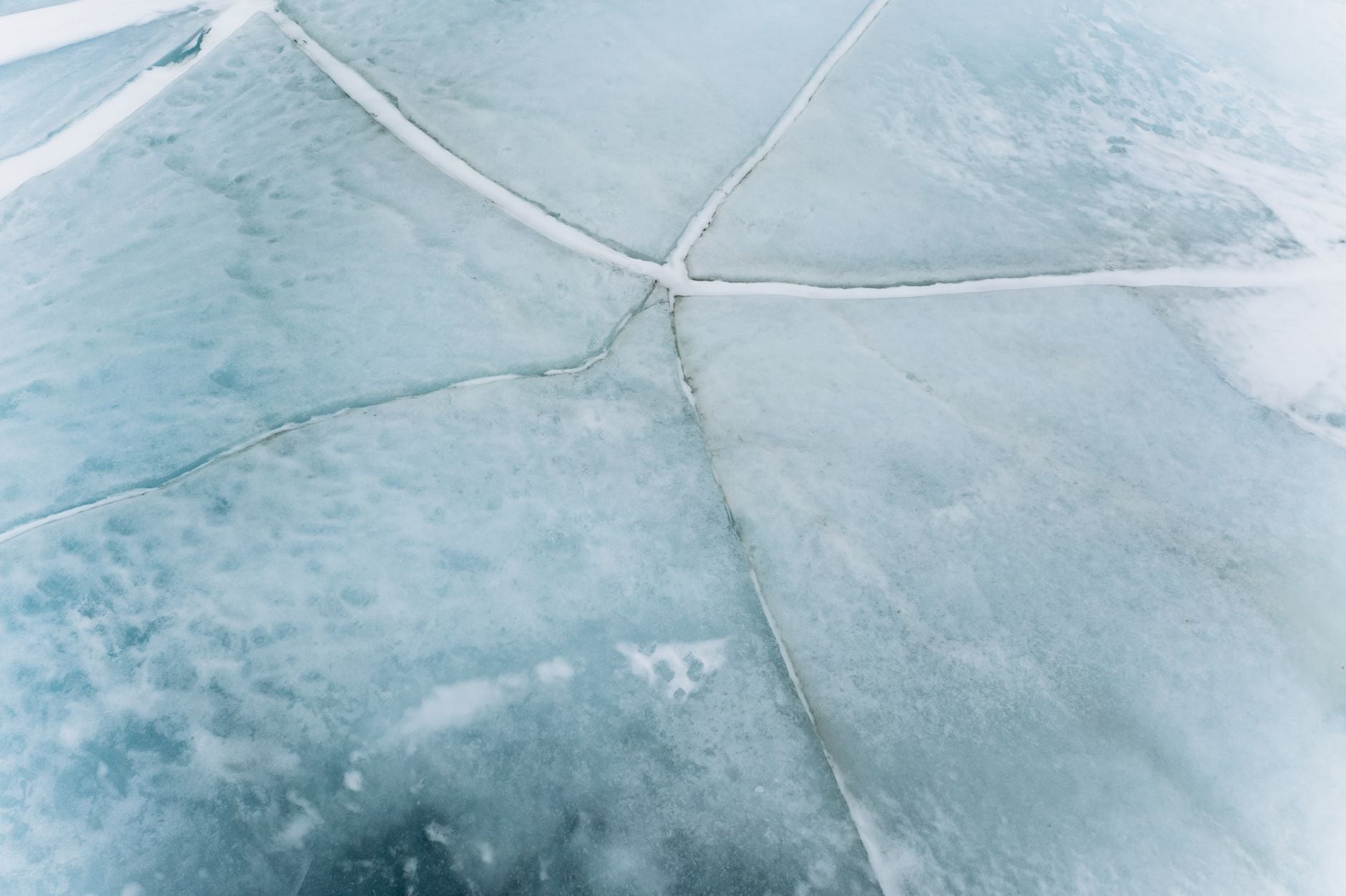
Much of Sputnik Planitia is divided into cells roughly 10 to 40 kilometres wide. Their centres are comparatively smooth and raised, while narrow troughs form many of the boundaries. This is the surface pattern expected when a layer of soft solid material circulates.
In a 2016 Nature model led by William McKinnon, nitrogen ice more than about one kilometre thick could convect under plausible conditions on Pluto. A layer several kilometres deep reproduced the broad cells seen by New Horizons.
Warm, buoyant nitrogen ice rises towards a cell centre, spreads sideways and eventually descends along the margins after cooling. Average surface speeds of a few centimetres a year were enough to move or renew material across a cell in about 500,000 years.
A crater does not need to be explosively destroyed. A bowl excavated into material that continually flows can be distorted, carried towards a downwelling boundary, buried by condensation or lost as the ice sublimates and is deposited elsewhere.
The human comparison belongs to the model
The oldest widely accepted fossils assigned to early Homo sapiens at Jebel Irhoud in Morocco were dated to 315,000 years ago, with an uncertainty of 34,000 years. That makes the headline comparison possible, but only with careful wording.
The crater record by itself does not show that Sputnik Planitia is younger than our species. Its upper limit is about 10 million years, far older than Homo sapiens. The comparison comes from the modelled half-million-year renewal time.
A complete trip across or through a convecting cell may take longer than the known history of our species. Yet the circulation is continuous. Ice that has only recently risen and spread across a cell centre can have been exposed at the surface for far less than 300,000 years. In that limited sense, parts of the visible ground can be younger than humanity.
It is an age of exposure, not the age of the nitrogen molecules or the basin beneath them. Sputnik Planitia itself is ancient and may have formed early in Pluto’s history. The surface presented to New Horizons in 2015 is the replaceable layer.
The source of the convection remains under study
The first convection models emphasised heat entering the nitrogen ice from Pluto’s interior. Radioactive decay in the rocky interior can provide a modest long-term heat flow, and nitrogen ice is soft enough for a small temperature difference to matter.
Later work refined that picture. A 2021 Nature study found that cooling associated with surface sublimation could drive convection and reproduce the observed flat polygons and narrow troughs under certain assumptions. That model still circulates material from depth, but it changes what supplies the buoyancy contrast.
The debate concerns the engine and boundary conditions, not whether the plain moves. The cells, flowing glaciers, drifting water-ice blocks, sublimation pits and absence of craters all describe a surface that is being renewed.
New Horizons did not photograph motion during its brief flyby. It photographed the accumulated geometry of motion slow enough to escape a camera and fast enough to erase geological time.