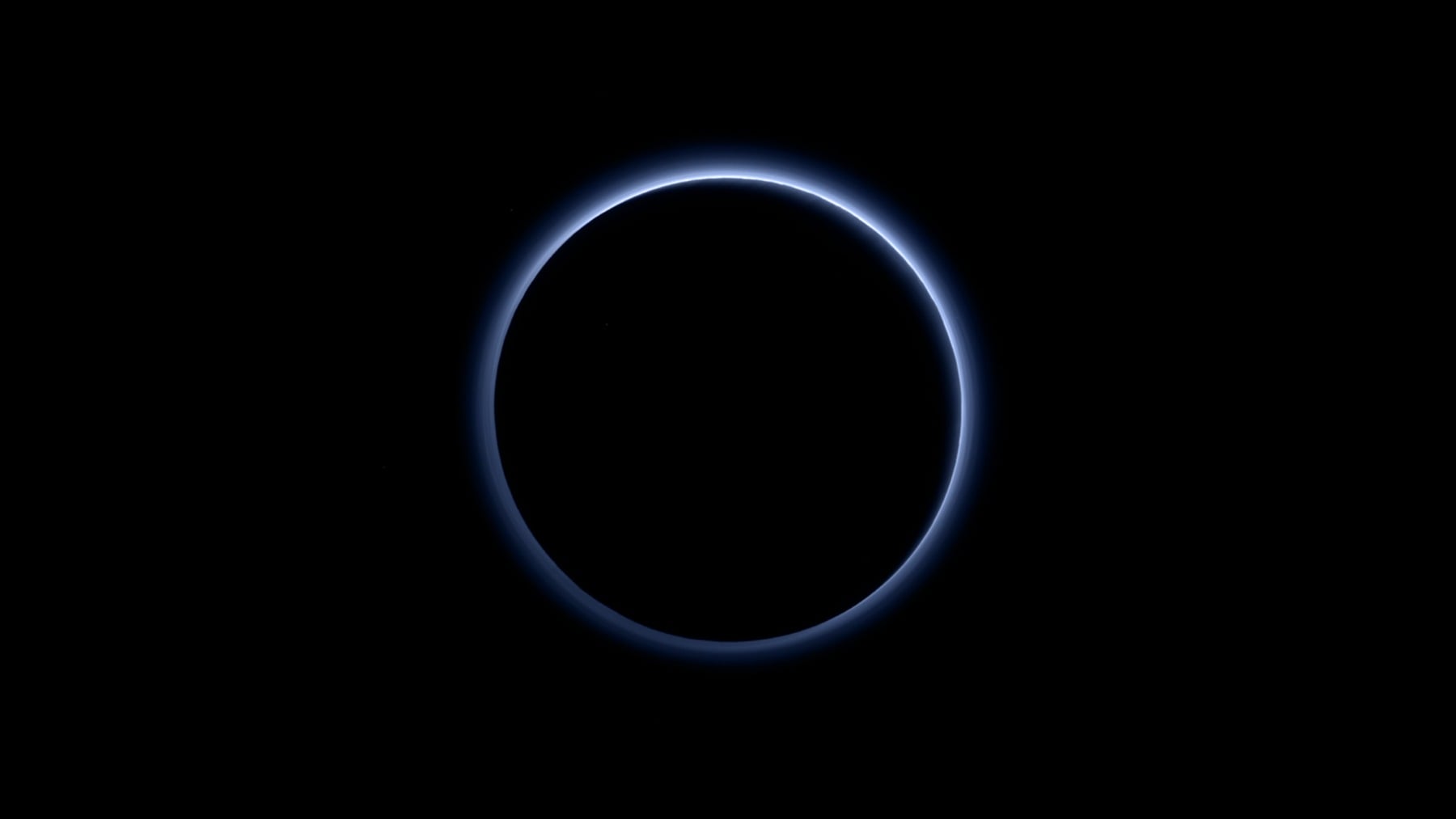
New Horizons had already passed Pluto when it made one of the flyby’s most revealing observations. The spacecraft turned its instruments back toward the dwarf planet, placing Pluto between the camera and the Sun. The surface became a dark disc. Around it appeared a thin, luminous atmosphere edged in blue.
The colour came from haze scattering sunlight, not from a blue surface or an Earth-like ocean of air. Pluto’s atmosphere is extremely tenuous and dominated by nitrogen, with methane and carbon monoxide present in smaller amounts. Yet that slight atmosphere contains an extended, layered veil of organic particles capable of carrying sunlight around the boundary of night.
Pluto has a blue twilight, but almost every word in that sentence needs a planetary qualifier.
The departure view changed the geometry
New Horizons reached closest approach on 14 July 2015 after a journey of more than nine years. Before and during the pass, sunlit views mapped mountains, plains, craters and volatile ice. Afterward, a different alignment became available. The spacecraft looked back with the Sun nearly behind Pluto, a high-phase geometry that turned the atmosphere into a bright rim around a dark world.
Backlighting matters because haze particles scatter light strongly in particular directions. Seen against an illuminated surface, a faint aerosol can be difficult to separate from the ground beneath it. Seen around a silhouette, the same particles send sunlight toward the camera along long slant paths through the atmosphere.
NASA’s mission account of Pluto at twilight described the first surprise: a brilliant halo, divided into sharply defined layers, extending above the surface. Some haze also hugged the ground, where oblique sunlight and mountain shadows exposed its presence.
SpaceDaily’s 2015 report on the spectacular backlit panorama recorded more than a dozen atmospheric layers and low-lying haze crossed by shadows. New Horizons was not merely photographing a ring. It was using the distant Sun as a lamp behind Pluto’s atmosphere.
The famous blue view is a calibrated colour image
The blue result came from Ralph, one of New Horizons’ remote-sensing instruments. Its Multispectral Visible Imaging Camera, or MVIC, measured Pluto through several wavelength bands. NASA combined blue, red and near-infrared information to reproduce colour as closely as possible to what a human eye might perceive.
That processing does not make the colour fictitious. Space cameras commonly record separate spectral channels rather than the three broad channels of an ordinary consumer camera. The relative brightness measured by MVIC showed that Pluto’s haze sent more short-wavelength visible light toward the spacecraft.
It does mean the published picture is not an untouched snapshot. Instrument response has to be calibrated, channels aligned and measured intensities mapped into a displayable image. The dark disc and luminous blue rim present real data through a deliberate colour reconstruction.
When NASA announced the colour result in October 2015, its blue-skies release noted a seeming contradiction. The suspended haze particles were probably grey or red, even though the light scattered by the haze looked blue.
Pluto’s blue is related to Earth’s, not identical
Earth’s daytime sky is blue mainly because molecules much smaller than visible wavelengths scatter short blue light more efficiently than long red light. The wavelength dependence is known as Rayleigh scattering. Pluto also showed a steep blue spectral slope, but the relevant scatterers were not simply nitrogen molecules reproducing Earth’s sky in thinner air.
The mission team inferred soot-like organic haze particles called tholins. Their optical behaviour had to explain two measurements at once: blue colour and very strong forward scattering in the backlit geometry. A single compact particle size struggles to satisfy both.
Later models proposed fluffy fractal aggregates built from much smaller monomers. The tiny components can generate a Rayleigh-like blue slope, while the larger aggregate redirects light strongly forward. A 2017 microphysical study of Pluto’s photochemical haze obtained aggregates roughly 0.1 to 0.2 micrometres across near the lower atmosphere, assembled from monomers only several nanometres in radius.
Those dimensions are model results constrained by brightness, colour, ultraviolet extinction and viewing angle. New Horizons did not photograph a single haze grain at microscopic resolution. The model explains how one population of complex particles can satisfy observations that otherwise point toward different sizes.
Why red organic material can make a blue halo
High in Pluto’s atmosphere, ultraviolet sunlight breaks apart and ionises nitrogen and methane. Reactive fragments build more complex positive and negative ions. After recombination, macromolecules form, cluster and acquire coatings as hydrocarbons and nitriles condense. Gravity slowly carries the particles downward.
Colour is not an immutable label attached to a material. It depends on composition, particle size, internal structure, illumination and viewing geometry. A reddish or grey substance divided into small suspended structures can preferentially scatter blue light. The same organic material, accumulated and altered on the ground, can help darken and redden Pluto’s surface.
There is therefore no conflict between a blue atmospheric rim and reddish terrain. The halo records light redirected by particles in flight. The surface records material after deposition, concentration and radiation processing.
SpaceDaily’s earlier report that New Horizons found blue skies and exposed water ice captured how the flyby separated these layers of colour. Some water-ice exposures appeared within red terrain, while a haze made from organic chemistry scattered blue above them.
Twilight light reached Pluto’s night side
The phrase “blue twilight” describes more than a coloured outline seen from space. Haze can redirect sunlight into places where the Sun itself has slipped below the local horizon. Sensitive New Horizons images detected terrain in nighttime regions that direct sunlight could not reach, softly lit by the extended atmosphere.
Near the terminator, gaps between mountains produced candidate crepuscular rays. Elsewhere, long narrow shadows cut through bright low haze. These are the same basic geometries that make sunbeams visible in dusty or misty air on Earth, operating in a colder atmosphere with different chemistry and pressure.
SpaceDaily’s contemporary Pluto at Twilight account described the low haze, rays and layered limb that made a remote world look superficially familiar. The familiarity should not be extended too far. Pluto’s surface pressure is around ten microbars, roughly one hundred-thousandth of Earth’s sea-level pressure.
An observer would not stand under a uniformly blue midday dome like Earth’s. The strongest measured colour came from a near-backlit line of sight through a long atmospheric path. Surface appearance would vary with direction, altitude and the Sun’s position. “Blue twilight” is defensible because scattered light survives beyond direct sunset; “Earth-like blue sky” without qualification is not.
The first altitude estimate was only the beginning
Initial post-flyby reports traced distinct haze to roughly 130 kilometres above the surface. Analysis of the fuller dataset later detected haze beyond 200 kilometres and identified about 20 layers. Those numbers are not necessarily contradictory. Different instruments, wavelengths, image processing and detection thresholds expose different parts of a diffuse atmosphere.
The 2016 Science synthesis of Pluto’s atmosphere placed the visible haze inside a nitrogen-dominated system containing methane and photochemical products including acetylene, ethylene and ethane. Imaging revealed structure, while ultraviolet solar occultation measured absorption as sunlight passed through the atmosphere.
Later work suggested that atmospheric waves generated as winds cross Pluto’s topography could help organize haze into layers. New Horizons saw layer thickness and distribution at one encounter, however. It could not remain to watch them rise, fall or reorganize over a season.
The particles may do more than colour the view. SpaceDaily later covered the proposal that hydrocarbon haze controls much of Pluto’s atmospheric cooling by absorbing energy and radiating it into space. The same material can connect photochemistry, temperature, surface deposits and twilight optics.
The atmosphere was known; its character was not
It would be inaccurate to say New Horizons unexpectedly discovered that Pluto had any atmosphere. Stellar occultations had revealed the atmosphere decades earlier, and photochemical models had considered haze. The spacecraft changed the level of detail.
The first look-back images showed a halo brighter, taller and more finely layered than many team members expected. The later colour data added the blue spectral slope. Principal investigator Alan Stern responded by asking who would have expected a blue sky in the Kuiper Belt. Carly Howett of the science team explained that the tint carried information about particle size and composition.
The surprise was therefore specific: not gas, but a high, structured aerosol whose scattering behaviour gave the edge of Pluto an unexpected colour. Preserving that distinction gives the pre-flyby work its due and explains what the spacecraft actually discovered.
A flyby leaves a blue answer and open questions
New Horizons did not enter orbit. It crossed the Pluto system at flyby speed, recorded a carefully planned sequence of views and spent more than a year transmitting the stored data home. Its changing perspective supplied several phase angles, but only during one brief encounter in July 2015.
The exact particle architecture, the mechanism maintaining roughly 20 layers and the atmosphere’s long seasonal evolution remain partly modelled. Pluto takes 248 Earth years to orbit the Sun. No spacecraft dataset follows its haze through a meaningful fraction of that cycle.
Even the phrase “what a human eye would see” has limits. MVIC’s calibrated channels support an approximate colour reconstruction; human vision at Pluto’s extremely low light level would adapt differently from a display viewed indoors. That boundary concerns perception, not whether the instrument measured preferential blue scattering.
Pluto’s daylight surface is not blue, and its air would not feel like air. But when sunlight grazes its organic haze after sunset, the particles hold short wavelengths in view and give the edge of night a blue colour.