

A visitor descending towards Pluto would meet contradictions before reaching the ground.
Above lies a blue atmospheric haze, even though the surface below is mottled red, cream and grey. The mountains are built from water ice, but the glaciers flowing around them are dominated by frozen nitrogen. Some broken pieces of the water-ice crust appear buoyant enough to travel across that nitrogen like icebergs. Overhead, the largest moon does not simply circle Pluto’s centre. Both bodies orbit a point suspended outside Pluto, between the two worlds.
Then there is the clock. Humans discovered Pluto in 1930, but Pluto needs about 248 Earth years to complete one trip around the Sun. We have changed its classification, sent a spacecraft past it and mapped named features across its surface without seeing it finish even one observed year.
Each fact needs a little precision. The haze appears blue rather than the ground. The floating hills have not been filmed moving in real time. Charon is still officially a moon, despite the unusual orbital geometry. Taken together, though, the details show why the 2015 New Horizons flyby transformed Pluto from a distant point of light into one of the Solar System’s most physically inventive landscapes.
Pluto’s blue sky is a veil of organic haze
The first colour images of Pluto’s atmosphere revealed a blue tint in its high-altitude haze. NASA produced the view by combining blue, red and near-infrared data from New Horizons’ Multispectral Visible Imaging Camera to approximate colours a human eye would perceive.
The explanation is related to, but chemically different from, Earth’s blue sky. Here, tiny molecules scatter short blue wavelengths efficiently. On Pluto, scientists think sunlight initiates reactions among nitrogen and methane high in the atmosphere. Those reactions build complex, soot-like organic particles called tholins.
The particles themselves are thought to be grey or red. Their size allows the suspended haze to scatter blue light, according to NASA’s account of the discovery. As the particles grow, volatile gases can frost their surfaces before they settle and contribute to Pluto’s reddish ground.
“Blue sky” therefore describes the colour of sunlight scattered by a tenuous atmospheric veil. It does not describe an Earth-like atmosphere, nor a blue surface. The sunlight at Pluto is much weaker, and the gas around the dwarf planet is extraordinarily thin.
The same substance can be a glacier here and a mountain there
Pluto reverses the roles familiar from Earth. Water ice is so hard at temperatures near 38 kelvin, roughly minus 235 degrees Celsius, that it behaves as structural bedrock. It can support mountains several kilometres high. Nitrogen ice is softer and more mobile under Plutonian conditions, accompanied in places by carbon monoxide and methane ice.
The clearest stage for this chemistry is Sputnik Planitia, the bright western half of the heart-shaped Tombaugh Regio. The basin contains a vast sheet of nitrogen-dominated ice with glacier-like flow at its margins and polygonal cells across its interior.
Those cells are not cracks in an inert shell. A New Horizons analysis published in Nature concluded that convection within the nitrogen-ice layer could continually renew the surface. Warmer material rises, cooler material descends, and the slow overturning helps explain why so few impact craters interrupt the plain.
Earth offers the analogy, but not the ingredients. Here, water ice creeps downhill over rock. On Pluto, nitrogen ice can flow around obstacles made from water ice, which fills the geological role of rock.
The “icebergs” are probably broken pieces of Pluto’s crust
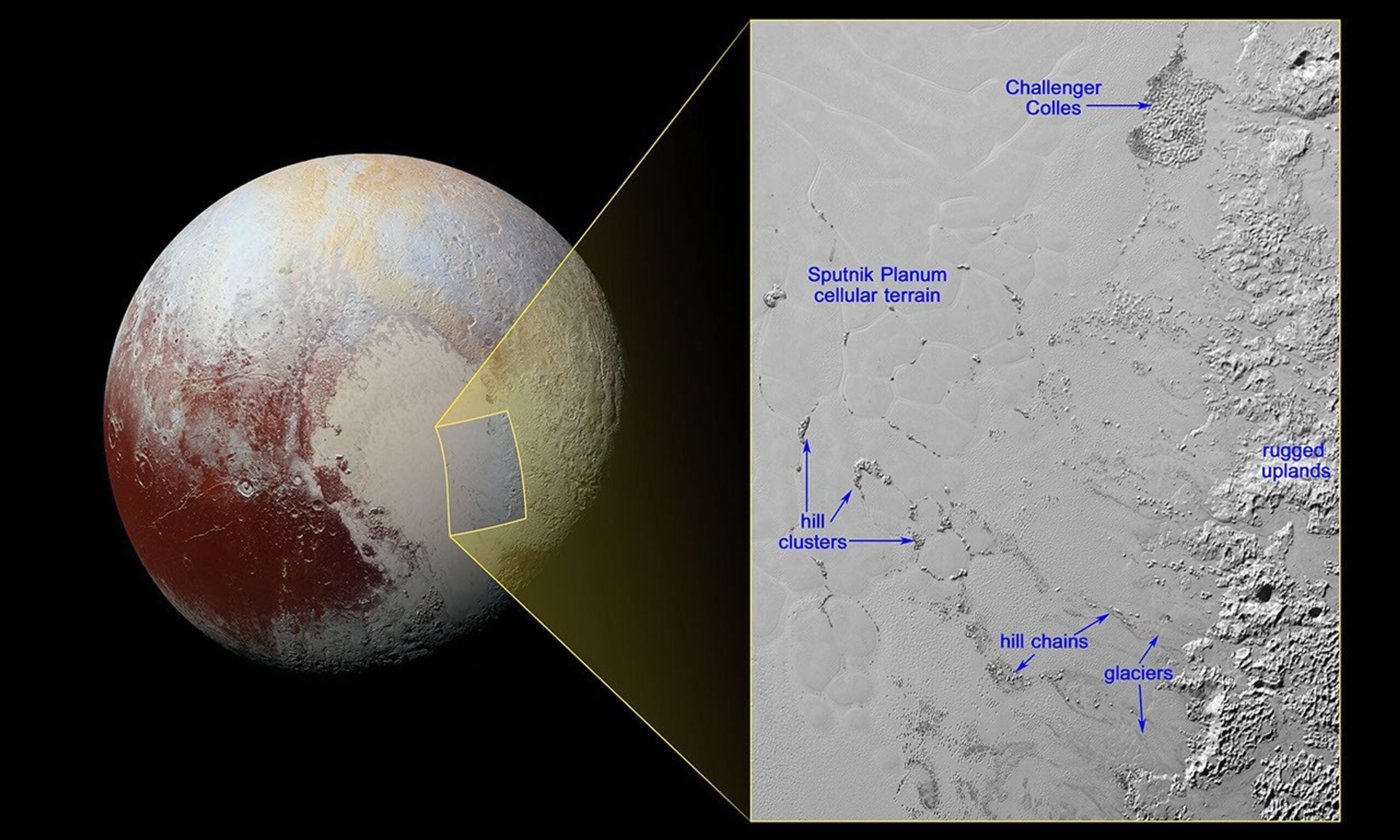
New Horizons photographed isolated hills scattered across Sputnik Planitia. Individual blocks measure roughly one to several kilometres across. There are chains along apparent flow paths and clusters near the borders of the plain’s convective cells.
The leading interpretation is that these hills broke from rugged water-ice uplands and entered the nitrogen glacier. Water ice is less dense than nitrogen-dominated ice under the relevant conditions, so the fragments can be buoyant. NASA’s annotated image of the floating hills says they are believed to move over time like icebergs in Earth’s Arctic Ocean.
Some clusters reach about 20 kilometres across. Challenger Colles, a particularly large accumulation near the northern edge of the imaged area, spans roughly 60 by 35 kilometres and may mark a place where hills became beached as the nitrogen ice grew shallower.
The language deserves its qualifier. New Horizons passed Pluto at high speed and did not stay to track a particular hill across years. “Floating” and “moving” are inferences from the blocks’ likely composition, relative density, position and the visible flow and convection patterns around them. They are well-motivated inferences, not a time-lapse observation.
Pluto and Charon dance around a point outside Pluto
Charon is about half Pluto’s diameter and roughly one-eighth its mass, unusually large proportions for a moon. The result is a centre of mass, or barycentre, that falls beyond Pluto’s surface.
Every 6.4 Earth days, Pluto and Charon both travel around that point in the space between them. NASA’s New Horizons mission history explains that this geometry is why the pair are sometimes described as a binary system. The term is informal in this case. The International Astronomical Union has not formalised a binary dwarf-planet category, and Charon remains classified as Pluto’s moon.
The pairing is stranger still because the two bodies are mutually tidally locked. Charon always presents the same hemisphere to Pluto, and Pluto always presents the same hemisphere to Charon. An observer on Pluto’s Charon-facing side would see the moon fixed in one region of the sky. Someone on the far side would never see it.
NASA’s record of Charon’s discovery and orbit notes that they circle their common centre of mass every 6.387 days. The distant system is not a large body sitting still while a negligible companion loops around it. Both worlds visibly participate in the dance.
Humanity has watched less than two-fifths of one Pluto year
Clyde Tombaugh identified Pluto on photographic plates in February 1930. Pluto’s orbit takes about 248 Earth years, so only about 96 of those years will have passed by the time this article appears. That is less than 40 per cent of one circuit.
As Space Daily’s earlier account of Pluto’s unfinished observed orbit detailed, the dwarf planet will not return to its discovery-era position until 2178. Its path is also elliptical and tilted. The distance from the Sun changes substantially over the orbit, producing seasons that unfold across decades.
This is more than a calendar curiosity. Pluto’s volatile nitrogen and methane move between the surface and atmosphere as sunlight and temperature change. A landscape seen during the New Horizons encounter on 14 July 2015 represents one seasonal state in a cycle no human observer has yet followed from beginning to end.
The orbit claim in the headline is literal, but it is not new evidence about Pluto. It is a consequence of comparing a well-measured 248-year period with the date of discovery.
New Horizons found one set of physics wearing unfamiliar clothes
When New Horizons flew past Pluto, it did not find a frozen relic with one simple surface history. The mission’s initial scientific results described a water-ice crust, volatile transport, glacial flow, haze layers and terrains of very different ages. The encounter forced researchers to explain how a small world so far from the Sun could remain active.
The answer is not that Pluto breaks familiar physical laws. Light still scatters according to particle size. Less-dense material can still float in a denser medium. Warm ice can still rise while cooler ice sinks. Two masses still orbit their shared centre, and a year is still one completed path around a star.
What changes are the substances and scales. Nitrogen becomes glacier ice. Water becomes mountain rock. A moon is large enough to pull the system’s balance point into empty space. A single season can outlast a career, and a single year can exceed a human lifetime.
Pluto’s surprises are therefore not disconnected oddities. They are a demonstration of how radically different a world can look when ordinary physics is given unfamiliar materials, weak sunlight and nearly two and a half centuries to complete one lap.