

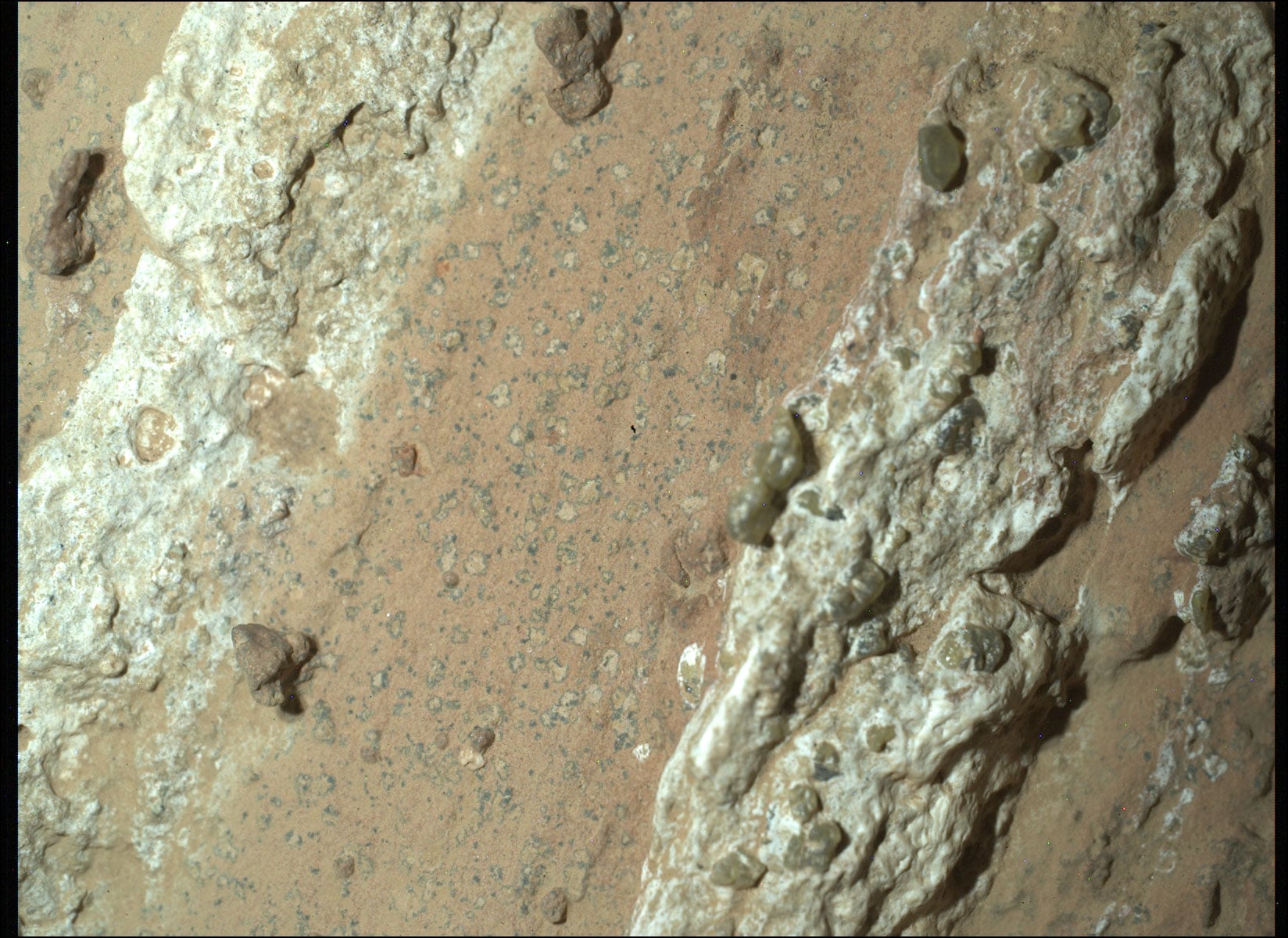
Two NASA rovers have now found organic material in ancient sedimentary rocks in widely separated regions of Mars.
Perseverance made its measurements in Jezero Crater, where an old river carried sediment into a lake. Curiosity made its discoveries in Gale Crater, where streams and groundwater fed another long-lived lake system. The two sites are separated by roughly 3,750 kilometres along the Martian surface.
That separation changes the significance of the chemistry. Organic carbon in one crater could be an unusually well-preserved local deposit. Organic material in two distant water-shaped environments suggests that carbon chemistry associated with habitability was not confined to one isolated basin.
It does not show that life existed at either location. “Organic” describes carbon-containing chemistry, not a biological origin. Meteorites, reactions between water and rock, and other non-living processes can all produce organic compounds. The important result is narrower: ancient Mars repeatedly brought water, sediment, minerals and organic carbon together in places where the material could survive for billions of years.
What Perseverance found in an ancient river channel
Perseverance encountered the most striking Jezero material in 2024 while driving through Neretva Vallis, a dry river valley that once carried water toward the crater lake. In a light-toned sedimentary formation called Bright Angel, the rover examined fine-grained mudstones containing clay, silt and evidence of chemical alteration.
One rock, nicknamed Cheyava Falls, contained pale spots with dark rims that the mission team informally called leopard spots. Perseverance drilled a core from the rock and sealed it in a sample tube under the name Sapphire Canyon.
A 2025 paper in Nature reported organic carbon in the Bright Angel mudstones together with small nodules and reaction fronts enriched in iron phosphate and iron sulfide minerals, probably vivianite and greigite. The spatial relationships suggest that the organic matter participated in low-temperature chemical reactions after the mud was deposited.
That combination is scientifically interesting because similar reactions on Earth can occur in the presence of microbes and can provide energy for microbial metabolism. It is not uniquely biological. The authors considered non-biological routes, including reactions involving organic matter made on Mars or delivered from space.
Perseverance’s SHERLOC instrument supplied the organic signal. SHERLOC shines an ultraviolet laser onto a rock and reads the fluorescence and Raman-scattering response. NASA’s published spectra from Bright Angel contain Raman G-bands associated with carbonaceous material. PIXL, an X-ray instrument on the same robotic arm, mapped the elements and minerals within the spots.
These techniques preserve location. They show where carbon-rich material sits in relation to iron, sulfur, phosphorus and the visible textures of the rock. But they cannot fully resolve the original molecular structures or determine whether the carbon was produced by life.
What Curiosity found in Gale Crater
Curiosity’s organic record has accumulated across more than a decade. Its Sample Analysis at Mars laboratory, known as SAM, accepts powdered rock drilled from the surface, heats it in small ovens and measures the gases and molecules released.
The first firm detection came from a drill sample called Cumberland in the Sheepbed mudstone at Yellowknife Bay. NASA reported chlorobenzene and chlorinated hydrocarbons in the sample, after accounting for known contamination within the instrument. The mudstone formed from fine sediment deposited in an ancient lake.
In 2018, researchers reported a broader suite of material in roughly 3-billion-year-old mudstones from the Murray formation. The Science paper described thiophenic, aromatic and aliphatic products released at high temperatures. The results indicated that larger, resistant organic material had survived in the rock, probably helped by sulfur becoming incorporated into it.
Curiosity later measured the amount of organic carbon in the older Sheepbed mudstone. A 2022 Proceedings of the National Academy of Sciences study used an oxygen-assisted combustion experiment to separate carbon released at different temperatures. The authors concluded that the 3.5-billion-year-old rock contained indigenous Martian organic and inorganic carbon, while leaving its ultimate source unresolved.
The chemistry became more complex in 2025. Researchers reanalysed the Cumberland material using a different SAM procedure and detected decane, undecane and dodecane, chains containing 10, 11 and 12 carbon atoms. The PNAS paper on the long-chain alkanes proposed that they may be fragments produced when larger carboxylic acids broke apart during heating.
Fatty acids are used by life on Earth, including in cell membranes, but they can also form through non-biological chemistry. The result showed that relatively large organic structures can persist in Martian mudstone despite radiation and an oxidizing surface environment. It did not identify their origin.
The measurements are related, but not identical
It is tempting to place the Jezero and Gale results in a single list and treat them as duplicate detections. The comparison is more useful when their differences are preserved.
Perseverance examined the surface of intact rock at microscopic scales. SHERLOC mapped a broad carbonaceous signature, while PIXL mapped nearby elements and minerals. That combination provides geological context but limited molecular identification.
Curiosity physically drilled its targets and heated the powder inside SAM. Gas chromatography and mass spectrometry could identify particular compounds released during the experiment, but the heating process can break larger molecules apart or create reaction products involving salts in the sample.
Neither rover can perform the full range of tests available in an Earth laboratory. Scientists cannot yet isolate individual grains, measure every relevant isotope at high precision, or use multiple independent instruments to establish how the organics formed.
The instruments therefore tell complementary stories. Perseverance shows organic carbon embedded in a network of low-temperature mineral reactions within river-deposited mudstone. Curiosity shows that several lake-deposited mudstones preserved a diverse and increasingly complex organic inventory.
Why the distance matters
Jezero and Gale are distinct impact basins with separate drainage systems, rock histories and episodes of water activity. NASA selected both because orbital observations suggested that they had once held lakes, but there was no guarantee their preserved chemistry would match.
A simple great-circle calculation using the rover landing locations and the radius of Mars places them about 3,750 kilometres apart. The rocks were not parts of one continuous lake or one local groundwater system. Whatever supplied and preserved their organic carbon operated in widely separated environments.
There are several ways that could happen without biology. Carbon-rich meteorites and interplanetary dust fall across the planet. Early Martian volcanism, atmospheric chemistry and water-rock reactions could have generated organic molecules in many places. Rivers and lakes could then have concentrated that material, while clay minerals, sulfur and rapid burial helped protect it.
The two-crater comparison does not prove that organic-rich mudstone was globally common. Two sites are still only two sites, and both were deliberately selected because they offered unusually strong evidence of ancient water and preservation. The rovers are not a random survey of Mars.
Even with that selection effect, the result argues against treating Gale’s chemistry as a solitary curiosity. Jezero provides an independent setting where organic carbon survived inside another ancient sedimentary system.
Ingredients, habitability and life are different claims
Water, organic carbon, sulfur, phosphorus and chemical energy are all relevant to life as scientists know it. A location containing them may have been habitable, meaning it could have supported organisms under suitable conditions. That is different from showing the location was inhabited.
The Cheyava Falls features are described by NASA as a potential biosignature because some biological processes could produce the observed mineral and chemical relationships. “Potential” carries most of the scientific weight. Abiotic explanations have not been eliminated, and the signal is at the first stage of NASA’s confidence framework for evaluating possible evidence of life.
Gale’s long-chain molecules face the same boundary. Some are compatible with fragments of fatty acids, but fatty acids do not require cells. A 2026 modelling study found that the non-biological sources it considered did not fully explain the measured abundance, yet that shortfall is not proof of biology. Unknown production pathways, preservation effects and uncertainties in the original concentration remain possible.
The strongest shared conclusion is about ancient Martian chemical opportunity. At two distant craters, liquid water interacted with sediment and minerals in environments where organic matter could accumulate and survive. Mars did not merely possess water in the abstract. It repeatedly assembled several parts of the chemical setting that makes the search for ancient life scientifically reasonable.
Why the cached Jezero sample matters
Perseverance has sealed a core from Cheyava Falls inside the Sapphire Canyon sample tube. That material preserves the precise rock in which the organic carbon, iron phosphates, sulfides and reaction textures occur together.
If the sample reaches Earth, laboratories could examine its carbon and sulfur isotopes, molecular structures, mineral grains and microscopic textures with instruments far more sensitive than anything a rover can carry. Multiple teams could test biological and non-biological formation pathways on the same material.
Until then, the comparison with Gale is already valuable. Curiosity established that one ancient Martian lake preserved organic chemistry. Perseverance has now found organic carbon in river mudstones almost 3,800 kilometres away.
That does not turn two crater floors into evidence of ancient organisms. It does suggest that the raw carbon chemistry relevant to habitability may have been a planetary feature of wet ancient Mars, not an accident confined to one lake.
Sources
Hurowitz et al., Redox-driven mineral and organic associations in Jezero Crater, Mars, Nature, 2025
NASA/JPL overview of the Bright Angel and Cheyava Falls findings
NASA/JPL SHERLOC spectra from the Bright Angel formation
Eigenbrode et al., Organic matter preserved in 3-billion-year-old mudstones at Gale crater, Mars, Science, 2018
Stern et al., Organic carbon concentrations in 3.5-billion-year-old lacustrine mudstones of Mars, PNAS, 2022
Freissinet et al., Long-chain alkanes preserved in a Martian mudstone, PNAS, 2025
NASA summary of the 2026 analysis of possible non-biological sources
NASA/JPL comparison of the Gale and Jezero rover sites and instruments