

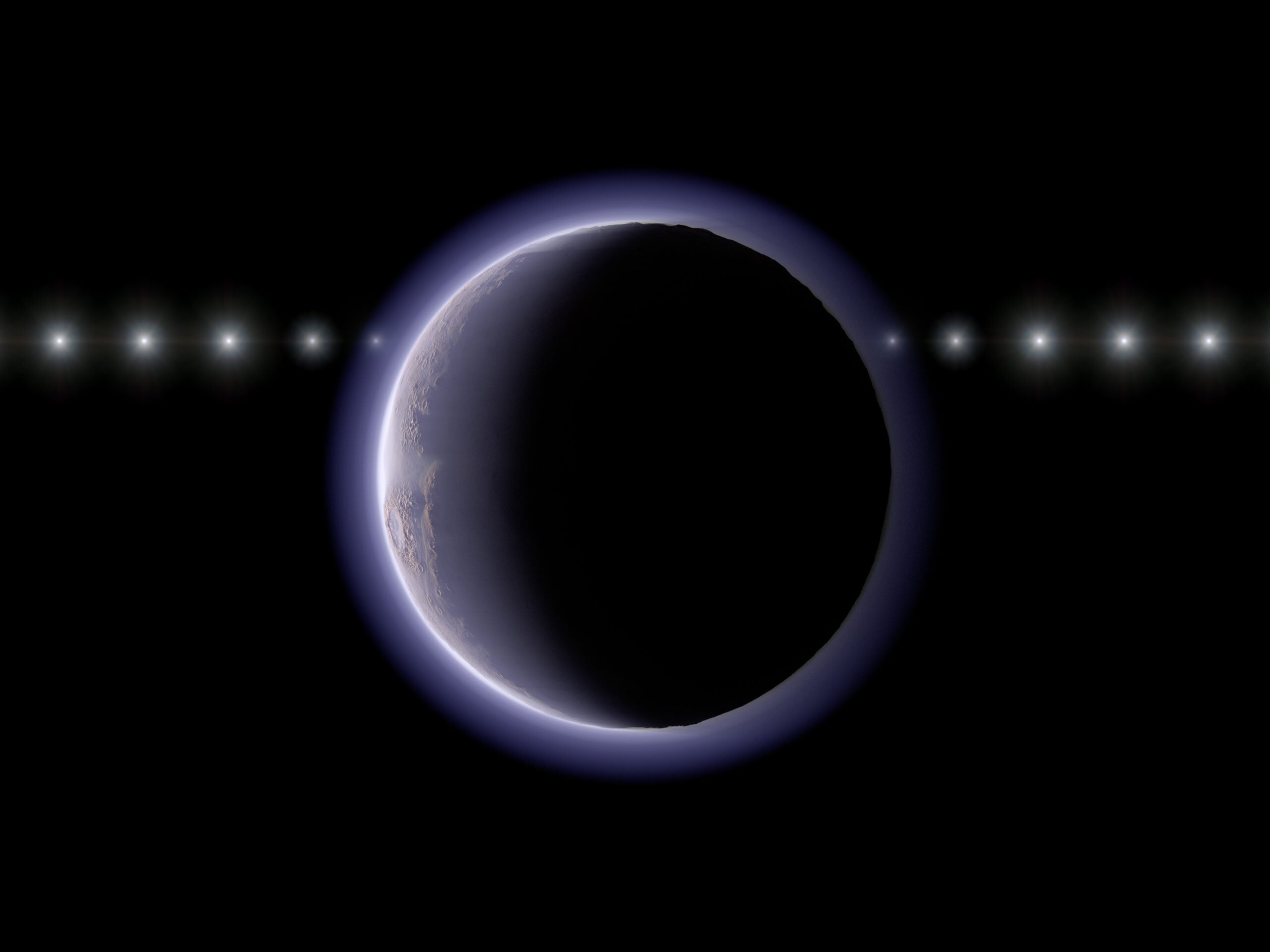
A body only about 500 kilometres wide, circling in the deep cold beyond Neptune, appears to possess an atmosphere. That sentence is difficult to reconcile with the world’s weak gravity, and the team that reported the result has not pretended otherwise.
The object is (612533) 2002 XV93. In a Nature Astronomy study published on 4 May 2026, Ko Arimatsu and colleagues described a brief dimming of a background star that is consistent with atmospheric refraction. Their models put the pressure at the surface between 100 and 200 nanobars.
That is vanishingly thin by terrestrial standards. Yet it is much more gas than researchers expected this little world to retain. Without replenishment, their calculations indicate that the atmosphere should escape in less than 1,000 years, barely an instant in the history of the Solar System.
The observation therefore presents two mysteries at once. Astronomers need to confirm that they have interpreted the starlight correctly, then explain why the gas happens to be there now.
A shadow that did not arrive sharply
No telescope resolved an atmospheric rim around 2002 XV93. The evidence came from a stellar occultation, an alignment in which a nearby Solar System body crosses in front of a much more distant star.
As seen from Japan on 10 January 2024, the orbit of 2002 XV93 carried it across one such star. Professional and amateur astronomers organised a campaign at Kyoto, Kiso Observatory and a site in Fukushima. The geometry turned the object’s moving shadow into a natural experiment.
If an airless solid body covers a point-like star, the measured light should fall abruptly once the edge arrives. An atmosphere changes that edge. Its varying density bends, or refracts, some of the starlight before the solid surface blocks the star, producing a more gradual transition.
Kyoto and Kiso recorded passages behind the main body. At Fukushima, where the telescope lay close to the projected shadow rather than squarely within it, the light curve showed a possible gradual drop without a clear solid-body occultation. Taken together, the profiles favoured a refracting layer around the object.
The National Astronomical Observatory of Japan’s account calls the data consistent with attenuation by an atmosphere. That careful formulation matters: this is a model-based inference from a fleeting event, not a photograph of gas.
What 100 to 200 nanobars actually means
A nanobar is one-billionth of a bar. Earth’s average sea-level pressure is close to one bar, so the proposed atmosphere of 2002 XV93 is about 5 million to 10 million times thinner than the air around us.
Even Pluto’s atmosphere, itself tenuous enough to behave very differently from Earth’s, is roughly 50 to 100 times denser. Pluto has an average surface pressure near 10 microbars. The new result is not turning 2002 XV93 into a miniature Earth or even a close physical copy of Pluto.
It would nevertheless be a global atmosphere held around the body, rather than a few molecules kicked briefly from the ground. If confirmed, 2002 XV93 would be the first trans-Neptunian object other than Pluto with a clearly detected atmosphere and the smallest known outer Solar System body to display one.
The occultation cannot yet identify the gas. The authors found that models dominated by methane, nitrogen or carbon monoxide could each reproduce the observed refraction. Those are plausible volatile molecules in this region, but choosing among them will require further observations.
A plutino much smaller than Pluto
2002 XV93 belongs to a dynamical group called the plutinos. Like Pluto, it is locked in a 2:3 orbital resonance with Neptune: it completes two circuits of the Sun during every three completed by Neptune. The resonance helps stabilise the orbit, but it says nothing about whether the body should have air.
Size is the harder issue. The measured radius is around 250 kilometres, while Pluto’s diameter is 2,377 kilometres. At the time of the occultation, 2002 XV93 was more than 5.5 billion kilometres from the Sun, farther away than Pluto and cold enough that volatile ices would ordinarily remain frozen.
The outer Solar System is full of selection effects. SpaceDaily’s recent examination of the distant dwarf-planet candidate 2017 OF201 showed how a world’s orbit can leave it beyond survey range for almost all of its journey. Atmospheres are hidden in a different way: the right body, background star, observing sites and fast cameras must line up during a shadow that lasts seconds.
Finding one case therefore cannot tell us whether it is unique. It does show that the assumption that all small trans-Neptunian objects are inert and airless now has an interesting exception to explain.
Why the gas cannot simply stay there
Atmospheric molecules are always moving. On a large world, gravity recaptures most of them. On a 500-kilometre object, the escape speed is low enough that a volatile atmosphere gradually leaks into space, even at the frigid temperatures beyond Neptune.
The study’s estimated survival time is under 1,000 years. That figure is model-dependent, but changing it by a modest factor would not remove the central problem. The Solar System is about 4.6 billion years old. A primordial atmosphere exposed at the surface could not plausibly have waited intact until the present.
Either the gas was produced recently, or a continuing process replaces it as it escapes. The timing is what makes the result more than a curious pressure measurement. We may have caught a temporary aftermath, or detected evidence that an apparently frozen minor planet remains active inside.
The obvious source is missing from the surface
Pluto offers a familiar mechanism. Sunlight warms nitrogen-rich surface ice and turns some of it directly into gas. As seasons and illumination change, gas can condense back onto colder terrain. The atmosphere and surface act as one exchanging volatile system.
That simple explanation does not fit 2002 XV93 comfortably. According to the research team, James Webb Space Telescope observations found no sign of frozen methane, nitrogen or carbon monoxide on its surface, the accessible reservoir from which a sublimation-supported atmosphere might arise.
A non-detection is not proof that every grain of volatile ice is absent. A deposit could be buried, confined to a small region or masked in a spectrum averaged over the unresolved body. But there is no observed broad surface reservoir that naturally accounts for the gas.
This leaves the atmosphere and its source separated. The occultation points to gas above the surface; the spectrum has not shown the corresponding ice on the surface. The two leading explanations move the missing reservoir either into the recent past or beneath the crust.
A collision could have made a temporary sky
One possibility is that a small icy object struck 2002 XV93 relatively recently. The collision could vaporise material from the projectile, excavate volatile-rich ice from below the surface, or do both. The released molecules would briefly form an atmosphere before escaping.
In an enormous belt of small bodies, impacts are unavoidable over long periods. Catching the resulting atmosphere during its sub-1,000-year lifetime would still require fortunate timing, but it would not require the object to sustain geological activity indefinitely.
This hypothesis makes a useful prediction. If the collision supplied a finite pulse of gas, later occultations should find the atmosphere weakening as that supply disperses. Its composition might also retain clues about material excavated or delivered by the impactor.
The obstacle is that no collision was observed, and the occultation alone cannot date one. An impact is a plausible mechanism, not an event reconstructed from direct evidence.
Cryovolcanism would make the world active today
The alternative is continuing release from the interior. Cryovolcanism is a broad term for cold-world activity in which volatile liquids, vapours or slurries move upward through fractures instead of molten rock erupting as it does on Earth.
For 2002 XV93, gas rising from buried layers could replace molecules lost to space. That would explain why the atmosphere is present now without demanding that astronomers happened to observe the brief aftermath of one collision.
It also creates a deeper question. A small body so far from the Sun should have lost much of its early heat. Radioactive decay, freezing in a buried volatile mixture or tidal effects in a binary can sometimes provide energy on other worlds, but no specific engine has yet been demonstrated here.
The researchers therefore offer cryovolcanism as a possible supply route, not a detected eruption. There are no resolved plumes, vents or fresh flows in the data. For now, the atmosphere is the only sign that something may have moved material upward.
One occultation is a beginning, not the verdict
Stellar occultations have an impressive record. They revealed Pluto’s atmosphere before New Horizons arrived, measured the shapes of distant worlds and exposed rings around bodies too small and far away to image directly. They are also brief and geometrically demanding.
The 2002 XV93 claim rests on one event and on fitting atmospheric models to a small number of light curves. Alan Stern, who led the New Horizons science team and was not involved in the study, told the Associated Press that the result needs independent verification. That is a proportionate response to an observation with large implications.
Another well-observed occultation could test whether a gradual refractive edge appears again and whether the inferred pressure is changing. Webb or another sensitive infrared observatory could search for atmospheric spectral features, although analysing such an extremely thin, distant envelope will be difficult.
The passage of time can help distinguish the origins. A measurable fade over the next several years would favour a finite impact-produced atmosphere. Persistence, replenishment or repeatable seasonal change would make continuing internal activity more credible.
A small world’s atmosphere becomes a clock
The most valuable part of this finding may be its instability. An ancient, unchanging atmosphere would tell us what a body can retain. An atmosphere that must be replaced within 1,000 years tells us that something happened recently enough to leave a trace, or is still happening now.
The authors’ preprint frames the result as evidence that at least some distant icy minor planets can host atmospheres temporarily. That does not mean every small world beyond Neptune has hidden weather. It means size alone may not determine the answer when impacts and interior activity can create short-lived exceptions.
2002 XV93 remains a dim point whose surface has never been mapped. Its atmosphere has not been sampled, its composition is unknown, and neither proposed source has been observed. The honest conclusion is narrower than the most dramatic version of the story, but no less interesting.
A tiny world appears to carry gas that should soon be gone. If later observations confirm it, that improbable veil will function as a clock, counting down from an event we have not identified or being rewound by a process we have not yet seen.