
One faint point of light cannot be turned into 200 discovered worlds. It can, however, expose how incomplete a survey must be.
That is the logic behind the population argument for 2017 OF201, a trans-Neptunian object announced in 2025. Its orbit is so stretched that observations comparable in depth to the survey in which it was found could detect it for only about 0.5 percent of a circuit. For the other 99.5 percent, it would be too far away and faint for those data.
Invert 0.5 percent and the intuitive answer is one in 200. If astronomers found one member of a broadly similar population during its brief visible interval, roughly 199 others might occupy the much longer invisible parts of their own orbits. That is a useful first estimate. It is not a literal count, and several assumptions sit between the arithmetic and the sky.
Why one orbit lasts nearly 24,000 years
The peer-reviewed discovery paper in The Astrophysical Journal Letters gives 2017 OF201 a semimajor axis of about 830 astronomical units. A semimajor axis describes the scale of an ellipse; it is halfway between the orbit’s nearest and farthest distances when measured through the Sun.
For an object orbiting the Sun, Kepler’s third law says that the period in Earth years is approximately the square root of the semimajor axis in astronomical units cubed. The square root of 830 cubed is about 23,900. That is why “nearly 24,000 years” and the often-used rounded figure of 25,000 years describe the same orbit.
The ellipse is extreme. The object’s perihelion, its closest point to the Sun, is about 45 astronomical units away, a little beyond Neptune and comparable to Pluto’s orbital region. Its aphelion is near 1,600 astronomical units. The object is currently around 90 astronomical units from the Sun and travelling outwards.
A single year on 2017 OF201 therefore spans longer than recorded human history many times over. No astronomer will watch even a meaningful fraction of one orbit. Its path has to be reconstructed from a short measured arc and the laws of orbital motion.
Detection range is not a wall in space
The 0.5-percent figure is a statement about a particular class of observations. It does not mean 2017 OF201 physically vanishes beyond a fixed distance. A more sensitive telescope, longer exposure, different sky background or improved search method could follow it farther.
The problem is reflected sunlight. Far from the Sun, the object receives less light per square metre. The reflected light then spreads out again on its journey back towards Earth. For a distant body observed near opposition, apparent brightness falls approximately with the fourth power of distance. Moving ten times farther away can make an otherwise unchanged object roughly 10,000 times fainter.
The authors modelled whether an object like 2017 OF201 would be detectable in imaging with the depth of the Dark Energy Camera Legacy Survey. Their result was about 0.5 percent of the orbital period. On a 23,900-year circuit, that corresponds to roughly 120 years near the detectable part of the orbit, although it should not be imagined as a perfectly sharp 120-year window.
Survey coverage, weather, image quality and the object’s position against background stars also matter. “Beyond detection range” is consequently shorthand for falling below the practical sensitivity of the data used in the search.
How one detection leads to roughly 200
Suppose a set of objects all have comparable sizes, reflectivities and orbits, and suppose their positions are randomly distributed around those orbits. If each is visible for one part in 200, a snapshot survey should expose roughly one member for every 200 that exist.
Finding one visible object then points towards a parent population on the order of 200. In statistical language, the expected number visible becomes about one. Even then, randomness is substantial. A population expected to place one object in the visible window has about a 63-percent chance of placing at least one there under a simple Poisson model, not a guarantee.
The reverse inference is broader still. One detection is compatible with a range of underlying populations. Astronomers must account for the area of sky examined, the probability that the software recovers a real moving point, and the distribution of orbital orientations. A survey that covered only part of the relevant sky could imply more objects than the one-in-200 orbital argument alone.
Differences within the population pull in other directions. A brighter surface makes an object easier to detect; a darker one makes it harder. Smaller bodies drop below the limit sooner. Orbits with different perihelia have different visibility windows. The paper’s claim is therefore that the discovery suggests hundreds of objects with similar properties, not that exactly 200 twins have been established.
“Similar worlds” is doing important work
2017 OF201 is called a dwarf-planet candidate because its estimated size may be large enough for gravity to have pulled it into a rounded shape. The estimate is about 700 kilometres across, derived from its brightness while assuming an albedo, or reflectivity, of 0.13.
That diameter is not a direct measurement. A small bright body and a larger dark body can return similar amounts of light. Thermal observations, a resolved shape or other follow-up measurements would narrow the answer.
The International Astronomical Union’s formal definition requires a dwarf planet to orbit the Sun, not be a satellite, not have cleared its orbital neighbourhood, and have enough self-gravity to become nearly round. The final condition is the difficult one to establish for a point of light around 90 astronomical units away.
This is why “candidate” is not timidity. It marks a real observational gap. The inferred companions would be similar large, wide-orbit trans-Neptunian objects, not automatically 200 officially recognised dwarf planets. Pluto, resolved up close by New Horizons, belongs to a much more securely characterised category than 2017 OF201 does today.
The discovery itself ran backwards through an archive
The provisional designation can also mislead. “2017” identifies the half-month and year attached to the observation on which the designation was based. The extreme orbit was recognised and announced in 2025.
Sihao Cheng, Jiaxuan Li and Eritas Yang searched archival Dark Energy Camera Legacy Survey images with software designed to connect sparse detections separated by months or years. After locating the candidate, they recovered appearances in other archives. The final orbital solution uses 24 observations spanning 20 years, from 2004 to 2025.
That long baseline is disproportionately valuable. At such a distance, a body moves slowly across the star field. A short arc can be fitted by several somewhat different orbits. Watching the apparent motion and parallax change over decades gives far more leverage on its distance and radial motion.
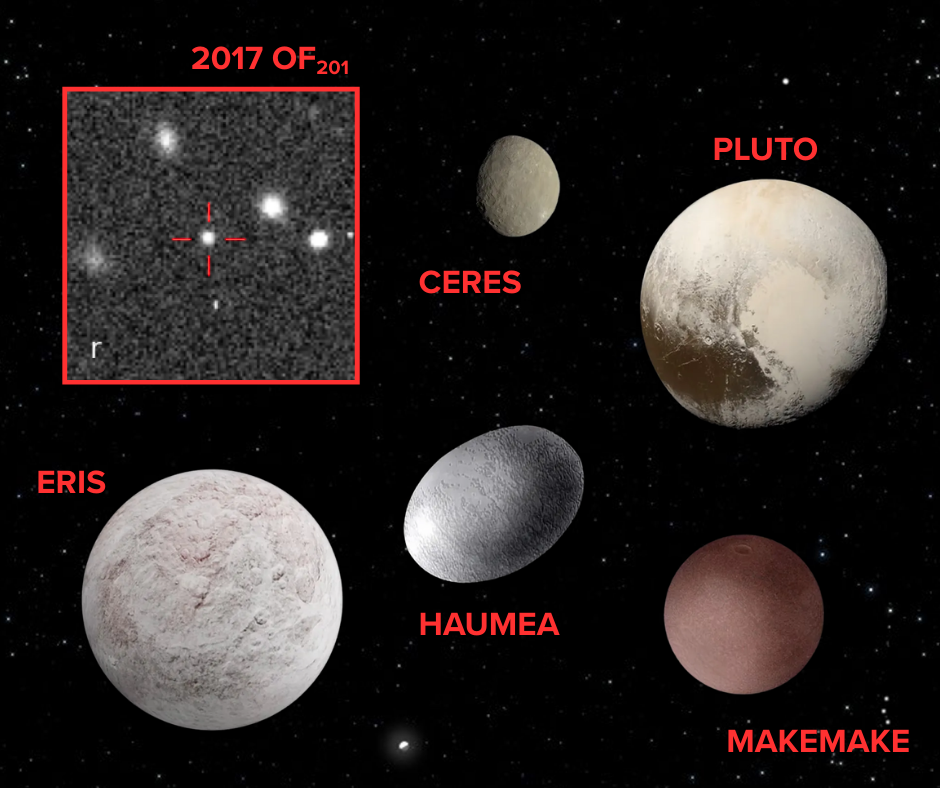
The Minor Planet Center’s 2025 announcement established the provisional identity, while the later peer-reviewed analysis refined the orbit. The Institute for Advanced Study’s original account also supplied the comparative image used with this article.
A hidden population could carry significant mass
The study goes beyond a head count. If a broad population of large objects shares the same region, the authors estimate that its combined mass could approach one percent of Earth’s mass, a significant addition to the known scattering disk.
That estimate inherits the uncertainties in the population calculation. It depends on the assumed sizes, densities, reflectivities and orbital distribution of bodies that have not been seen. It should not be read as a measured reservoir sitting on a scale.
Still, the order of magnitude is revealing. Two hundred roughly 700-kilometre icy bodies can contain far more material than the phrase “faint points” suggests. There may also be a much larger number of smaller objects that fall below current limits even near their closest approach.
It also complicates the Planet Nine argument
Some previously known extreme trans-Neptunian objects appear to have their elongated orbits aligned in a similar direction. That pattern has been interpreted as a possible gravitational signature of an undiscovered massive planet.
2017 OF201 does not share that alignment. In the paper’s simulations, its orbit remains stable for billions of years under the known giant planets and the Galactic tide. A particular proposed Planet Nine configuration destabilises it on a much shorter timescale.
That is a constraint on a model, not a clean disproof of every possible distant planet. The inferred hidden population matters here too. If severe selection effects have left most extreme objects unseen, the apparent clustering could change as the sample grows.
What finding one really means
Space Daily’s earlier report traced the discovery and its updated orbital record. The narrow point behind the new headline is the selection effect: almost the entire orbit lies outside the reach of the survey that found the object.
The number 200 is the inverse of that visibility fraction. It is a clean way to express the intuition, but not a catalogue, lower bound or promise of 199 exact copies. The peer-reviewed conclusion is deliberately broader: hundreds of bodies with similar wide orbits and large sizes may exist.
What changed with 2017 OF201 was not simply the known object count. Astronomers gained a worked example of how strongly an outer-solar-system census favours bodies caught near perihelion. Finding one during a 0.5-percent window makes an empty-looking sky less persuasive. Most of the population, if it exists, is not absent. It is merely spending almost all of its time too far away for the observations that revealed its first visible member.