

The opening storm in The Martian does exactly what a film storm should. It bends an antenna, hurls debris across the surface and forces a crew to flee. The plot needs the air to move with terrestrial violence.
Mars can produce winds around 60 miles per hour. Yet speed is only half the story. Near the ground, the Martian atmosphere contains roughly one percent as much gas per unit volume as Earth’s air at sea level. Far fewer molecules are available to strike a person, vehicle or antenna.
Once that density is included, the cinematic exaggeration becomes measurable. A 60 mph gust in representative Martian air produces about the same aerodynamic push as a gentle breeze of roughly 6 to 8 mph on Earth.
The qualifier matters. This is a comparison of wind loading, not temperature, sound, dust exposure or what unprotected skin would feel. An astronaut would be inside a pressure suit, and the precise force would depend on local air density, body position and the shape of the suit.
Wind speed is not the same thing as wind force
Terrestrial weather reports train us to treat speed as a shorthand for severity. A 60 mph gust on Earth can damage trees, roofs and power lines because it brings a dense stream of air molecules with it.
That shorthand works tolerably well when comparisons stay near Earth’s surface. Air density varies with elevation, temperature and weather, but not usually by two orders of magnitude between neighbouring forecasts. Moving the same number to Mars breaks the shortcut.
The relevant quantity is dynamic pressure. In its simplest form, it is written as q = ½ρv², where ρ is the density of the gas and v is the wind speed relative to the object. The aerodynamic force also depends on the object’s frontal area and drag coefficient.
Speed is squared, so doubling the wind speed quadruples its dynamic pressure. Density enters directly. Reduce density to one hundredth while keeping speed unchanged and the pressure falls to roughly one hundredth.
Sixty miles per hour becomes about 6.8
A worked example from Purdue University uses a Martian density of 0.016 kilograms per cubic metre and an Earth density of 1.23 kilograms per cubic metre. For a 60 mph wind, or 26.8 metres per second, the calculated drag on a representative human shape is about 4.8 newtons, just over one pound-force.
To find the Earth wind that produces the same loading, set the two dynamic pressures equal. The equivalent speed is the Martian speed multiplied by the square root of the density ratio. With those numbers, the answer is 3.1 metres per second, or 6.8 mph.
A simpler estimate starts with NASA’s statement that Mars’s atmosphere is about one percent as dense as Earth’s. The square root of one percent is one tenth, so 60 mph becomes 6 mph. If the local density is closer to 1.5 or 2 percent of Earth’s value, the equivalent rises towards 7 or 8 mph.
There is therefore no single planet-wide conversion. Mars has topography, seasons and large temperature swings. Its density changes between deep basins, high ground, winter and summer. “About 6 to 8 mph” captures the scale without pretending the atmosphere is uniform.
Pressure and density are related, but not identical
NASA gives typical Martian surface pressure as 6 to 10 millibars. Earth’s sea-level pressure is about 1,013 millibars. This is the origin of the familiar description that Mars has an atmosphere roughly one hundred times thinner.
Static pressure is the weight of the atmosphere pressing on a surface. Density is the mass of gas in a given volume. The two are linked through temperature and gas composition, but they are not the same measurement.
Mars’s atmosphere is mostly carbon dioxide, whose molecules are heavier than the nitrogen and oxygen molecules dominating Earth’s air. Its colder temperature also affects density. Those details are why a pressure ratio cannot always be copied directly into a drag calculation.
For the mechanical push of wind, density is the quantity that enters dynamic pressure. At representative surface conditions, both routes tell the same broad story: Mars has only about one hundredth to a few hundredths of Earth’s near-surface atmospheric density.
What an astronaut would actually notice
The breeze comparison is often phrased as how a Martian wind would “feel.” That word is convenient but incomplete. Mars’s surface environment would be fatal without protection, so no astronaut would experience the wind directly on bare skin.
A suit presents its own shape to the flow. A person facing the wind offers a different area from someone turned sideways or crouching. Backpack, tools, loose covers and fabric joints change the drag coefficient. A broad solar panel can receive more total force than a human because it presents a much larger area.
Force is not the only sensation either. Thin carbon-dioxide gas carries heat differently, transmits sound differently and entrains dust. A 6.8 mph Earth breeze is an analogy for the aerodynamic push on a comparable shape, not a complete recreation of standing in Martian weather.
The arithmetic nevertheless resolves the cinematic question. NASA notes that the strongest Martian storm winds reach roughly 60 mph, but says even large storms are unlikely to tip people or tear apart major equipment in the way the film requires.
Weak wind loading does not make dust harmless
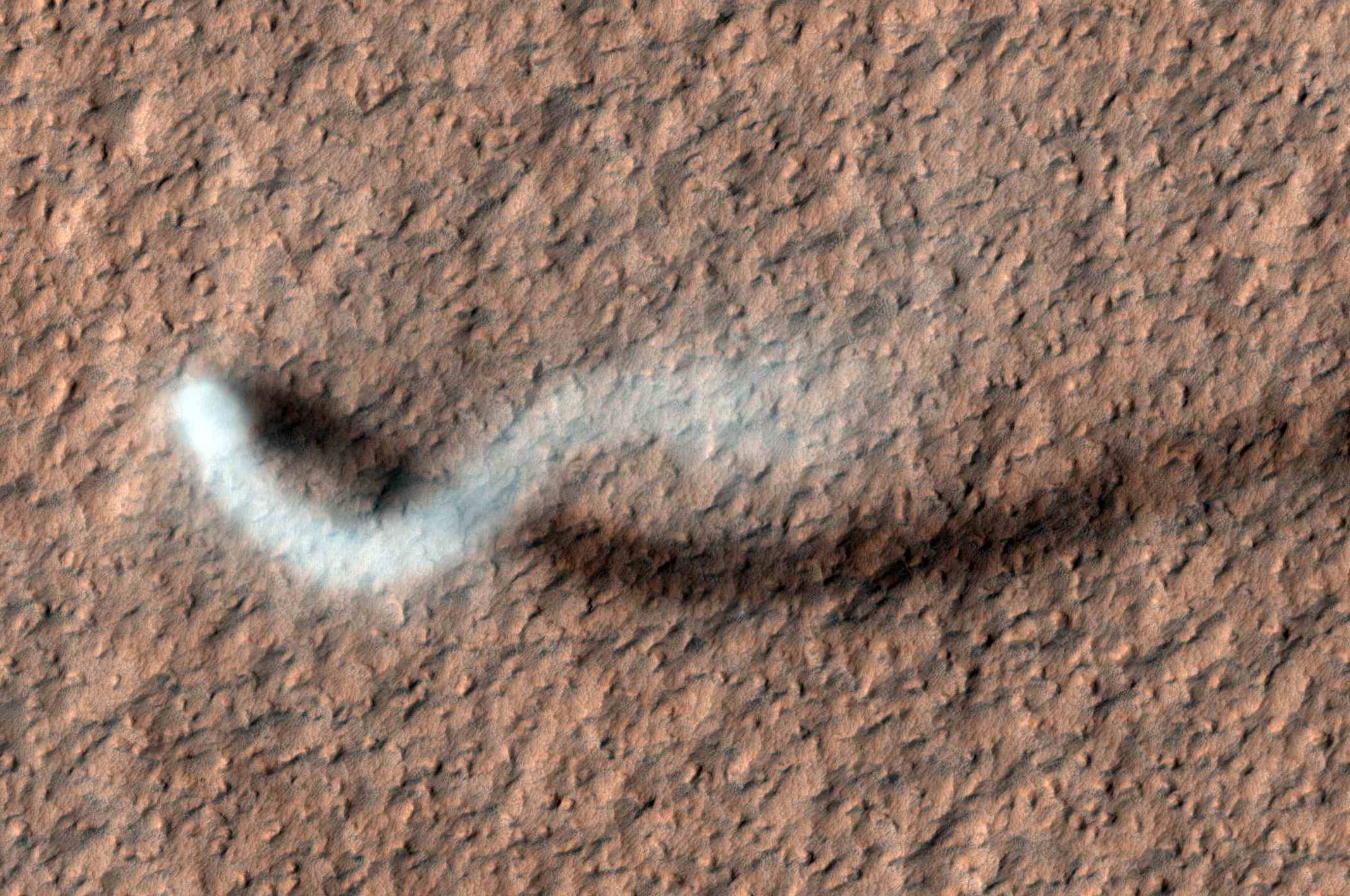
Mars clearly moves dust. Spacecraft have photographed active dust devils, shifting ripples, dark wind streaks and storms spanning continents. The feature image above shows a plume reaching more than 800 metres above Amazonis Planitia.
The apparent paradox begins at the surface. Starting a sand grain moving on Mars can require a relatively fast gust because the air is so thin. Once grains begin hopping, collisions can knock smaller particles loose. Mars’s lower gravity and lack of rain then help fine dust remain aloft.
Dust also changes the weather that carries it. It absorbs sunlight and warms the surrounding atmosphere, strengthening temperature differences and circulation. NASA’s Earth Observatory describes this feedback as one reason a Martian storm can feed itself after dust becomes airborne.
None of this requires hurricane-like force against an astronaut. A cloud can spread across a planet because atmospheric circulation transports tiny particles over time. Geographic scale and local wind pressure measure different things.
The real mission danger is often darkness
Martian dust is fine, slightly electrostatic and persistent. It can coat optics and solar panels, work into moving parts, reduce visibility and alter how machinery sheds heat. Future crews will have reasons to respect it even if it cannot blow them off their feet.
The sharpest historical example is Opportunity. As SpaceDaily previously recounted, the rover travelled more than 45 kilometres after arriving with a 90-sol design life, but a planet-encircling storm finally cut sunlight to its solar panels in 2018. The air did not sweep the rover away. The sky went dark enough for its energy supply to collapse.
Global storms can persist for weeks or months, blocking a substantial fraction of incoming sunlight. Solar-powered equipment may have to curtail work, preserve battery charge or enter survival modes. Nuclear-powered systems avoid the immediate solar problem but still face dust on mechanisms, seals and instruments.
For a human base, the large pressure difference between a habitat’s interior and the Martian atmosphere would be a much greater structural load than ordinary wind. Engineers would also plan around cold, radiation, abrasive dust and the reliability of life-support equipment.
Ingenuity demonstrates both sides of the physics
If Martian air pushes so weakly, a helicopter should struggle to fly. Ingenuity did. Its achievement was not evidence that the atmosphere is substantial; it was evidence that careful engineering could extract lift from very little gas.
The helicopter used two counter-rotating rotors spanning about 1.2 metres and spun them far faster than a conventional helicopter on Earth. It was extremely light, and its blades had to move a large volume of thin air downwards to generate enough upward force.
A helicopter and a standing astronaut obey the same underlying rule. Aerodynamic force depends on how much air is intercepted and how quickly its momentum changes. Ingenuity compensated with large, fast rotors. A human-sized body standing in a 60 mph gust has no equivalent multiplier.
The wind still matters for flight operations. Changes in density alter rotor performance, and blowing dust can obscure navigation features or signal worsening weather. Weak loading on a person does not mean an aircraft can ignore the atmosphere.
Hollywood preserved the storm and replaced its weight
The fiction did not invent Martian weather. Mars genuinely has gusts near the quoted speed, towering dust devils, regional storms and occasional events that veil almost the entire planet.
The exaggeration was subtler: the scene treated Martian wind speed as though the moving gas had something close to Earth’s density. It kept the 60 mph number and quietly gave every cubic metre of air perhaps one hundred times more mass.
Put the real density back into the equation and most of the mechanical violence disappears. A representative calculation gives about 4.8 newtons of drag on a person, comparable to a light terrestrial breeze rather than a storm capable of throwing heavy equipment.
Mars remains hostile. Dust can darken the sky, disable solar power, foul machinery and transform the climate around it. But in the specific matter of pushing an astronaut, even a fast Martian storm has a surprisingly light hand.