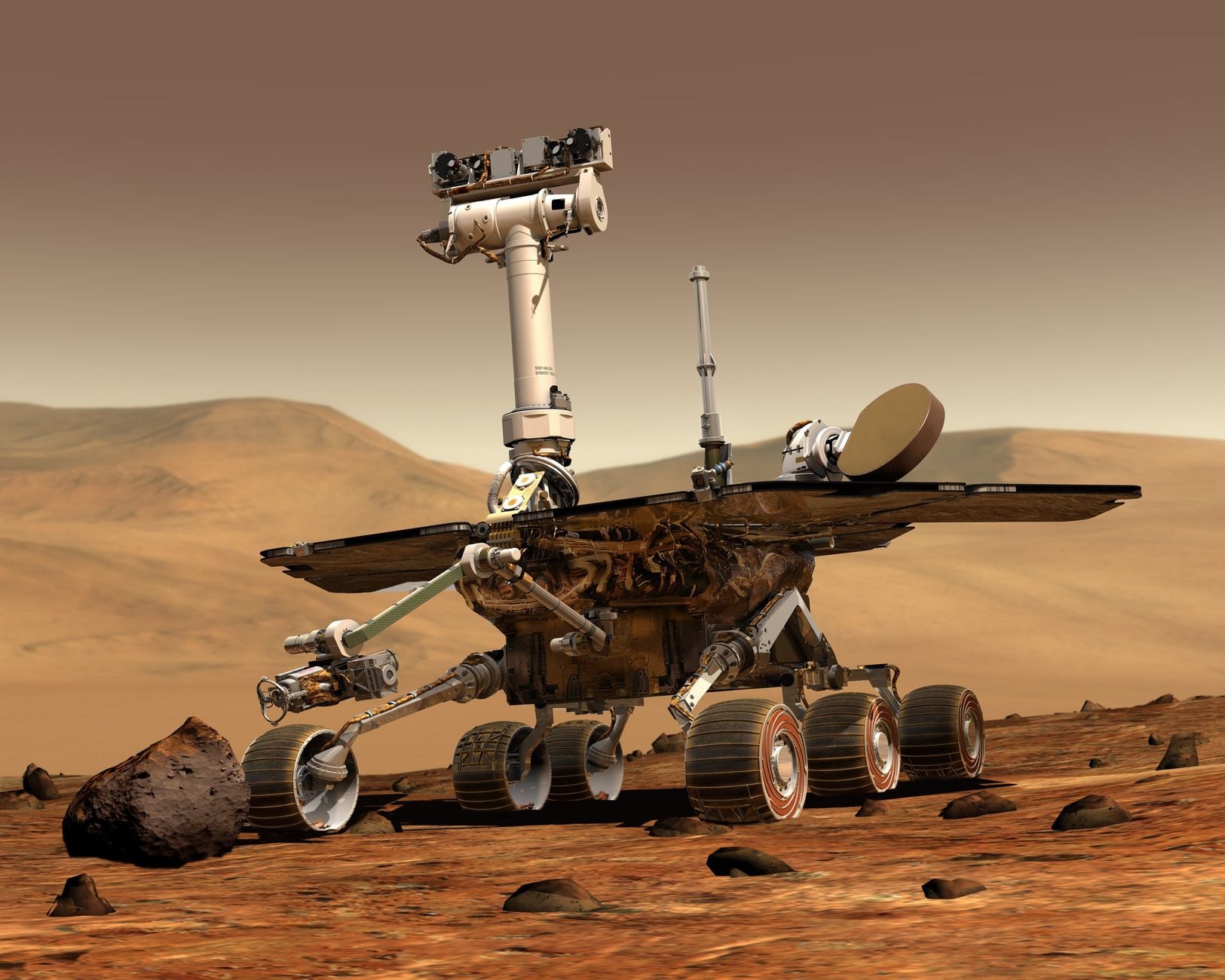
Opportunity reached Mars with a requirement to survive 90 Martian days and drive at least 600 metres. When it finally stopped speaking, it had worked for more than 14 years and its odometer read 45.16 kilometres.
Those numbers make the rover sound almost indestructible. It was not. Opportunity repeatedly survived because its hardware retained enough margin, Martian winds sometimes cleaned its solar panels, and engineers on Earth learnt how to operate an ageing machine around each new weakness.
The end came in June 2018, while Opportunity was descending Perseverance Valley on the western rim of Endeavour crater. A dust storm expanded around Mars, turning the daylight above the solar-powered rover into a dim reddish haze. Its final telemetry showed energy collapsing as the atmosphere grew darker.
That is the real event behind the famous line, “My battery is low and it’s getting dark.” Opportunity never transmitted those English words. They were a human translation of what the measurements appeared to say.
Ninety sols was a requirement, not an expiry date
Opportunity landed at Meridiani Planum on 24 January 2004, three weeks after its twin, Spirit, reached the other side of Mars. Their primary job was to examine rocks and soils for evidence that liquid water had once shaped the planet.
The prime mission was specified in sols, the Martian day of 24 hours and about 39 minutes. NASA expected each rover to operate for at least 90 sols and explore at least 600 metres from its landing site. A pre-mission NASA record of decision gave 600 metres as the minimum and one kilometre as the goal.
Later NASA summaries sometimes use the one-kilometre figure when describing what Opportunity was designed to travel. Both figures belong to the original plan, but they describe different thresholds.
The 90-sol figure did not mean parts were programmed to fail on the next morning. It set the period for which the mission had to meet its requirements and for which operations were initially planned and funded. Engineers still designed flight hardware with margins. If the rover remained healthy and continued returning useful science, NASA could approve extensions.
Opportunity completed its primary mission in April 2004. Almost everything remembered about the rover came afterwards.
Survival became a series of engineering workarounds
Mars did not preserve Opportunity in perfect condition. The rover accumulated faults, wore components and sometimes came close to being lost.
Its right-front wheel began drawing more current than the other wheels, so controllers often drove the rover backwards to reduce the strain. In 2005, all six wheels dug into a soft sand ripple later named Purgatory Dune. The team spent weeks testing escape manoeuvres with a rover on simulated Martian soil at JPL before gradually freeing Opportunity.
Dust settling on the solar arrays steadily reduced their output. Unexpected gusts periodically swept some of that coating away, restoring power and extending the mission. The rover also survived a severe dust storm in 2007 by suspending most activity and conserving enough battery energy to wait for clearer skies.
A JPL review of Opportunity’s endurance describes these episodes not as passive luck but as a continuing partnership between robust machinery and changing operating methods. The team planned drives around wheel currents, slopes, winter sunlight and the shrinking abilities of the rover.
This is a similar kind of engineering story to the one I explored in my article about the small plutonium supply keeping Voyager alive. Long missions do not remain unchanged. They continue because engineers keep finding useful work inside a declining power budget.
Forty-five kilometres opened a larger history of water
The distance mattered because Opportunity was a field geologist. A stationary lander can examine one patch in great detail. A rover can compare different rock layers, craters and ancient environments.
Soon after landing, Opportunity found sedimentary rocks and small iron-rich spheres nicknamed “blueberries”. The chemistry and structure of the rocks showed that liquid water had once been present, although some of those early conditions were acidic and salty.
Years later, at Endeavour crater, the rover encountered gypsum veins formed by water moving through fractures. It also examined clay-bearing rocks associated with water closer to a neutral pH. Mars had not possessed one simple watery past. Opportunity’s traverse sampled environments that differed in chemistry and geological setting.
NASA’s 20-year retrospective on Spirit and Opportunity credits the twin missions with demonstrating that early Mars had been wet and with laying practical foundations for Curiosity and Perseverance.
That record connects directly with a question I considered in my article on whether surviving Martian life could have retreated underground. Opportunity could establish that surface water once existed and that some environments were more habitable than others. It could not determine whether life began there, much less reach the deep refuges where traces might persist.
The 2018 storm removed almost all usable daylight
NASA’s Mars Reconnaissance Orbiter detected the developing storm on 30 May 2018. Within days it spread across a large portion of the planet and enveloped Opportunity’s position in Perseverance Valley.
For a solar rover, atmospheric dust is not merely bad visibility. It stands between the Sun and the power source. Engineers describe that opacity using a value called tau. A low tau means a comparatively clear sky. A high one means very little direct sunlight reaches the surface.
On 10 June, the last day Opportunity communicated, the opacity was measured at roughly 10.5 to 10.8, depending on the NASA account and calibration used. The previous major storm in 2007 had peaked around 5.5 above Opportunity.
A NASA graphic titled “On Mars, Light Is Energy” records only 21 watt-hours available on the final sol, the lowest Opportunity had measured. Before the 2007 storm, its solar panels had commonly produced hundreds of watt-hours per day.
Opportunity was expected to enter a low-power fault mode, shutting down almost everything except a mission clock and periodically checking whether the batteries had recovered. Dust storms can warm the Martian air by absorbing sunlight, so cold was not initially the only concern. The decisive uncertainty was whether the rover could wake after a prolonged discharge, keep time and establish communications once the sky cleared.
It never did.
The famous last sentence was never transmitted
Opportunity’s final communication arrived on 10 June 2018, the rover’s 5,111th sol on Mars. It consisted of engineering data and images, not a farewell written in natural language.
One of the final products was a dark, incomplete frame from the panoramic camera. The camera had looked towards the Sun through the storm, but almost no sunlight was visible. The transmission ended before the full image arrived, leaving part of the frame missing. NASA now presents it as Opportunity’s last message.
The line “My battery is low and it’s getting dark” came later from science reporter Jacob Margolis, who described it as a plain-language rendering of the last data. It spread because it compressed the rover’s condition into a sentence that sounded like a final thought. The underlying facts were real: critically low energy and a sky of unprecedented opacity. The rover did not compose the words.
That distinction does not make the ending less affecting. Opportunity had been operated by people for more than a decade. It carried no consciousness, but its daily condition had become legible to the team through voltages, temperatures, wheel currents, images and radio signals. Translating telemetry into an emotional sentence was an act performed by humans who understood what the numbers meant.
The mission ended eight months after the signal
Silence in June did not immediately end the mission. Engineers waited for the atmosphere to clear, listened through the Deep Space Network and transmitted commands intended to address several possible faults. They considered failed radios, a disrupted onboard clock and a rover whose solar panels might remain buried under dust.
More than a thousand commands were sent without a reply. On 13 February 2019, NASA declared the mission complete. A JPL account of the final recovery campaign places Opportunity’s last resting point on the western limb of Perseverance Valley.
Opportunity’s legacy is visible in every later Mars rover that plans a drive, chooses a rock target or relays data through an orbiter. It also reaches smaller machines. In my article about Ingenuity’s flights on Mars and the much larger Dragonfly mission to Titan, the link between generations was autonomy: each mission extends the distance a robotic field scientist can explore without constant direct control.
The numbers remain the cleanest measure of Opportunity’s achievement. A 90-sol mission became 5,111 sols of communication. A 600-metre requirement became 45.16 kilometres. The final data did not speak in a human voice, but it recorded with unusual clarity the physical limit that had finally been reached: the sunlight was disappearing faster than the rover could turn it into life.