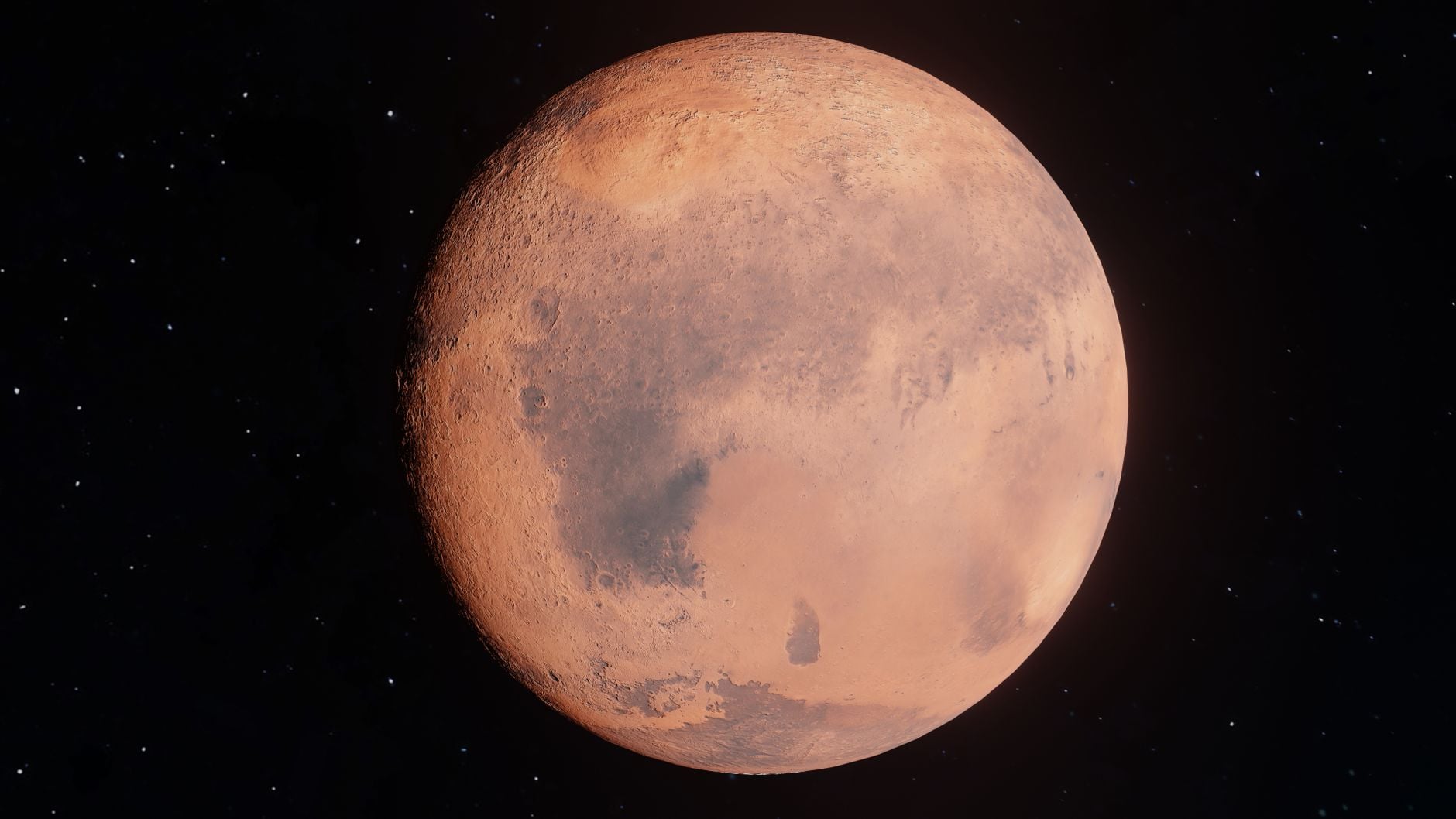
Mars has a life-search problem built into its geology. The material we can reach most easily sits in the part of the planet least suited to preserving, let alone sustaining, an organism.
The modern surface is cold, dry and chemically oxidising. Mars’s atmosphere is about one per cent as dense as Earth’s, liquid water is generally unstable in the open, and the planet has no global magnetic field to deflect charged particles from the Sun. Ultraviolet light and energetic particles reach the ground with far less shielding than they receive on Earth.
Ancient Mars was different. River valleys, lake deposits and water-formed minerals record long periods when liquid water moved across the surface. In 2025, NASA’s MAVEN mission directly observed atmospheric sputtering at Mars, a process in which incoming particles help knock atoms out of the upper atmosphere. Over geological time, atmospheric loss contributed to the planet’s transition from a wetter world to the thin-aired desert we see now.
If microbial life ever appeared during the earlier period, moving underground would have offered protection as conditions deteriorated above.
A June 2026 review in Astrobiology, led by Devan Nisson, brings together the laboratory work, Earth analogues and Mars observations behind that possibility. I found the most useful part of the review to be the way it turns “underground” into a series of very different environments. Ten centimetres, two metres and ten kilometres do not answer the same question.
This is a review of possible habitats and metabolisms. It is not evidence that life exists, or ever existed, below Mars.
There is no single safe depth
Getting below the surface immediately removes direct ultraviolet exposure and some of the most reactive surface chemistry. Galactic cosmic rays are harder to escape. Their high-energy particles can penetrate rock and soil to depths of metres, damaging cells and gradually altering organic molecules that might once have recorded biology.
Alexander Pavlov and colleagues tested that problem for a 2022 paper in Astrobiology. They exposed amino acids mixed with Mars-like silicates, hydrated minerals and perchlorate salts to gamma radiation at low temperatures. In their model, some simple amino acids in the upper 10 centimetres could be destroyed in about 20 million years. That is a short interval when the traces being sought may be more than three billion years old.
The authors described the top two metres as a difficult place to search for ancient amino acids. They did not establish a universal two-metre sterilisation line. Preservation depends on the molecule, mineral, temperature, ice content and length of exposure.
A 2025 follow-up study from Pavlov’s group illustrates the difference. Amino acids embedded in Mars-like water ice survived simulated cosmic-ray exposure far longer than amino acids in rocky material, with estimated survival beyond 50 million years. That makes young, ice-rich deposits interesting targets for recent biosignatures, but 50 million years still does not bridge the full distance back to early Mars.
Depth is therefore not just a shield setting. It changes what we might reasonably expect to find.
Rock and water could provide energy without sunlight
The surface life we know best depends directly or indirectly on sunlight. Earth’s deep biosphere shows that this is not the only arrangement available to microbes.
Organisms have been found in fractures and groundwater far below Earth’s surface, where photosynthesis contributes little or nothing. Some obtain energy from chemical differences created when water reacts with rock. Others use molecular hydrogen generated by radiolysis, the splitting of water molecules by radiation from naturally occurring radioactive elements in the surrounding crust.
That gives radiation a less obvious role. Near the Martian surface, incoming radiation destroys organic material. Deeper down, radiation released inside rocks could help produce chemical fuel.
Jesse Tarnas and colleagues examined Martian meteorite compositions for a 2021 Astrobiology study. Their calculations suggested that, if groundwater is present, radioactive elements in Martian rock could split water and generate enough hydrogen and complementary oxidants to support the kinds of sulphate-reducing microorganisms found in Earth’s deep crust.
The condition in that sentence matters: groundwater has to be there. The study showed that an energy pathway is chemically plausible. It did not locate an aquifer or a microbial community on Mars.
The strongest water clues are far below any drill
NASA’s InSight lander never sampled deep water, but the marsquakes it recorded allowed researchers to infer properties of the crust. In a 2024 Proceedings of the National Academy of Sciences paper, Vashan Wright and colleagues reported that seismic velocities and gravity near the landing site were consistent with fractured igneous rock containing liquid water at depths of roughly 11.5 to 20 kilometres.
“Consistent with” is doing necessary work here. The result came from rock-physics models and a Bayesian inversion of geophysical data, not a sample of water. It covers the region below one landing site, and other analyses of InSight data have favoured a largely dry crust. Treating it as the discovery of a planet-wide underground ocean would run ahead of the measurement.
A separate 2025 study in Astrobiology combined maps of buried ice and radioactive elements with a model of Mars’s underground temperature. The authors identified a possible habitat between 4.3 and 8.8 kilometres beneath southern Acidalia Planitia where conditions might suit microbes resembling two families of Earth methanogens.
Again, this was a model. It assumed several poorly constrained ingredients, including accessible water and carbon, and it used terrestrial organisms as analogues for hypothetical Martian biology. Its value is in identifying a place and depth that future measurements can challenge.
Our deepest samples came from centimetres down
The distance between those proposed habitats and our sampling record is hard to ignore. ESA places the deepest material explored for organic molecules on Mars at roughly 15 centimetres, collected by the Viking landers in the 1970s. NASA’s rock-drilling rovers have reached about seven centimetres.
Ground-penetrating radar can reveal buried layers, and seismology can constrain the physical properties of the crust. Neither method can place a cell, a metabolism or a biological molecule in a sample tube.
The next substantial step is ESA’s Rosalind Franklin rover. The ExoMars mission is targeting a 2028 launch, followed by a planned landing in 2030. Its drill is designed to collect samples from as deep as two metres, where ancient organic material should be better protected from surface radiation and temperature swings.
Two metres would be much deeper than any previous direct sampling on Mars. It would still be thousands of times shallower than the kilometre-scale environments proposed for active groundwater and present-day metabolism.
A preserved trace and a living cell are different targets
I kept coming back to this distinction while reading the research. A mission looking for ancient life wants old organic matter or mineral patterns that survived burial. A mission looking for living organisms needs to reach a place where liquid water, usable energy and tolerable chemistry exist together now.
The first target may be accessible at metre scale in the right clay or ice. The second could require drilling kilometres into an environment whose location is still uncertain. It would also demand tight contamination controls, because a deep sample containing a few cells would be easy to confuse with microbes carried from Earth.
For now, the Martian subsurface remains a plausible habitat without a confirmed inhabitant. Rosalind Franklin should tell us much more about the protected shallow layers. The deeper groundwater question will remain indirect until a future mission can sample rock or fluid at the depths where the models place it.