

For more than a quarter of a century, Type Ia supernovae have been among the most important distance markers in cosmology. Their measured brightness helped reveal that the expansion of the universe is accelerating, a discovery now usually explained by dark energy.
But these explosions are not perfectly identical. Astronomers standardize them by correcting for properties such as the shape and colour of their light curves, as well as characteristics of the galaxies in which they occur. If an unrecognized property changes systematically across cosmic time, it could distort the distances inferred from supernova brightness and, in turn, the history of cosmic expansion.
That possibility is now at the centre of an unusually direct scientific argument. A Yonsei University-led team reported in November 2025 that the ages of Type Ia supernova progenitors create a strong bias that existing analyses do not adequately remove. After applying its correction, the team found that combined supernova, baryon acoustic oscillation and cosmic microwave background data favoured rapidly evolving dark energy and a universe that may already have stopped accelerating.
A large international group led by the University of Southampton challenged that result in June 2026. It argued that the apparent age effect was either negligible or largely absorbed by corrections already used in modern supernova cosmology. On 27 August, the Yonsei researchers published a peer-reviewed counter-response maintaining that the Southampton analysis had flattened the age signal through its methodological choices.
The exchange has not established that the universe is decelerating. Nor has it reduced the dispute to a simple error that everyone now accepts. It has identified a narrower and testable question: after Type Ia supernovae are standardized, does the age of the exploding stellar system leave a residual brightness trend large enough to change cosmological conclusions?
Why the age of a supernova might matter
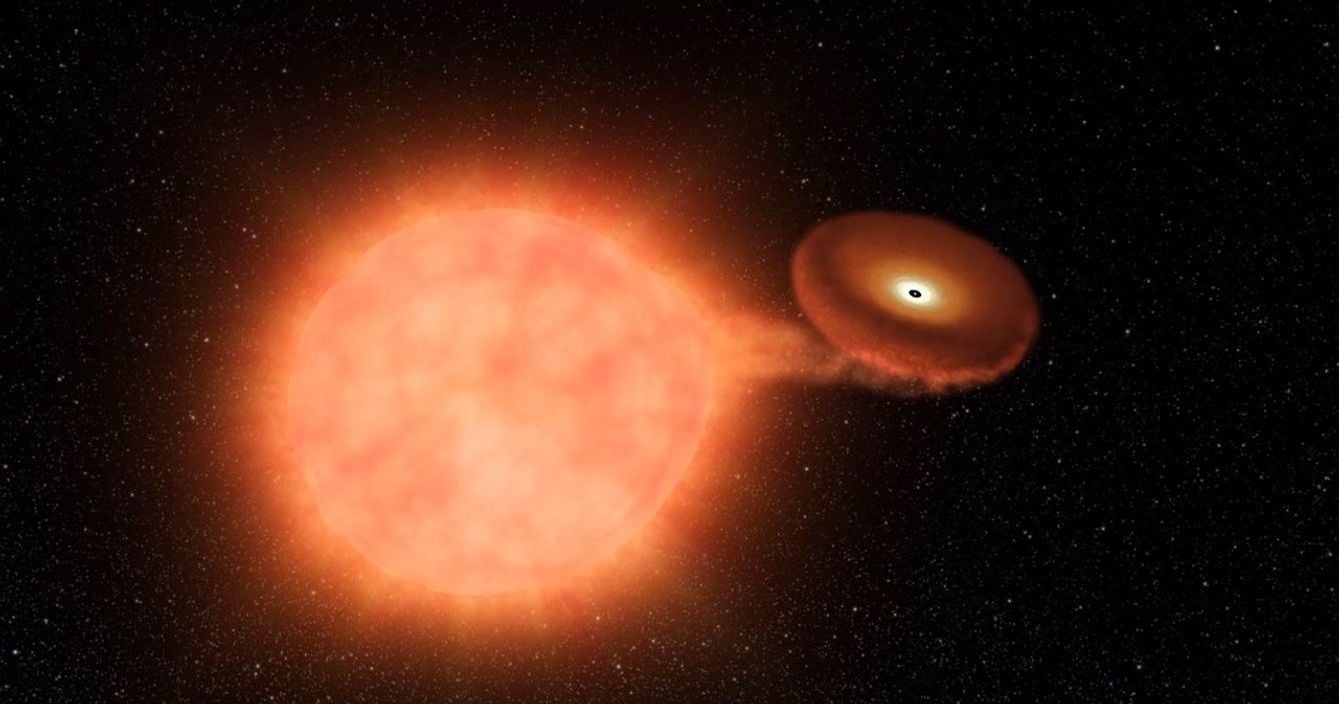
A Type Ia supernova occurs when a white dwarf in a binary system undergoes a thermonuclear explosion. These events reach similar peak luminosities, and empirical corrections make them sufficiently consistent to serve as “standardizable candles.” Astronomers compare how bright an event appears with its standardized luminosity to estimate its distance.
The remaining difference between a supernova’s standardized brightness and the brightness expected from a cosmological model is called a Hubble residual. If those residuals correlate with a property that also evolves with redshift, distant and nearby supernova samples may not be directly comparable.
In their November 2025 paper in Monthly Notices of the Royal Astronomical Society, Junhyuk Son and colleagues argued that standardized supernova magnitude has a significant relationship with progenitor age. They adopted an age-brightness slope of about 0.030 magnitudes per billion years and modelled how the typical progenitor population changes with redshift.
Applying that redshift-dependent correction moved two major supernova compilations, Pantheon+ and the Dark Energy Survey five-year sample, closer to the cosmology preferred by DESI baryon acoustic oscillation measurements combined with cosmic microwave background data. Under the time-varying dark-energy model used in the analysis, the combined result showed greater than nine-sigma tension with the standard Lambda cold dark matter model.
The paper’s most striking conclusion concerned the deceleration parameter, usually written as q. A negative present-day value means expansion is accelerating; a positive value means it is decelerating. After the proposed age correction, the team’s preferred model moved to positive q at the present epoch.
That conclusion was conditional on the correction being physically and statistically justified. It was not a direct observation of dark energy switching off. The argument depended on both the measured relationship between age and standardized brightness and the estimated difference between nearby and distant progenitor populations.
The Southampton rebuttal
Phil Wiseman of the University of Southampton and a broad group of supernova researchers re-examined those ingredients. Their June 2026 MNRAS paper focused first on a standard correction known as the host-mass step.
Even after light-curve shape and colour have been considered, Type Ia supernova brightness shows an environmental relationship with the stellar mass of the host galaxy. Modern cosmology samples therefore include a host-mass correction, along with survey-bias corrections. Galaxy mass and stellar age are correlated, so the Southampton team asked whether the existing mass correction was already capturing much of the apparent age trend.
Using updated Pantheon+ residuals for supernovae in the earlier samples, the group measured an age-brightness slope of roughly -0.007 magnitudes per billion years after mass and survey-bias corrections. Its uncertainty included zero, making the residual relationship statistically insignificant in that analysis. The original value used by Son and colleagues was about four times steeper.
The Southampton team also challenged the mapping between the age of a galaxy and the age of the particular binary system that eventually produces a Type Ia supernova. A galaxy may contain stars formed at many different times. The delay between star formation and explosion is itself a distribution, so an old host galaxy does not guarantee an equally old supernova progenitor.
Its simulations produced a progenitor-age difference of about 1.9 billion years between redshifts zero and 1.2, rather than the approximately 5.3-billion-year change used in the 2025 work. Selection effects could reduce the recovered difference further. The paper concluded that the proposed correction was too large by a factor of several and that current Type Ia supernova measurements remain consistent with cosmic acceleration.
Why the original team says the rebuttal is not decisive
The Yonsei researchers have now disputed both central arguments. Their counter-response, published in MNRAS on 27 August 2026, says the Southampton team combined supernovae across a redshift interval from about 0.04 to 0.42 when estimating the age-Hubble-residual slope.
According to Chul Chung and colleagues, the average host population changes substantially across that interval. Combining the full range before fitting the age relationship can therefore mix population evolution into the regression and make the slope appear artificially shallow. When the analysis is restricted to a narrower redshift interval, they report that a stronger age dependence returns. They also reproduce the flattening trend in mock data as the maximum redshift is progressively increased.
The counter-response further argues that the Pantheon+ mass correction used by the Southampton group depends on a dust model whose relationship with host-galaxy mass conflicts with observed galaxy attenuation curves. In that interpretation, the mass step does not demonstrate that progenitor age has been physically corrected. It may instead suppress the same signal without identifying its cause.
Finally, the Yonsei team argues that the progenitor-age mapping cannot be changed independently of the measured age-brightness slope. If a given difference in supernova brightness is spread over a smaller inferred age difference, the slope per billion years becomes steeper. The redshift-dependent correction is approximately the product of those two quantities. In the team’s calculations, reducing one while increasing the other leaves the final correction largely unchanged.
This does not automatically validate the November 2025 cosmological result. It shows why the authors do not accept the claim that progenitor-age evolution alone makes their correction disappear.
The publication dates hide an overlapping argument
The journal record makes the papers look like a clean sequence: the original result in November, a rebuttal in June, and a counter-rebuttal in August. The actual exchange overlapped.
The Southampton paper first appeared as a preprint in January 2026. The Yonsei counter-response was posted to arXiv on 20 May, several weeks before the typeset Southampton paper appeared on 10 June. It was then revised, accepted and formally published in MNRAS in August. Both sides were therefore developing and reviewing their arguments across much of the same period.
That matters because the August paper should not be described as a new observation independently demonstrating deceleration. It is a methodological response using the disputed samples, corrections and population models. The disagreement remains about how those data should be analysed.
What would settle the question
The cleanest test would compare supernovae whose environments and progenitor populations are similar across redshift, reducing the need to model how age distributions change. The Yonsei group proposes an “evolution-free” sample restricted to young, similarly aged host galaxies. It says preliminary versions of that test support its earlier conclusion, but much larger samples will be needed for a decisive result.
The Vera C. Rubin Observatory is expected to discover and monitor enormous numbers of supernovae. Better spectra of host galaxies, stronger constraints on dust, and improved models of the delay between star formation and explosion should help separate stellar age from galaxy mass and other correlated environmental properties.
It is also important to keep this supernova dispute distinct from the broader evidence about dark energy. DESI measurements have independently strengthened interest in models where dark energy changes with time, but the statistical preference depends on which cosmological datasets and supernova compilations are combined. A correction that materially shifts the supernova distance scale would affect that comparison; a correction already captured by current methods would not.
For now, Lambda-CDM has not been overturned, and cosmic deceleration has not been established. The more defensible conclusion is that one of cosmology’s foundational tools is being stress-tested at the level required by modern precision data. The argument is no longer simply whether supernova age matters. It is whether existing corrections remove the relevant physics, and whether the remaining age signal is large enough to change the inferred fate of the universe.
Sources
Son et al., Strong progenitor age bias in supernova cosmology – II. Alignment with DESI BAO and signs of a non-accelerating universe, MNRAS, 2025
Wiseman et al., Still accelerating: Type Ia supernova cosmology is robust to host galaxy age evolution, MNRAS, 2026
Chung et al., Still non-accelerating: age-bias correction in supernova cosmology is robust to host-progenitor age mapping, MNRAS, 2026
Open preprint of the 2025 Son et al. paper
Open preprint of the Southampton-led analysis
Open preprint of the Yonsei counter-response