
Universe
We assume life needs a sun, but a team at Ludwig Maximilian University of Munich…
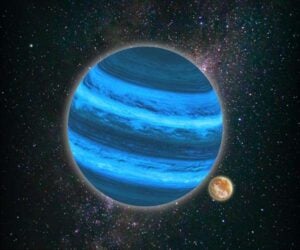
The conditions for life may not require starlight at all—just the right moon orbiting the right rogue planet.
The conditions for life may not require starlight at all—just the right moon orbiting the right rogue planet.
What ground control dismissed as static turned out to be humanity's first whisper from another world.

A dying world's cooling core is literally pulling its skin tight, creating dramatic geological scars that reveal how planets age.

The cosmos's dustiest rebels: ancient stars in a metal-poor galaxy are forging heavy elements astronomers thought impossible without cosmic maturity.

Voyager 1 is often imagined as a spacecraft still pushing itself outward, an engine burning faintly somewhere beyond the planets.
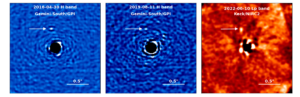
A planet can orbit two stars without being strange in fiction. The strange part is finding one in a real telescope image, tucked far closer to its twin suns than astronomers thought such a directly photographed world ought to be.

In 1984, Soviet cardiologist Oleg Atkov spent 237 days aboard Salyut 7 with a portable echocardiography unit, producing what appear to be the first real-time ultrasound images of a human heart remodeling in microgravity — and founding a tradition of orbital imaging that still guides ISS medicine today.

NASA has reduced one of the strangest milestones in human engineering to a timestamp.

Most comets are treated as leftovers from a local story. They formed with the planets, spent billions of years in the cold outskirts of the Solar System, and occasionally fall inward, warming just enough for sunlight to pull gas and dust from their surfaces.

The simplest picture treats dark energy as a constant. DESI's 2025 galaxy survey, combined with other data, hints instead that it was stronger in the past and has been weakening, though the signal is not yet at the level physicists call a discovery.

On March 31, 2025, four first-time astronauts flying the first human mission ever to loop directly over Earth's poles carried a commercial off-the-shelf X-ray…

On 14 January 2005, a small European probe dropped through an orange atmosphere, broke through the haze and settled onto a world nearly 1.5 billion kilometres from the Sun.

At Saturn's north pole, clouds race around a shape that looks as if it was drawn with a ruler.

The story sounds almost too neat: a spacecraft launched in 1977, a set of thrusters last used in 1980, and a team on Earth asking them to work again 37 years later.

Four light-years sounds close only because astronomy usually deals in much larger numbers.

Mercury is a planet of extremes. At the equator during the day, its surface can become hot enough to melt lead.