

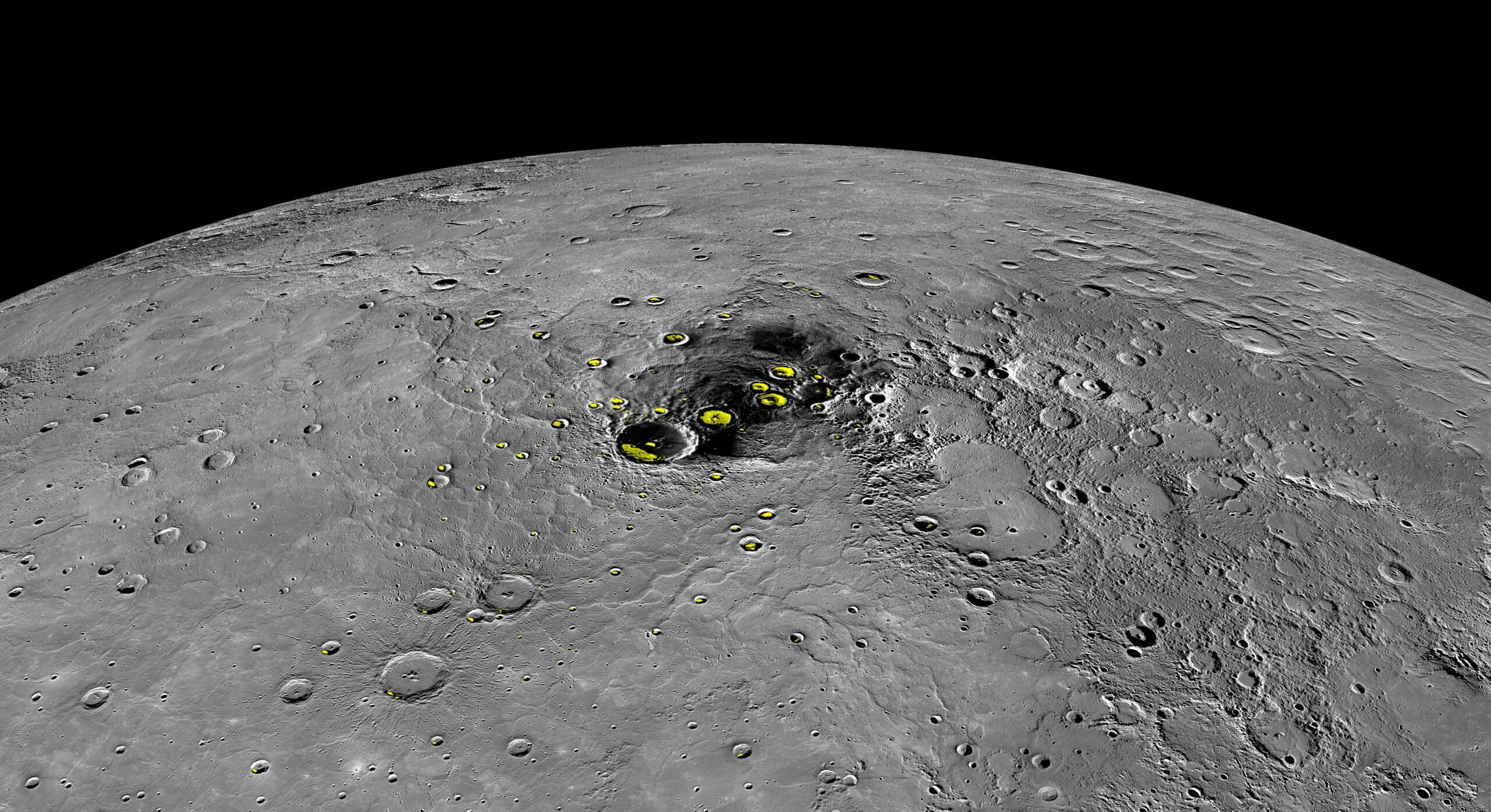
Mercury is a planet of extremes. At the equator during the day, its surface can become hot enough to melt lead. Yet near the poles, deep crater floors may never see the Sun at all. Inside those pockets of permanent darkness, temperatures can remain low enough for water ice to survive, perhaps for billions of years.
The apparent contradiction is not a trick. Being the closest planet to the Sun does not make every part of Mercury uniformly hot. The planet has almost no atmosphere to move heat from one place to another, and its rotational axis is tilted by only a tiny amount. Sunlight therefore reaches the polar landscape at a very shallow angle. The rims and walls of some craters block it completely from their deepest floors.
These places act as cold traps. While a sunlit patch nearby may become intensely hot, a permanently shadowed floor can remain colder than about minus 170 degrees Celsius. At such temperatures, water molecules can stay frozen instead of escaping into space. NASA’s Mercury facts page notes that polar ice can persist only in regions of permanent shadow, where local conditions are radically different from those on the illuminated surface.
The first clues came from Earth
Scientists suspected that something unusual was hidden at Mercury’s poles long before a spacecraft entered orbit around the planet. In the early 1990s, radio telescopes transmitted radar signals towards Mercury and detected exceptionally bright reflections near its polar regions. The reflections had properties similar to radar echoes from ice.
Radar brightness alone did not prove the material was frozen water. Certain rough surfaces or unusual minerals can also produce strong returns. But the locations were suggestive, and later observations sharpened the pattern. A combined Arecibo radar and MESSENGER illumination map showed that the bright deposits at the south pole coincide with areas mapped as permanently shadowed.
The same relationship appears in the north. In NASA’s north polar projection of Mercury, radar-bright areas are marked in yellow across the floors of many craters. They are not spread randomly over the landscape. Their restriction to cold, dark terrain is exactly what researchers would expect if the material were volatile ice.
MESSENGER assembled the case
NASA’s MESSENGER spacecraft transformed a persuasive hypothesis into a much stronger conclusion. It became the first probe to orbit Mercury in March 2011 and spent more than four years mapping the planet before its planned impact in 2015. NASA now lists verification that the polar deposits are dominantly water ice among MESSENGER’s major accomplishments.
No single instrument carried the entire argument. MESSENGER approached the deposits through several independent measurements. Its cameras established where sunlight could and could not reach. Its laser altimeter measured the reflectivity and topography of the surface. Its neutron spectrometer detected a reduction in energetic neutrons coming from the north polar region, a signal consistent with large concentrations of hydrogen close to the surface.
Hydrogen is a key component of water, so the neutron measurements supported the ice interpretation. Thermal models then tested whether water could remain stable at the measured locations. The pieces agreed: radar-bright material sat in permanent shadow, temperatures there were cold enough to preserve ice, and the polar soil contained far more hydrogen than ordinary Mercury terrain.
A NASA summary of MESSENGER’s scientific results describes this convergence of radar, imaging and temperature evidence. It is the agreement among methods, rather than a photograph of a familiar white glacier, that makes the conclusion so compelling.
Some ice is exposed and some is buried
Mercury’s polar deposits are not all identical. In the coldest locations, water ice can be stable directly at the surface. Elsewhere it appears to be covered by a thin layer of darker material that helps insulate a much thicker deposit below.
MESSENGER obtained unusually detailed images inside shadowed northern craters by using the small amount of light scattered from their walls. One such image revealed a sharp boundary between different kinds of dark terrain. NASA’s account, “A Shot in the Dark”, says that the boundary matched temperature-model predictions for a surface layer of volatile-rich, organic material tens of centimetres thick overlying water ice.
Calling that material “organic” does not imply life. In planetary science, organic compounds are simply carbon-bearing chemicals. Similar material can form without biology and is common in primitive asteroids and comets. A dark covering may have arrived along with the water and then remained after some ice near the surface was lost.
How water reached the hottest planet
The leading delivery candidates are asteroids, comets and water-bearing dust. Impacts release volatile compounds across Mercury’s surface. Most water molecules exposed to sunlight would rapidly be destroyed, heated away or lost to space. A small fraction, however, could hop across the surface after repeated cycles of release and recondensation until it reached a polar cold trap.
Once inside permanent shadow, a molecule might remain. Over immense spans of time, repeated deliveries could build substantial deposits. Researchers have also explored whether solar-wind particles reacting with minerals could create some water locally, although the relative importance of each source is uncertain.
The phrase “may have survived for billions of years” therefore needs care. Thermal models show that ice in the coldest traps can be stable over geological timescales. That does not mean scientists have dated every deposit or proved that all of it has been present since Mercury’s youth. Some ice could be ancient, some could have arrived later, and impacts may remove or replenish material.
The sharp edges seen in certain polar deposits may even suggest geologically recent modification, because constant small impacts tend to blur surface boundaries over time. Mercury’s cold traps can preserve ice for billions of years while still receiving new material and losing old material. Long-term stability and a mixed-age inventory are compatible.
A planet where distance is not destiny
Mercury’s day side can exceed 430 degrees Celsius, while its night side falls below minus 180 degrees. This enormous range exists because the planet’s exosphere is far too thin to behave like an atmosphere and redistribute heat. At the poles, its near-upright spin axis prevents the Sun from climbing high above the horizon, allowing crater topography to create permanent night.
That geometry matters throughout the solar system. Permanently shadowed regions on the Moon also preserve water ice, and cold traps may exist on other airless bodies. Mercury provides the most dramatic lesson because it sits so close to the Sun. A planet’s average distance from its star cannot by itself describe every environment on its surface.
The ice is also a record of material moving through the inner solar system. Its abundance, chemistry and layering could reveal what delivered water to the terrestrial planets and how volatile compounds survive on airless worlds. Yet Mercury’s poles remain difficult to observe. Permanent darkness hides the deposits from ordinary sunlight, and no lander has sampled them.
What scientists have instead is a remarkably coherent case built from radar echoes, hydrogen measurements, laser reflections, images and heat-flow calculations. Together, those observations show how the solar system’s innermost planet can shelter one of its coldest environments. Just beyond sunlit crater rims, water ice may have endured in darkness across a significant fraction of planetary history.