

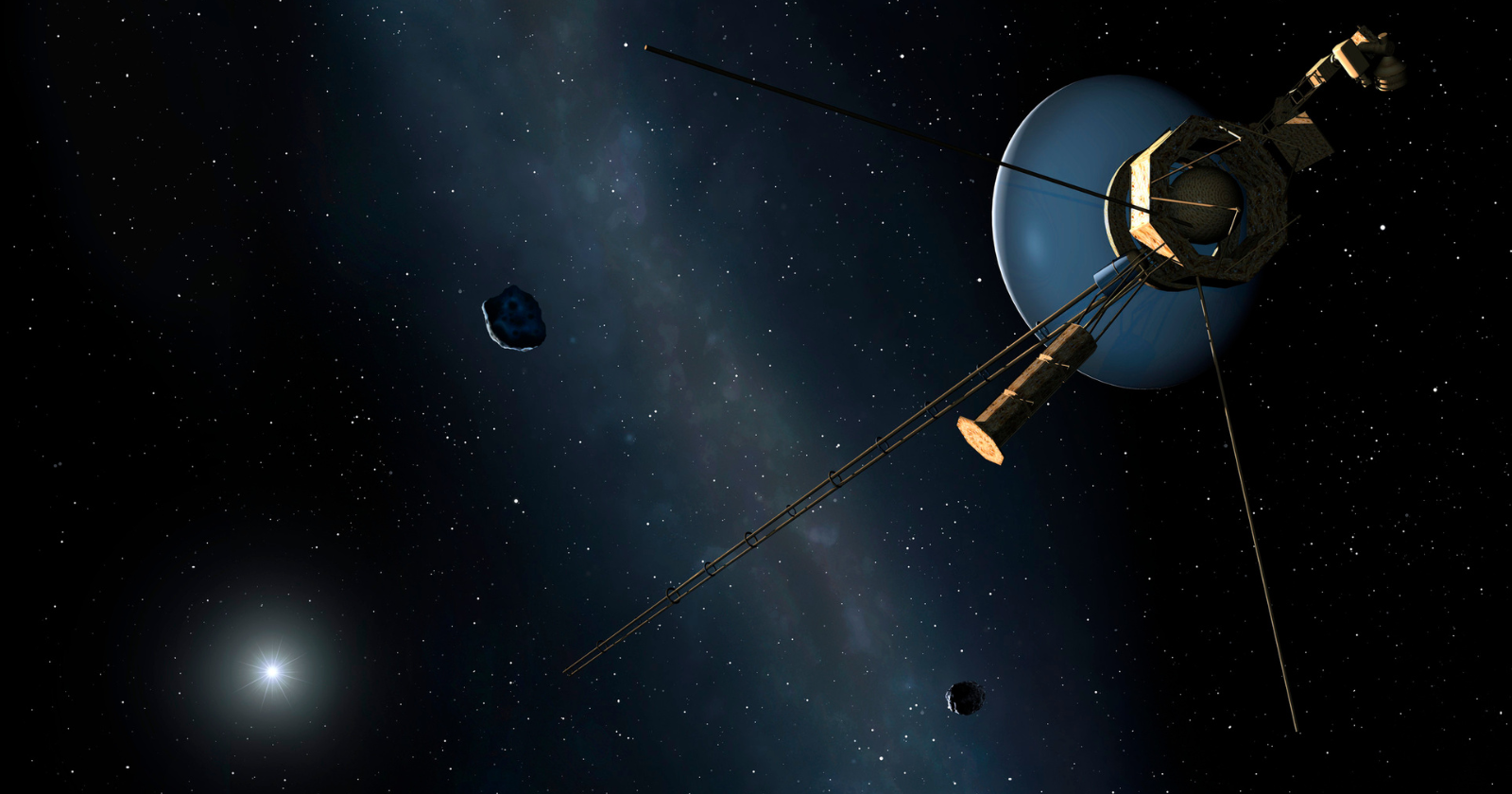
The story sounds almost too neat: a spacecraft launched in 1977, a set of thrusters last used in 1980, and a team on Earth asking them to work again 37 years later.
The harder version is better. Voyager 1 was not being saved by nostalgia. It was being kept alive by attitude control. If the spacecraft could not keep its high-gain antenna pointed at Earth, the mission would lose the narrow radio link that makes every other success matter.
In a NASA Voyager operations update, the agency later described the problem plainly: some of Voyager 1’s attitude-control thrusters were degrading, forcing them to fire more often to keep the antenna pointed home. To reduce the strain, the team fired up another set of thrusters on Voyager 1 that had not been used in 37 years.
That sentence is doing a great deal of work. It compresses four decades of hardware ageing, a radio delay measured in hours, and the fact that there is no technician standing beside Voyager 1 with a wrench.
The spacecraft had to keep looking home
Voyager 1’s antenna is not a decorative part of the probe. It is the mission’s voice. The spacecraft is so far from Earth that its signal is weak by the time it reaches the Deep Space Network, and its antenna must remain pointed with extraordinary care.
The ageing thrusters involved in that pointing do not work like engines in a launch vehicle. They fire in small pulses to turn the spacecraft slightly. Enough of those pulses, applied over enough time, can keep the antenna aligned. Too many pulses, or a system that becomes too inefficient, can turn into a mission-ending problem.
By 2017, the thrusters Voyager 1 had been using for attitude control were requiring more frequent firings. NASA’s 2019 account says the team switched to a different set, the trajectory correction maneuver thrusters. Those thrusters had last been used in November 1980, after Voyager 1’s encounter with Saturn, when the spacecraft no longer needed them for planetary targeting.
In ordinary engineering life, 37 years of dormancy would be enough to make a mechanism suspect. In deep space, it becomes a question with no easy test environment. The spacecraft was more than 13 billion miles from Earth at the time. A command could be sent, but the answer would come back only after the radio path had done its slow work.
Why the wait mattered
The delay is part of the engineering drama, but it is also part of the discipline. Nothing at Voyager happens in real time for the people operating it. The command leaves Earth. It travels at light speed across the distance to the probe. If the spacecraft accepts it and acts on it, the result has to travel back through the same distance.
That means an operation can feel like making a decision in the dark, then waiting for physics to report what happened. The team could not nudge the spacecraft, watch a gauge, and adjust immediately. They had to plan the command sequence, send it, and wait for the signal that said whether the old thrusters had responded.
The result was yes. Voyager 1’s dormant trajectory correction maneuver thrusters worked, and NASA later said the switch let the spacecraft continue transmitting data for additional years. It was not impossible in the literal sense. The hardware had been built with redundancy, and the team understood the system. But the age, distance, and stakes made the success feel like something outside the normal scale of machine maintenance.
A fading power supply
The word fading is not just poetic here. The Voyagers are powered by radioisotope thermoelectric generators, which convert heat from plutonium-238 decay into electricity. NASA’s 2019 update said each spacecraft was producing about four fewer watts of electrical power each year, and about 40% less than at launch.
That decline changes everything about operating the probes. It means heaters, instruments, and subsystems have to be judged against one another. It means some equipment can no longer be kept as warm as engineers once intended. It means the mission has become an exercise in rationing power without losing the scientific return that makes the rationing worthwhile.
NASA’s account also explained why heaters matter. If fuel lines powering the thrusters were to freeze, the spacecraft could lose the ability to keep its antenna aimed at Earth. The old thruster story therefore sits inside a larger problem: not only can parts wear down, but the power needed to protect them also shrinks over time.
This is why Voyager engineering can look, from the outside, like a sequence of unlikely recoveries. In practice, it is a careful chain of tradeoffs. Keep this instrument warm. Turn that heater off. Change the command timing. Switch from one thruster set to another. Accept a narrower margin because the alternative is no margin at all.
The 2025 echo
The old 37-year thruster event is not isolated. Voyager 1 has continued to need patient repair from a distance. In May 2025, NASA reported that the team had revived backup thrusters before a planned command pause, after re-examining a problem that had kept them unavailable for years. That later operation was different from the 2017 switch, but it belongs to the same family of work.
Both episodes show what deep-space operations become when a spacecraft outlives its expected design life by decades. Engineers are no longer running a mission in the tidy sense of executing a fixed plan. They are maintaining a one-of-a-kind machine whose parts are ageing in ways no laboratory can fully reproduce.
Voyager 1 also survived a separate communications crisis in 2024. NASA announced in April that the spacecraft had resumed sending engineering updates after months of unusable data, another reminder that the mission now exists in a narrow operating corridor.
Why the old thruster firing still matters
The 37-year thruster firing matters because it captures the real character of the Voyager mission now. The hard part is not speed, showmanship, or a new destination. It is continuity. A spacecraft built for planetary flybys is still returning data from interstellar space because teams keep finding disciplined ways to preserve a radio link.
That is not the same as pretending Voyager can run forever. It cannot. The power supply is declining, instruments have been turned off, and each recovery takes place against a shrinking set of options. The lesson is more exact than optimism. Redundancy matters. Documentation matters. Conservative engineering matters. So does the ability, decades later, to look at an old system and ask whether a door everyone stopped using might still open.
When the signal came back and the dormant thrusters had worked, the spacecraft did not become young again. It simply remained reachable. For Voyager 1, that was enough. In deep space, enough can be an extraordinary word.