
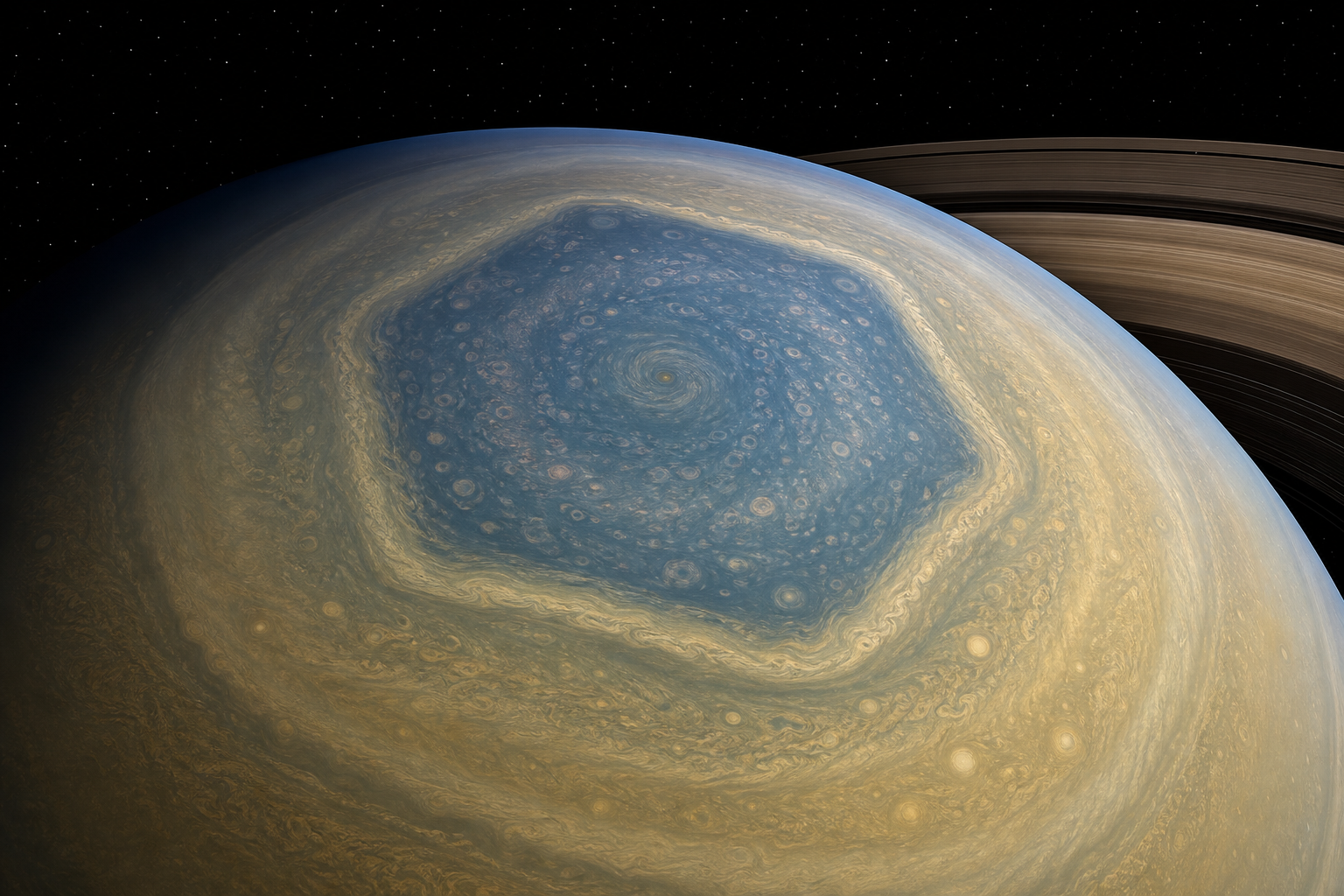
At Saturn’s north pole, clouds race around a shape that looks as if it was drawn with a ruler. Six broad sides meet at six corners, enclosing a region roughly 30,000 kilometres across. Earth could fit inside it with room to spare.
The hexagon is real, but it is not a rigid object and not quite a single storm. It is a powerful eastward jet stream that meanders into a six-lobed wave around the north pole. A separate hurricane-like cyclone spins at the centre. Together they produce one of the most recognisable weather systems in the solar system.
NASA describes the hexagon as a wavy jet stream about 30,000 kilometres wide, with winds near 322 kilometres per hour. Its sides are gently curved rather than mathematically perfect, and smaller clouds constantly move within and around it. The astonishing part is not absolute geometric precision. It is that a turbulent atmosphere has maintained such a clean sixfold pattern for at least four decades.
Voyager saw the corners before Cassini saw the whole
Voyager 1 and Voyager 2 first photographed portions of the feature during their Saturn flybys in 1980 and 1981. Their trajectories did not provide a complete overhead portrait, but image mosaics revealed an unexpected polygon circling the north pole.
David Godfrey’s 1988 analysis, “A hexagonal feature around Saturn’s north pole”, established that the pattern was associated with a high-speed jet near 76 degrees north. The vertices moved around Saturn with a remarkably steady period, making the hexagon look almost stationary relative to the planet’s deeper rotation.
When Cassini reached Saturn in 2004, northern winter had placed the pole in darkness. Visible-light cameras could not immediately deliver the desired view, but infrared instruments could detect heat and see through the night. As spring returned, Cassini eventually obtained full, high-resolution mosaics from above.
The result confirmed that the Voyager feature had survived more than 20 years. NASA’s Cassini account of the hexagon notes that the spacecraft observed it through darkness, changing sunlight and seasonal colour shifts. The same six-sided circulation remained in place.
The hexagon is a wave in a fast jet
The leading physical picture treats the hexagon as a planetary wave trapped in an eastward jet. On a rapidly rotating planet, large atmospheric motions are governed by the Coriolis effect and by gradients in vorticity. Disturbances can become Rossby waves, the giant relatives of meanders that shape weather patterns on Earth.
Wrap a wave with six crests around a circle and its alternating inward and outward displacements trace a hexagon. The corners are therefore not hinges or solid boundaries. They are the most outward parts of a wave travelling, or nearly standing, around the pole.
A 1990 paper proposed a stationary Rossby-wave interpretation, suggesting that the jet’s peculiar shape could arise from atmospheric wave dynamics. Later Cassini measurements strengthened the connection between the polygon and a narrow, powerful current of air.
This explains how a fluid can make straight-looking sides without a container. It does not, by itself, answer every question. Scientists still need to explain why this jet selects a dominant sixfold mode, how deeply the responsible circulation extends, what role the central polar vortex plays and why no equivalent hexagon appears at Saturn’s south pole.
A spinning tank can make polygons
The basic idea has been tested in the laboratory. Researchers placed water in a rotating cylindrical tank and created a ring-shaped jet by driving inner and outer regions at different speeds. Under suitable conditions, the initially circular boundary became unstable and formed stationary polygons.
The 2010 laboratory model published in Icarus produced shapes with different numbers of sides, including a hexagon. The experiment showed that no mountain, solid wall or alien engineering is required. Rotation and shear in an ordinary fluid can spontaneously organise a jet into a polygonal wave.
It also exposed the remaining problem. The tank can generate triangles, squares, hexagons and other patterns as the speed difference and fluid conditions change. Saturn has maintained six sides across enormous seasonal changes. A successful explanation must reproduce not just a polygon, but this polygon’s size, wind profile, rotation rate, vertical structure and extraordinary longevity.
A pattern that survives Saturn’s seasons
Saturn takes about 29 Earth years to orbit the Sun, so each season lasts more than seven years. Its axial tilt exposes the poles to long periods of darkness and sunlight. Heating, haze production and atmospheric chemistry change substantially, yet the underlying hexagonal jet persists.
A study using Cassini and ground-based observations from 2008 to 2014 found that the jet profile remained essentially unchanged through strong seasonal forcing. The vertices rotated with a period of about 10 hours, 39 minutes and 23 seconds. Comparisons with Voyager and earlier ground observations showed only a small change associated with a large anticyclone present during the earlier era.
That stability led the researchers to interpret the hexagon as a vertically trapped Rossby wave on a deep-rooted jet. The phrase “deep-rooted” is important but relative. Cassini did not lower a weather station into the hexagon. Scientists infer depth from wind behaviour, thermal structure, gravity measurements and models, all of which leave room for competing details.
Numerical work has tested whether instability in the combined jet and polar vortex can sustain the observed form. A 2017 study on the dynamical nature of Saturn’s north polar hexagon found that a jet-plus-vortex configuration could generate a long-lived structure resembling the observation more successfully than a jet-only case. This suggests the central cyclone may help organise or stabilise the surrounding wave, even though the cyclone and hexagonal jet are distinct features.
The shape extends far above the visible clouds
Cassini’s infrared measurements revealed another surprise as Saturn’s northern hemisphere moved towards summer. A warm stratospheric polar vortex developed hundreds of kilometres above the main cloud deck, and its boundary also became hexagonal.
The discovery, reported in Nature Communications, showed that the sixfold influence can span more than 300 kilometres vertically from the tropospheric cloud region into the stratosphere. Researchers could not yet determine whether the upper hexagon always exists but becomes visible only under favourable seasonal temperatures, or whether it develops upward as the northern summer vortex forms.
Ultraviolet observations from Cassini’s final orbits also detected the north polar structure at high altitude. The 2019 analysis of those measurements reinforced the view that the hexagon is not a shallow outline painted on one cloud layer. Its atmospheric signature appears across different pressures and wavelengths.
Why has it not disappeared?
Earth’s familiar storms usually encounter continents, oceans with changing temperatures and neighbouring weather systems that disrupt them. Saturn offers no solid surface beneath the clouds. Its atmosphere wraps continuously around the planet, while rapid rotation supports strong, persistent east-west jets.
A wave locked to one of those jets can preserve its large-scale geometry while individual clouds form, stretch and vanish inside it. The hexagon is therefore less like one thunderstorm surviving for 40 years and more like a durable current whose moving boundary continually recreates the same pattern.
That is the broad explanation. The full explanation remains incomplete. Models differ over how shallow or deep the wave is, how the jet and polar vortex share energy, which instability selects six sides, and why Saturn’s south pole has a cyclone but no matching polygon.
Calling the hexagon “perfect” captures what the eye sees, but its scientific value lies in its small departures from perfection. Subtle drift, changing haze, vertical temperature structure and distortions caused by nearby vortices reveal the forces maintaining it. Saturn’s six-sided storm system refuses to disappear because it is not a temporary object sitting in the atmosphere. It is the visible geometry of the atmosphere’s motion itself, and scientists are still working out exactly why that motion has settled into six enduring sides.