
On 14 January 2005, a small European probe dropped through an orange atmosphere, broke through the haze and settled onto a world nearly 1.5 billion kilometres from the Sun. For 72 minutes after landing, Huygens continued sending data from the surface of Saturn’s moon Titan.
No spacecraft has landed farther from Earth. More importantly, no other landing has taken place on a world known to possess stable rivers, lakes and seas at its surface. NASA describes Titan as the only place beyond Earth known to have standing bodies of liquid.
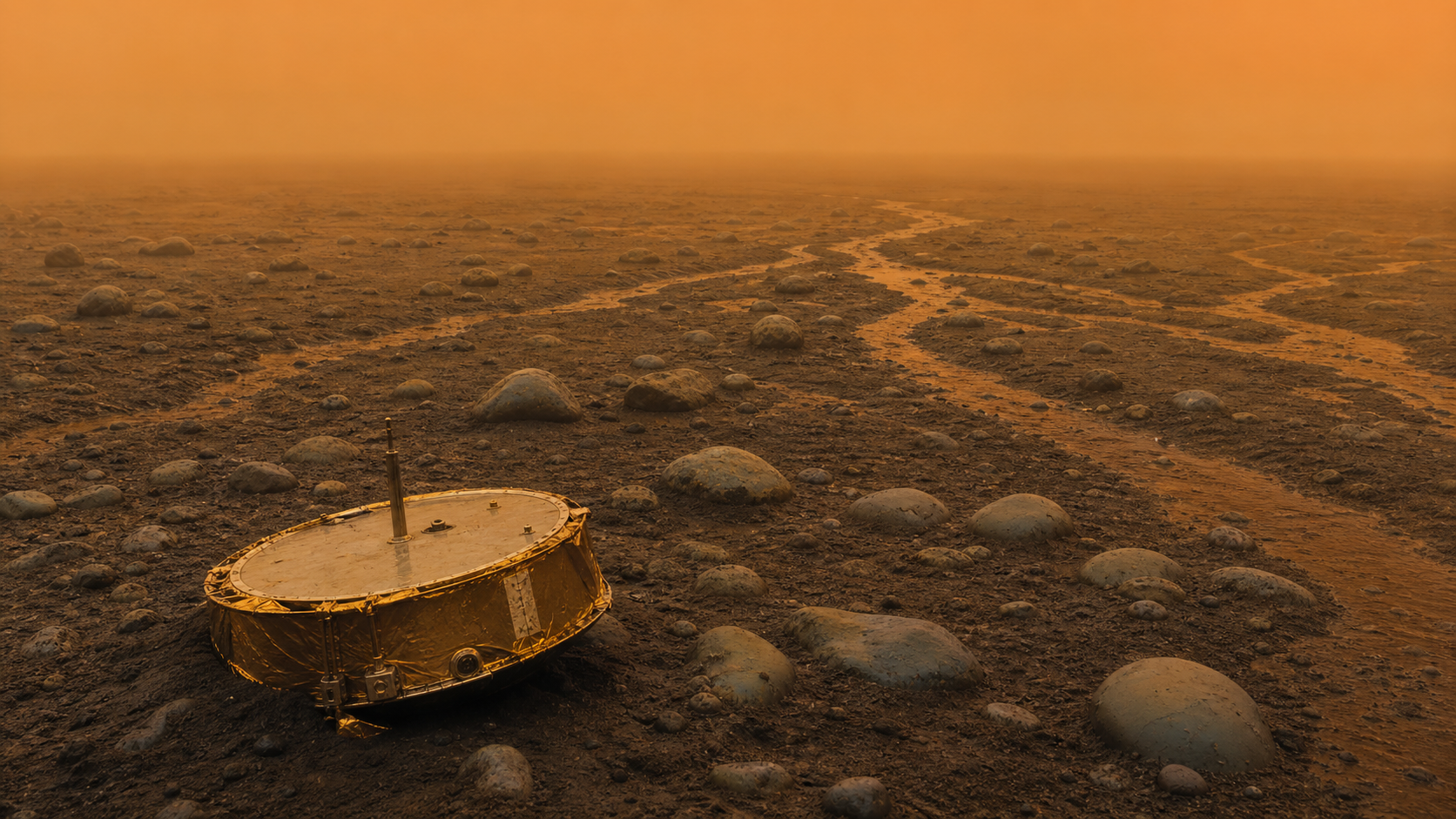
There was no lake beside Huygens. The probe came down on a dark equatorial floodplain, while Titan’s great seas lie near its poles. Yet the rounded ice cobbles, branching channels and soft ground at the landing site all carried signs that liquid methane had flowed there. The world Huygens touched was dry at that moment, but it had been shaped by weather.
A probe fell through an alien sky
Huygens travelled to Saturn attached to NASA’s Cassini spacecraft. The pair launched in 1997 and reached the Saturn system almost seven years later. Cassini released the battery-powered lander on 25 December 2004, placing it on a three-week coast towards Titan with no engine capable of correcting its course.
When Huygens struck the upper atmosphere, its heat shield endured a fiery entry before three parachutes slowed the craft. It then spent about two hours and 27 minutes descending through clouds and haze. The instrument package measured temperature, pressure, chemistry, light and the properties of the surface, while cameras assembled the first views from beneath Titan’s obscuring atmosphere.
The images gradually revealed bright highlands cut by dark drainage channels. Below them lay flatter terrain that resembled a coastline and offshore islands. Huygens was not seeing open water. The European Space Agency interpreted the scene as evidence of methane rainfall, erosion and flooding on a frigid world where water ice behaves like rock.
The wind became sound
Huygens did not only photograph Titan. Its Atmospheric Structure Instrument carried a microphone, while the Surface Science Package used an acoustic sounder near the ground. ESA’s description of the Huygens instruments says the onboard microphone sent back sounds from Titan.
The widely shared audio is not an untouched tape of four uninterrupted hours. The mission team processed the measurements and compressed a long sequence into a short recording. ESA explains that its one-minute Huygens audio spans roughly four hours of real events, from parachute deployment through the descent and time on the surface.
What listeners hear is therefore authentic mission data made audible and condensed, not a human ear’s exact experience of standing on Titan. NASA has also published a laboratory reconstruction based on what the microphone detected during descent. The changing rush gives a sensory dimension to measurements that otherwise appear as plots: a machine built on Earth was listening while it swung beneath a parachute in another world’s wind.
Wind speed was also inferred from tiny Doppler shifts in Huygens’ radio carrier. A receiver configuration error aboard Cassini threatened that experiment, but radio telescopes on Earth captured the signal directly. The resulting profile showed weak winds near the surface and much stronger winds higher in the atmosphere.
The ground looked wet even when it was not
Huygens hit at about 16 kilometres per hour, bounced and slid before stopping. The surface was not a hard sheet of ice. Measurements and later analysis suggested a crust over softer material with a consistency compared to damp sand or wet clay. ESA reported that the probe may have slumped into sand that had been dampened by liquid methane.
The stones in its final photographs were probably rounded pieces of water ice. On Titan, the temperature is about minus 179 degrees Celsius, so water is rigid bedrock while methane and ethane can circulate as liquids. Cassini later supplied the planetary-scale confirmation. Radar observations found dark, smooth features near the poles, and by 2006 scientists had reported definitive evidence of lakes filled largely with liquid methane.
Further mapping showed a landscape with coastlines, islands and seas. NASA estimates that Cassini mapped more than 1.6 million square kilometres of liquid lakes and seas. Methane evaporates, forms clouds, falls as rain and runs across the ground, creating a cycle that resembles Earth’s water cycle with radically different chemistry.
Seventy-two minutes on the surface
Huygens had been designed primarily to survive its descent. Reaching the ground intact was already a bonus, but the probe kept operating. Cassini received its signal for 72 minutes after touchdown as the orbiter passed overhead, collecting hundreds of images and measurements for relay to Earth.
The end was governed by geometry rather than a dramatic mechanical failure. Cassini moved below the landing site’s horizon and could no longer receive the transmission. Ground-based radio telescopes continued detecting the carrier for a short time, and an ESA technical report concluded that Huygens’ batteries were fully discharged about 15 minutes after the final ground signal.
The probe is still there, resting among ice pebbles beneath the permanent haze. It has no way to wake, recharge or call home. Its brief conversation with Earth ended forever, but its measurements transformed Titan from a blurred orange moon into a recognisable world of weather, drainage basins, soft ground and distant seas.
That is what makes the audio so haunting. It is not merely noise from an instrument. It is a processed trace of air moving on the only world beyond Earth where a spacecraft has landed beneath skies that feed stable liquid at the surface. For a few hours, an alien atmosphere had a microphone inside it.