
A planet can orbit two stars without being strange in fiction. The strange part is finding one in a real telescope image, tucked far closer to its twin suns than astronomers thought such a directly photographed world ought to be.
The new world is called HD 143811 AB b, and it belongs to a binary star system roughly 446 light-years from Earth in the Scorpius-Centaurus star-forming region. In December 2025, a Northwestern University-led team reported that astronomers had directly imaged the planet orbiting two stars, making it one of the rare real systems that invites the unavoidable comparison to Tatooine.
But the comparison only gets you so far. This is not a desert planet under a cinematic double sunset. It is a young, hot, giant planet several times the mass of Jupiter, glowing faintly in infrared light because it still holds heat from its formation. The remarkable thing is not that it has two suns. It is where the planet sits.
According to the discovery team, HD 143811 AB b is six times closer to its pair of stars than any other directly imaged planet previously found in a binary system. NASA’s exoplanet catalog lists the planet as a 6.1-Jupiter-mass gas giant discovered by imaging in 2025, with an orbital radius of about 63 astronomical units and an orbital period of 320.5 years.
That does not sound close by everyday solar system standards. Sixty-three astronomical units is well beyond Pluto’s average distance from the Sun. But among directly imaged planets around binary stars, this one is unusually compact. Previous examples tended to sit on extremely wide paths, far enough out that the violence of a close stellar pair could be treated almost as a distant complication.
HD 143811 AB b removes that comfort. The two central stars whirl around each other every 18.6 days. Around them, the planet follows a much slower, centuries-long path. The whole system is young, only about 13 million years old, meaning the planet formed after the age of dinosaurs had already ended on Earth.
The planet was hiding in old data
The discovery did not come from a brand-new telescope staring at an obvious target. It came from patient reanalysis. The Gemini Planet Imager, once mounted on the Gemini South telescope in Chile, observed HD 143811 AB as part of a large survey between 2014 and 2019. That survey used adaptive optics and a coronagraph to suppress the glare of bright stars so faint companions could be seen nearby.
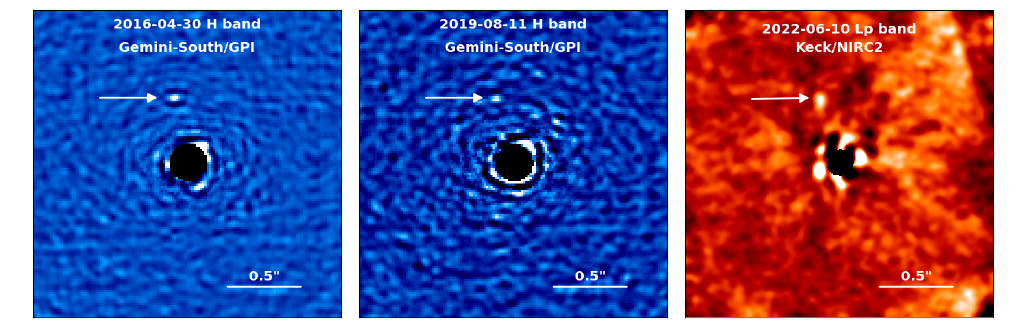
Years later, Northwestern graduate researcher Nathalie Jones revisited the archive. A faint point of light appeared in Gemini data from 2016 and 2019, and then again in a 2022 observation from Keck/NIRC2. The important test was whether the point moved with the star system across the sky. If it did not, it could simply be a background star caught in the same line of sight. If it did, it was probably bound.
The peer-reviewed paper in The Astrophysical Journal Letters reports that common proper motion, orbit fitting and spectral analysis all point to the same conclusion: the object is a substellar companion bound to the binary. The paper estimates a planet mass of about 5.6 Jupiter masses and an effective temperature a little over 1,000 kelvin, consistent with a young giant planet still cooling after birth.
The actual image is not a postcard. It is a technical detection map: a speck beside a blocked-out star, processed so aggressively that the center looks carved away. That is what direct imaging usually means. Astronomers are not photographing a world the way a spacecraft photographs Mars. They are separating a faint planetary glow from the blinding light of its host stars.
Why two suns make formation harder
Planet formation is already a race against time. Around a young star, dust and gas must collect into larger bodies before the disk disperses. Around two close stars, that disk is stirred, heated and pulled in changing directions. The gravity is not a simple central pull. It is a moving pattern.
That does not make planets impossible. The Kepler mission found multiple circumbinary planets by watching them pass in front of their stars. But those planets were generally discovered indirectly, by tiny dips in starlight. Direct imaging is different. It tends to find young, massive planets on wide orbits, because those worlds are hot, bright in infrared and far enough from the stars to be separated from their glare.
That is why HD 143811 AB b matters. It is the first directly imaged planet around a binary that is not on an ultrawide orbit, according to the ApJL team. It pushes direct imaging into a part of parameter space where close binary dynamics are no longer a minor detail.
The problem is not simply that the planet is close to two stars. It is that the system asks astronomers to explain how a giant planet grew or arrived there while the central pair was stirring the environment. Did the planet form in place in a circumbinary disk? Did it form farther out and migrate inward? Did interactions in the young system reshape its orbit?
For now, the honest answer is that no one knows. Jason Wang, a senior author on the Northwestern study, put the uncertainty plainly: the team does not yet have enough examples to assemble the full picture. The new planet is a clue, not a solved case.
A moving laboratory
The advantage of this system is that astronomers can keep watching it move. Because both the binary stars and the planet can be tracked in the sky, HD 143811 AB b gives researchers a rare three-body laboratory. Over coming years, each new observation can tighten the planet’s orbit, refine its mass and reveal whether current formation models can survive the added constraint.
That makes the planet valuable even if it never becomes famous outside astronomy. It is not just another distant dot added to a catalog. It is a world sitting in a place where theory becomes uncomfortable.
Science often advances this way. A system that should have been too messy turns out to have built a planet anyway. A speck buried in old data becomes a direct image of a giant world circling two suns. And the neat categories astronomers had been using to describe where planets can form have to make room for something less tidy.
HD 143811 AB b is not literally Tatooine. It is larger, hotter, younger and probably unrecognizable from any imagined surface. But it carries the same unsettling idea into real astronomy: a planet can belong to two suns, and sometimes it can survive in a place where the universe was not expected to put one.