

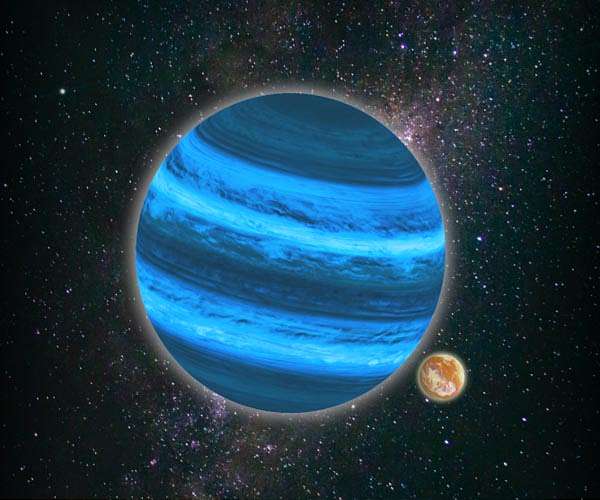
An Earth-sized moon orbiting a Jupiter-like rogue planet could retain surface liquid water for as long as 4.3 billion years without receiving energy from a star, according to a 2026 modelling study.
That maximum requires a 100-bar atmosphere dominated by hydrogen, roughly 100 times Earth’s sea-level pressure, plus continuing tidal heat from the moon’s orbit. The researchers did not observe such a world or detect life.
This is one study, not settled consensus. It describes what a coupled atmosphere and orbital model permits under favourable assumptions.
The longest result needs 100 bars of hydrogen
David Dahlbüdding of Ludwig Maximilian University of Munich and the Max Planck Institute for Extraterrestrial Physics led the work, published on 24 February 2026 in Monthly Notices of the Royal Astronomical Society.
The team modelled an Earth-mass, Earth-sized moon around a free-floating planet similar to Jupiter. A moon that large is a favourable case because it can generate more tidal heat and retain an atmosphere more readily than a smaller body.
The longest liquid-water intervals varied sharply with atmospheric pressure: about 95 million years at one bar, 699 million years at ten bars and 4.341 billion years at 100 bars.
Only the thickest model approached Earth’s age.
An eccentric orbit replaces stellar heating
Some rogue planets may form alone, while others are expelled from young planetary systems by close gravitational encounters. A giant planet can keep some of its moons during ejection, although their orbits may be altered.
A moon left on an eccentric orbit moves closer to and farther from its planet. The changing gravitational pull flexes its interior, converting orbital energy into heat. Io’s volcanoes and the buried oceans of Europa and Enceladus show what tidal heating can do within our own Solar System.
The 2026 calculation used orbital histories from a 2023 International Journal of Astrobiology study led by Giulia Roccetti. That earlier work simulated the ejection of planet-moon systems and followed the gradual decline in tidal heating as surviving moon orbits became more circular.
Hydrogen keeps internally generated heat near the surface
Producing heat is not enough. The moon must also keep it from radiating into interstellar space.
An earlier LMU model covered by Space Daily in 2021 used a carbon-dioxide atmosphere. Later work put the maximum temperate interval at 1.6 billion years, but carbon dioxide can condense in the cold upper atmosphere. If enough freezes out, the atmosphere can collapse and insulation weakens.
The new model used molecular hydrogen instead. Individual hydrogen molecules absorb infrared radiation poorly, but close collisions between them briefly create configurations that can absorb outgoing heat. This collision-induced absorption becomes stronger as hydrogen density rises.
The team combined radiative transfer with equilibrium chemistry containing hydrogen, carbon, oxygen and, in some runs, nitrogen. Hydrogen pairs remained the dominant absorber under the modelled habitable conditions, while the atmosphere avoided carbon dioxide’s condensation problem.
The calculation followed 6,945 surviving moons
The starting orbital simulation placed 26,293 Earth-mass moons through an encounter that expelled their Jupiter-like planets. Of those moons, 6,945 stayed bound. The team then calculated how their orbits and tidal heat changed with time.
With a 100-bar atmosphere, 43 per cent of the surviving modelled moons reached temperatures suitable for surface liquid water at some point. The longest interval lasted 4.341 billion years. Thinner atmospheres produced shorter maximum intervals and fewer qualifying cases.
These were one-dimensional atmosphere calculations. They did not simulate a working ocean, a detailed interior, surface geology or biology.
The model does not establish that these moons exist
The paper discusses ammonia and tide-driven wet-dry cycles as possible aids to prebiotic chemistry. Those ideas require shallow water, exposed land and surface-atmosphere interactions that were outside the calculation.
The model also held gravity constant with altitude, an approximation that becomes less secure for a very extended 100-bar atmosphere. It omitted moist convection, clouds and hazes. Smaller moons would produce less tidal heat and could struggle to retain dense hydrogen over geological time.
No exomoon has yet been confirmed beyond reasonable dispute, let alone an Earth-sized moon orbiting a rogue Jupiter under 100 bars of hydrogen. Detecting one would be difficult without a bright host star to backlight its atmosphere.
The paper therefore expands the calculated range of places where liquid water might persist. It does not show that starless oceans are common, inhabited or currently within reach of observation.