

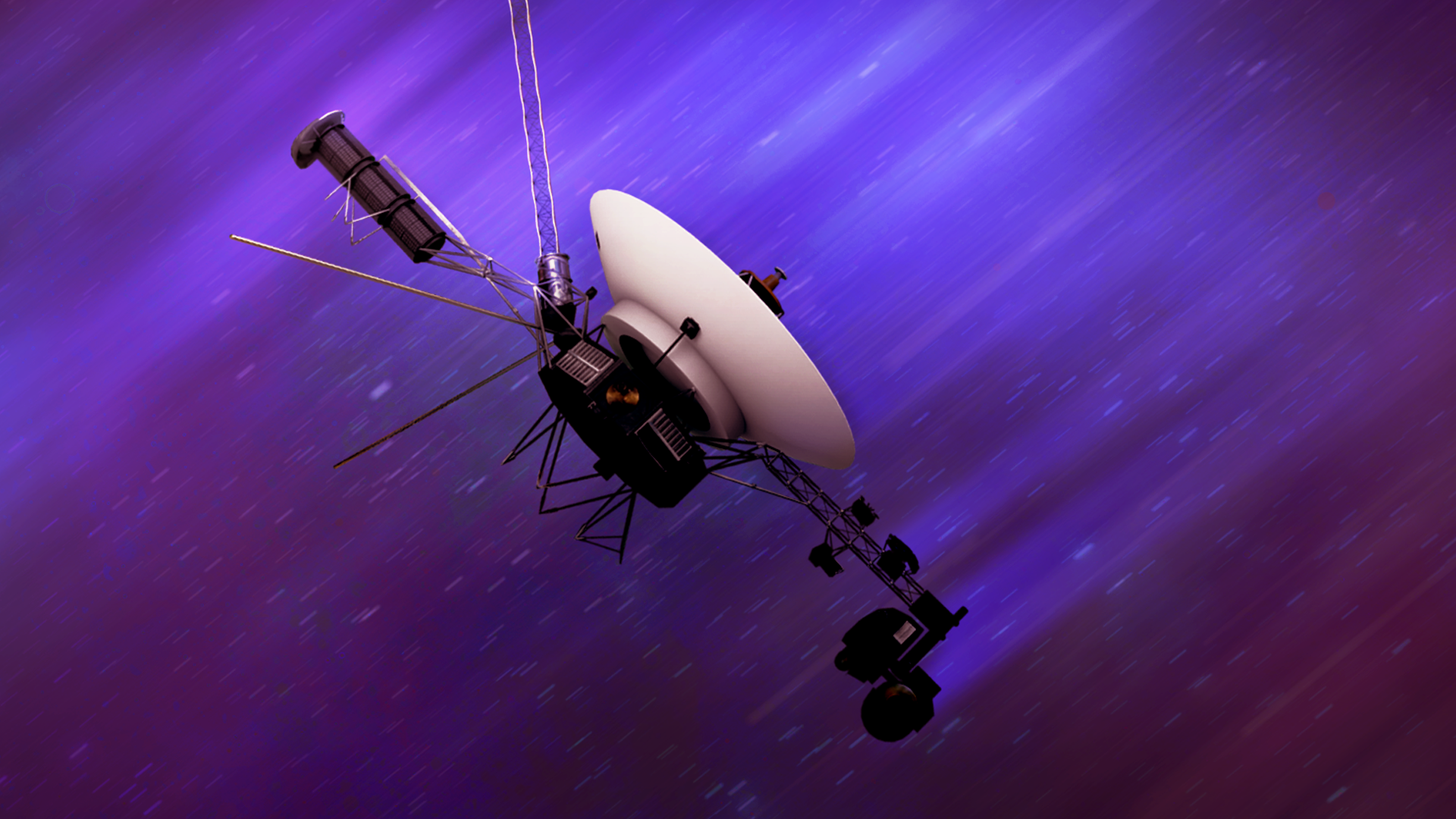
NASA has reduced one of the strangest milestones in human engineering to a timestamp.
On Wednesday, 18 November 2026, at 2:16:07 a.m. PST, Voyager 1 will be 16,094,799,096 miles from Earth. That is not just a large number. It is the distance light travels in 24 hours, which means the spacecraft will become the first human-made object one full light-day from home.
The phrasing sounds almost too neat: one light-day. But the number underneath it is not symbolic. It is a communications fact. A command sent from Earth at that distance will take a full day to arrive. A reply, if Voyager 1 sends one immediately, will take another full day to come back.
For a spacecraft launched in 1977, that is an astonishingly precise appointment with distance. NASA is not merely saying Voyager 1 will be “very far away” sometime in November. It is giving a second on the clock and a distance down to the mile.
When distance turns into time
Most spacecraft milestones are attached to places: launch pad, orbit, flyby, landing site, heliopause. The one-light-day mark is different. It is not a boundary Voyager 1 will cross in the way it crossed the heliopause in 2012. Nothing physical waits there. No magnetic wall, no ring of dust, no change in the darkness.
The milestone belongs to light.
At ordinary human distances, light travel time is invisible. A phone call, a video stream, a radio signal, a spacecraft command in low Earth orbit all feel effectively immediate. Even the Moon is close enough that a signal delay of roughly 1.3 seconds can be understood without changing the whole rhythm of an operation.
Voyager 1 has pushed that rhythm into another category. At one light-day, engineering becomes correspondence. A team on Earth sends a command into space and waits two days to know the full round-trip result. Even if every system works perfectly, physics imposes the delay.
That is why the exact timestamp matters. It marks the moment a machine built before the personal-computer era becomes so remote that the speed of light feels slow on a human schedule.
A 1977 spacecraft at a 2026 distance
Voyager 1 launched on 5 September 1977, aboard a Titan IIIE-Centaur rocket from Cape Canaveral. NASA built it for close flybys of Jupiter and Saturn, not for a half-century conversation across interstellar space.
The original planetary mission worked. Voyager 1 encountered Jupiter in March 1979 and Saturn in November 1980. It photographed worlds that had never been seen at close range, found new moons, studied Saturn’s rings, and sent back the data that helped turn the outer Solar System from a set of bright points into a set of places.
Then the mission outlived its mission.
NASA’s Voyager 1 page describes it as the most distant human-made object and notes that it entered interstellar space in August 2012. That statement itself needs care: Voyager 1 crossed the heliopause, the outer boundary of the Sun’s bubble of charged particles and magnetic field. It is still gravitationally tied to the Sun’s broad domain in a much looser sense. But in terms of the local plasma environment, it is sampling interstellar space.
The one-light-day mark is another kind of measurement. It says less about the medium around the spacecraft and more about the distance between the spacecraft and Earth.
A number that would once have sounded invented
When Voyager 1 launched, a spacecraft more than 16 billion miles from Earth and still being tracked by NASA would have sounded like speculative fiction. Not because the physics was unknown, but because the duration and discipline required were so extreme.
The machine had to survive launch, Jupiter, Saturn, decades of radiation, declining power, computer faults, fading heaters, clogged thruster lines, and a communications link stretched thinner each year. The Deep Space Network had to keep listening. Engineers had to keep finding ways to operate hardware built around 1970s assumptions from distances its designers could calculate but never personally experience.
That is the quieter achievement behind the number. Voyager 1’s one-light-day milestone is not simply a tribute to speed. The spacecraft is travelling at about 38,000 miles per hour relative to the Sun, but light covers its November 2026 Earth-distance in a single day. Voyager needed more than 49 years of continuous flight to reach that scale.
It is a machine moving slowly compared with light, and unimaginably far compared with everything humans normally build.
Still operating, but narrowing
The Voyager 1 that reaches one light-day will not be the full scientific observatory that left Earth. NASA’s current status table lists most of its original instruments as off, either to save power or because of degraded performance. As of the April 2026 update, Voyager 1 still has its magnetometer and plasma wave subsystem operating.
That narrowing is expected. Voyager’s radioisotope power source has been fading for decades. The mission team has repeatedly turned off instruments and heaters to preserve what remains. Each year, the spacecraft becomes less capable, but not yet silent.
The difference between motion and operation matters here. Voyager 1 will continue moving even after its final instrument is switched off. It does not need electricity to coast. But as a mission, it exists only as long as Earth can command it and hear it answer.
At one light-day, that answer becomes an event from yesterday.
The precision is part of the story
There is something almost absurdly human about the exactness. A spacecraft launched in 1977, now far beyond the planets, will reach a threshold defined by light at 2:16:07 in the morning Pacific time. The number is produced by tracking, modelling, ephemerides and decades of navigation work. It is also, at a plain-language level, a calendar entry for remoteness.
That precision does not make Voyager 1 less lonely. It makes the distance more real.
Sixteen billion miles can flatten into abstraction. A day of light cannot. It asks the mind to imagine a radio signal leaving Earth, crossing the orbit of the Moon in little more than a second, passing Mars in minutes, crossing the realm of the outer planets in hours, and still needing most of a day to reach a small, aging spacecraft.
Voyager 1 will not notice the milestone. It will not change course or send a special message because it has crossed a human unit of distance. But on Earth, the number gives shape to something otherwise too large to hold.
A probe built for Jupiter and Saturn has become a clock for the scale of human reach. On 18 November 2026, at 2:16:07 a.m. PST, that clock will tick over to one light-day.