

For most of the past three decades, physicists have treated dark energy as a constant. It is the name given to whatever is pushing the universe apart at an accelerating rate, and the simplest assumption has been that its strength never changes, that it has pushed at the same steady pressure since the expansion began to speed up. A large 2025 galaxy survey has produced the strongest hint yet that this assumption may be wrong.
The data suggest dark energy was stronger in the distant past and has been weakening in more recent times. It is a hint rather than a verdict, and it matters enough to be worth stating carefully.
What the survey measured
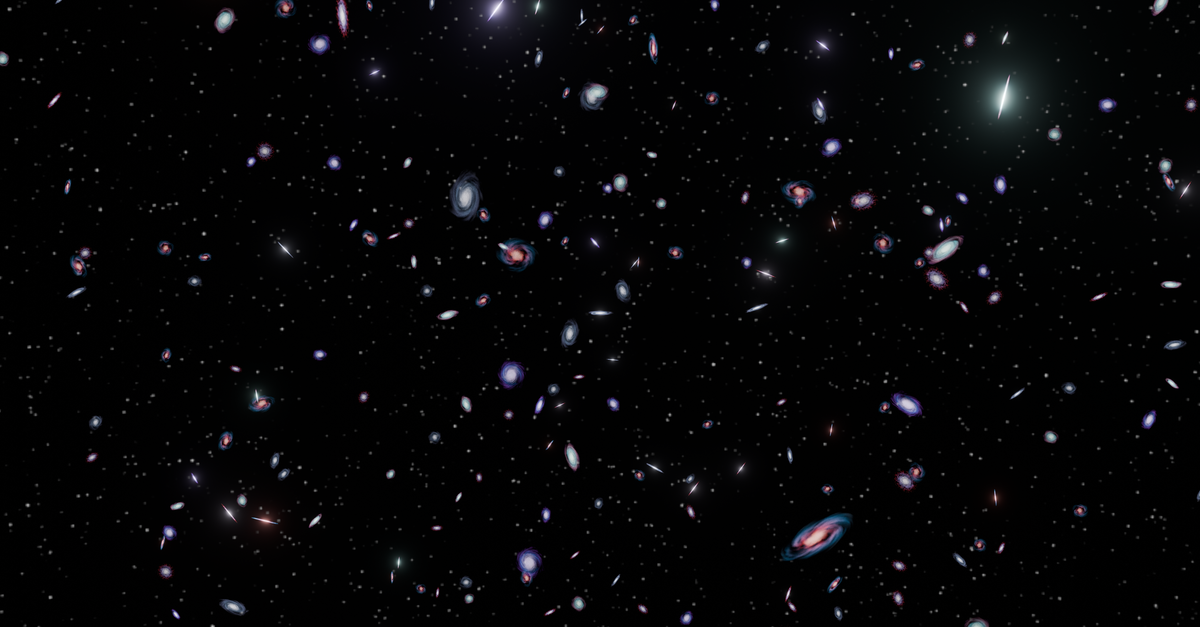
The result comes from the Dark Energy Spectroscopic Instrument, or DESI, a project run by an international collaboration and mounted on a telescope at Kitt Peak in Arizona. DESI is building the largest three-dimensional map of the universe ever made. Its second data release, published in 2025, drew on close to 15 million galaxies and quasars gathered over three years, and the collaboration opened a public catalogue that includes 13.1 million galaxies, together tracing the expansion back roughly 11 billion years.
The technique relies on a feature left over from the early universe. Sound waves in the hot plasma of the infant cosmos froze into a faint, preferred separation between galaxies, a fixed length that acts like a ruler printed across the sky. By measuring that ruler at different distances, and therefore at different times in the past, DESI can trace how fast the universe was expanding at each stage. That expansion history is where any change in dark energy would show up.
The pattern in the data
When the DESI team fitted models to that history, the data preferred a dark energy that changes over time rather than one that stays fixed. In the preferred fit, dark energy was more forceful earlier on and has been losing strength as the universe has aged. Read through that model, the pressure driving the expansion appears to have grown through the universe’s early history and then passed a turning point a few billion years ago, after which it began to fade.
That is the picture behind the striking version of the claim: a dark energy that dominated and strengthened for the first nine billion years or so, then started to weaken around four to five billion years ago. It is important to treat that timeline as the implication of a fitted model, not as something read directly off a dial. What DESI measures is the expansion history; the story of a rising and falling dark energy is the interpretation that best matches it.
Why this is still a hint, not a discovery
Several qualifications keep this short of a settled result, and they are the most important part of the story.
On its own, the DESI map is still consistent with a constant dark energy. The preference for a changing one appears only when the DESI measurements are combined with two other kinds of data: the cosmic microwave background, the relic light of the early universe, and catalogues of distant supernovae used as distance markers. Depending on which supernova catalogue is used, the combined preference for evolving dark energy sits at roughly 2.8 to 4.2 standard deviations. Physics treats five standard deviations as the threshold for claiming a discovery, so even the strongest of these figures falls short of that bar.
There is also a live question about the supernovae themselves. Part of the signal depends on how those exploding stars are calibrated, and different supernova samples pull the result by different amounts, which is exactly the pattern you would expect if some of the effect were coming from measurement systematics rather than from dark energy. The DESI data are a genuine and repeated hint, gathered from more objects than ever before, but a hint that leans on other datasets to reach its conclusion is not the same as a direct detection.
What it would mean if it holds
The reason the result draws attention is the size of what it would overturn. A constant dark energy, the cosmological constant, has been a fixed pillar of the standard model of cosmology. If dark energy instead grows and fades, that pillar has to be replaced with something more complicated, some field or mechanism that evolves.
It would also change the expected fate of the universe. A truly constant dark energy implies expansion that accelerates forever, thinning everything into cold and dark. A dark energy that is already weakening leaves other endings on the table, including the possibility that expansion could one day slow, stall or reverse. None of those outcomes is established by this data, and any of them would lie unimaginably far in the future, but the point is that a weakening dark energy reopens a question many physicists had considered closed.
What comes next
The way this gets resolved is more data and better cross-checks. DESI is still observing and will release larger samples, and other projects, including the Euclid space telescope and the Vera Rubin Observatory, are measuring the expansion history by independent routes. If the preference for evolving dark energy keeps climbing toward five standard deviations as those datasets grow, and if the supernova calibration questions are put to rest, the hint will harden into something the field has to accept.
For now the honest summary is the interesting one. The universe’s expansion has been mapped in more detail than ever before, and the simplest story about what drives it, a constant and unchanging push, no longer fits the data quite as well as a push that has been quietly running down.