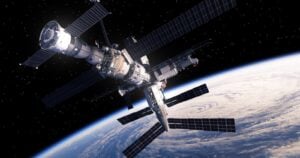
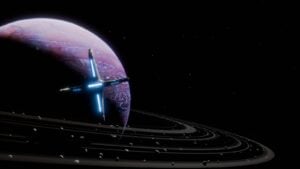
In May 1986, Leonid Kizim and Vladimir Solovyov left the newly opened Mir, crossed…
On 5 May 1986, Leonid Kizim and Vladimir Solovyov flew from Mir to Salyut 7 and back, the only crewed flight ever made from one space station to another.
Astronomy and cosmology
Deep Field covers astronomy and cosmology. Telescopes and what they find, planets near and far, and the strange physics of the deep universe, traced back to the journal papers and observatory data behind the headlines.

On 5 May 1986, Leonid Kizim and Vladimir Solovyov flew from Mir to Salyut 7 and back, the only crewed flight ever made from one space station to another.
Jul 11, 2026

In July 2026, Isar Aerospace signed an agreement for a launch complex in Nova Scotia whose disclosed fixed-payment schedule totals US$112.5 million over 10…
Jul 11, 2026

Europe's Euclid telescope has found 31 of the oldest known quasars in one go, and the haul roughly doubles the number known from that early stretch of the universe.
Jul 11, 2026

The Federal Communications Commission has authorized radio operations for Eärendil-1, a demonstration satellite built around a reflector measuring roughly 18 metres by 18 metres.
Jul 11, 2026

The usual picture of life begins with a star. A planet forms around it, settles into an orbit where temperatures are not too hot or too cold, and receives the steady energy that makes chemistry possible.
Jul 11, 2026

SpaceX has applied to the U.S. Federal Communications Commission for permission to operate a 100,000-satellite “Gen3” system in low Earth orbit, with…
Jul 11, 2026

Webb has twice hinted at dimethyl sulfide, a life-linked gas, at the possible ocean world K2-18b. Independent teams re-examining the data doubt the molecule is there at all.
Jul 11, 2026

The James Webb Space Telescope has tracked how the atmosphere of a distant gas giant changes from longitude to longitude during transit, revealing pronounced differences between its morning and evening regions.
Jul 11, 2026

Water was thought to arrive on planets aboard comets and asteroids. A 2025 Nature study shows sub-Neptunes, the galaxy's most common planets, can make their own by reacting hydrogen atmospheres with molten rock.
Jul 10, 2026

Saturn's moon Titan is the only other world with rivers, rain and seas, built from liquid methane running over water-ice bedrock at minus 179 degrees Celsius.
Jul 10, 2026

A thin streak of gas and young stars trailing a distant galaxy is the wake of a supermassive black hole moving at close to 1,000 kilometres per second…
Jul 10, 2026

Astronomers have measured both the mass and the distance of a rogue planet for the first time.
Jul 10, 2026

The two Voyagers left the Sun's bubble six years apart, in different directions and at opposite ends of the solar cycle, yet found its edge at nearly the same distance. Scientists are not sure why.
Jul 10, 2026

Six months on the International Space Station quietly rewires how astronauts sense the world — turning down inner-ear signals gravity has rendered useless, and handing orientation almost entirely to the eyes. Then they come home.
Jul 9, 2026

Scott Kelly returned to Earth on 1 March 2016 after 340 days aboard the ISS, and the part he keeps describing in interviews is not the launch or the year in orbit but the weeks afterward — when his balance, his skin, and a strange watching-from-behind-the-eyes detachment took far longer to resolve than anyone expected.
Jul 9, 2026

On October 22, 1975, the Soviet Venera 9 probe survived 53 minutes on the Venusian surface before 465°C heat and 92-bar pressure destroyed it — but in that hour it transmitted the first photograph ever taken from the ground of another planet, revealing sharp-edged rocks that overturned every prediction about Venus's surface.
Jul 9, 2026