
The usual picture of life begins with a star. A planet forms around it, settles into an orbit where temperatures are not too hot or too cold, and receives the steady energy that makes chemistry possible.
A 2025 study asks what happens if that picture is too narrow.
The paper, Life in the dark: Potential urability of moons of rogue planets, was written by Viktória Fröhlich and Zsolt Regály and posted on arXiv in November 2025. The arXiv text lists the manuscript as received in June 2025 and accepted in November 2025. It is a modelling study, not an observation of a real moon, and it should not be read as evidence that life exists on such worlds.
This is one study, not settled consensus. Its value is in the question it makes concrete: could a moon carried into deep space by a starless planet remain warm enough inside for long-lived liquid water?
A planet ejected by a dying star
Rogue planets are planets that are not gravitationally bound to any star. Some may form alone. Others may begin in ordinary planetary systems and later be thrown out by gravitational encounters, stellar evolution, or the violent mass loss that follows a supernova.
Fröhlich and Regály focused on the last path. They modelled planets orbiting massive stars that end their lives as core-collapse supernovae. When such a star explodes, it rapidly loses mass. That sudden change can destabilise the orbit of a companion planet and send it into interstellar space.
The key question was not just whether the planet escapes. It was whether any moon orbiting that planet survives the event.
In their simulations, the answer was yes. The authors report that all simulated moons remained bound to their planets after the supernova. The planets could leave the remnant star system, but their moons continued orbiting them.
That is only the first step. A moon in deep space has no sunlight worth counting. Its surface would be frozen. If it is to keep liquid water anywhere, the heat has to come from within.
The heat source is orbital flexing
The study relies on a process already familiar from our own Solar System: tidal heating.
When a moon travels around a much larger body on a slightly stretched orbit, gravity pulls on it unevenly. The moon is flexed again and again as its distance and orientation change. That mechanical deformation dissipates energy as heat inside the moon.
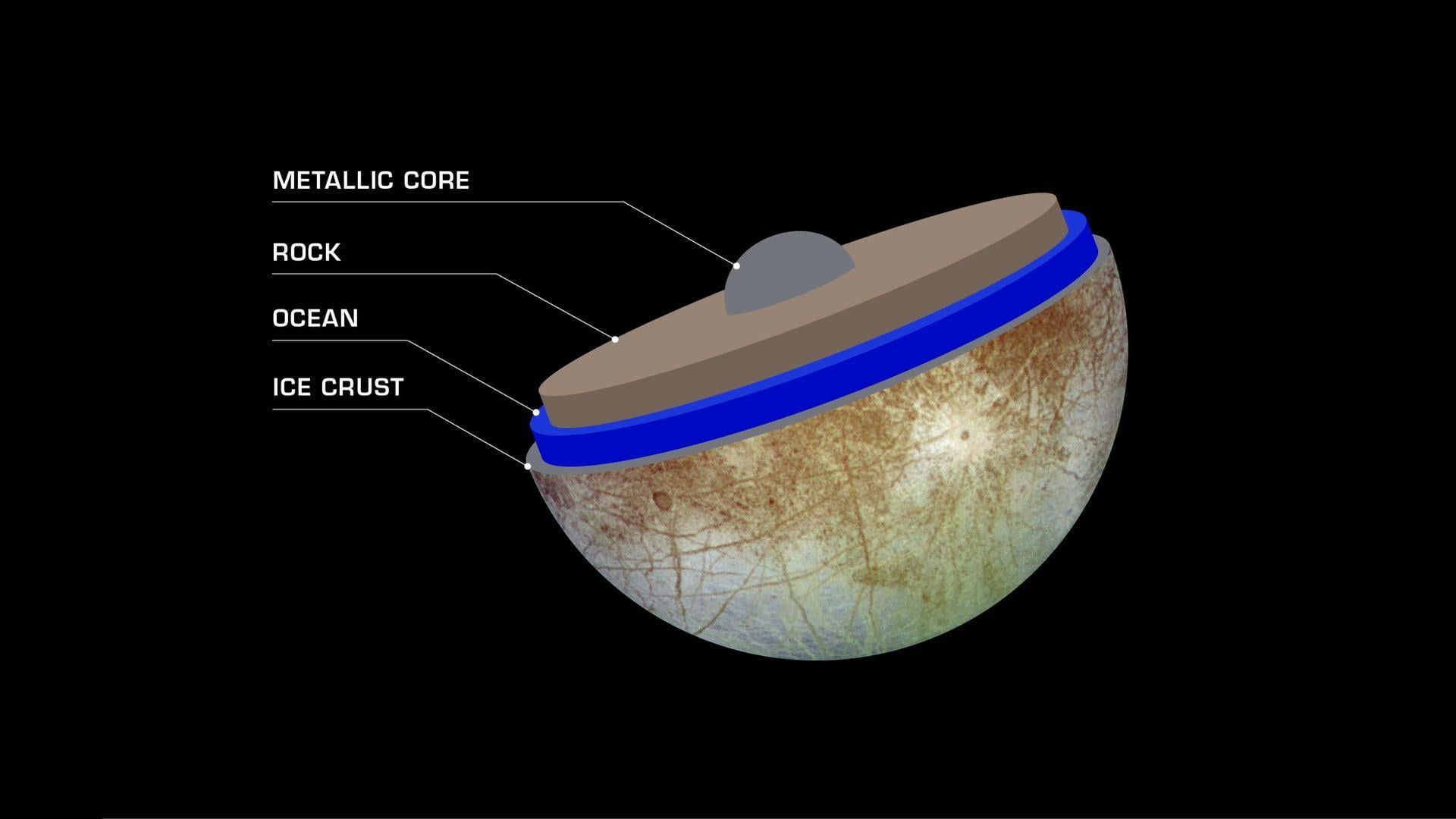
Jupiter’s moon Europa is the standard comparison. NASA describes Europa as an icy world likely containing a global saltwater ocean beneath its crust, with Europa Clipper designed to study the ice shell, ocean, composition and geology. Saturn’s Enceladus is another reference point: a small icy moon whose plumes show material escaping from a subsurface ocean.
The 2025 paper uses Europa and Enceladus as benchmarks. It asks whether rogue-planet moons, after a supernova has altered their orbits, could receive tidal heating in a comparable range.
The answer was conditional. In roughly 12 to 15 percent of the simulated cases, the tidal heating power fell between 0.1 and 10 times the estimates used for Europa or Enceladus. The successful cases were not random. They tended to involve moons orbiting relatively close to their planets and keeping enough orbital eccentricity for repeated flexing to matter.
In plain terms, the supernova does not simply eject the planet and leave the moon unchanged. It can reshape the moon’s orbit enough to leave a small but important irregularity. That irregularity can become the engine.
Billions of years without a sunrise
The timescale is the most striking part of the result.
Tidal heating fades if an orbit becomes too circular. The flexing weakens, and the internal heat source declines. For a starless moon, that would be the difference between a long-lived ocean and a frozen interior.
Fröhlich and Regály found that, for moons at distances of at least about 10 planetary radii, the damping timescale for orbital eccentricity could exceed the age of the Solar System. In other words, some of these moon systems could keep the relevant orbital distortion for billions of years.
That does not mean their surfaces would be warm. The study is mostly about subsurface oceans beneath ice crusts. A moon drifting through interstellar space would still be dark and externally cold. The possible habitat is sealed away: water under ice, warmed by the moon’s interior rather than by a sky.
The authors also use the term “urability”, meaning conditions that might allow life to begin, rather than simply conditions where existing life could persist. That distinction matters. A world with liquid water is not automatically a cradle for life. Chemistry, energy gradients, stability, raw materials and time would all matter, and the study does not show that those requirements are actually met.
What the model does not prove
No confirmed exomoon has yet been found, let alone one orbiting a rogue planet. The study also does not show that a particular planet-moon system exists after a supernova, or that any of these worlds contain oceans. It explores what could happen under a set of physical assumptions.
Those assumptions include the structure of the supernova mass loss, the planet and moon masses, orbital spacing, tidal dissipation properties and moon densities. Change those inputs and the outcome can change. The useful result is not a census of habitable starless moons. It is a demonstration that the idea is physically plausible in a non-negligible part of the model space.
There is also a detection problem. A rogue planet in interstellar space is hard to find. A moon around one is harder still. The paper notes that rogue planets may be numerous, but abundance does not make individual systems easy targets. Without starlight, many would be detectable only through indirect methods such as microlensing, thermal emission or future techniques sensitive to planet-moon signatures.
Even if such moons exist, the oceans discussed here would be buried. A telescope would not see an ocean directly. It might infer a moon, a planet, a temperature, a mass or an orbital pattern. Turning that into evidence for a subsurface ocean would be another step. Turning it into evidence for life would be a much larger one.
A wider definition of where to look
The point of the study is not that life is likely in the dark between stars. It is that the old habitability map may be too star-centred.
Earth depends on sunlight at the surface, but the Solar System has already taught us that liquid water can be protected under ice. Europa and Enceladus are important because they separate habitability from direct sunlight. A star warms Earth from above. A giant planet can warm a moon from the inside by forcing it to flex.
The 2025 study extends that logic into a harsher setting. If a planet is expelled during a supernova and keeps its moons, and if one of those moons has the right orbit, composition and internal response, then deep space is not automatically the same thing as thermal death. There may be pockets where water remains liquid for spans of time long enough to matter.
That is a careful claim, but it is a meaningful one. It shifts the question from “does life need a star?” to “what kinds of worlds can keep energy flowing long enough for chemistry to continue?”
For now, these moons are theoretical. They are products of simulation, not entries in a catalogue. But they mark a useful boundary in the search for possible living environments: some worlds may be dark at the surface and still not be cold all the way down.