
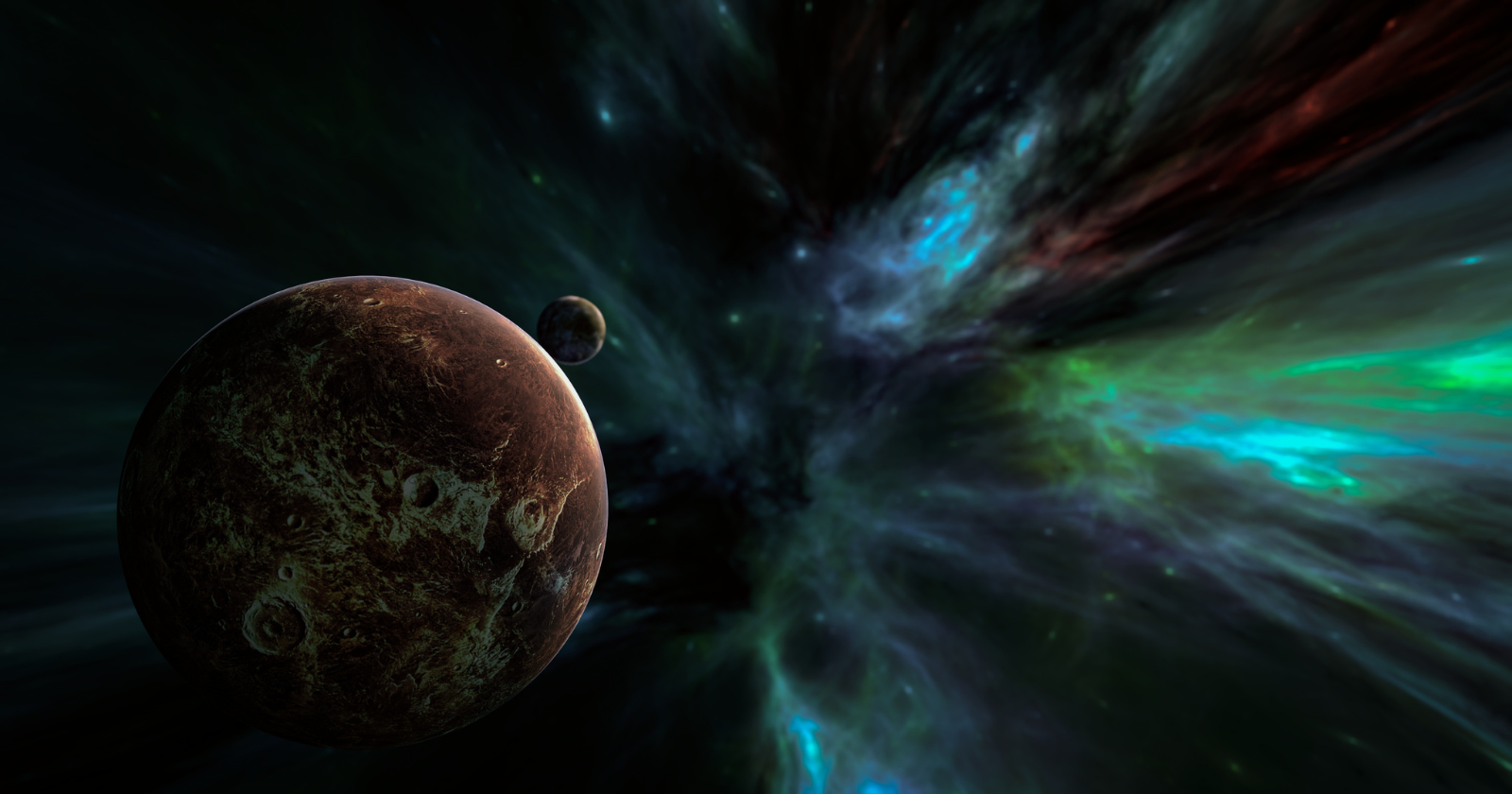
Astronomers have measured both the mass and the distance of a rogue planet for the first time. The object drifts through the galaxy with no star to orbit, and until now that kind of world had resisted the one measurement that would settle its identity: a firm mass.
It began as a two-day flicker. On 3 May 2024, a distant star in the direction of the galactic bulge brightened and faded, an event catalogued as KMT-2024-BLG-0792, also listed as OGLE-2024-BLG-0516. In a paper published in Science on 1 January 2026, a team led by Subo Dong of Peking University reports that the object behind that flicker sits about 9,800 light-years away, roughly 3,000 parsecs, and carries about a fifth of Jupiter’s mass, which the authors put on a par with Saturn. The full paper is available in Science.
It is one object.
Over the past decade astronomers have flagged around a dozen rogue-planet candidates through brief microlensing events, but none carried a directly measured mass. This is the first.
What the measurement actually did
Spotting the flicker was never the hard part. It was reading it. A microlensing event happens when a foreground object crosses the line of sight to a background star and its gravity bends and magnifies that star’s light. The shape of the resulting brightness curve carries information about the lensing object, but mass and distance are tangled together. The same curve can come from a small nearby object or a larger, more distant one. Astronomers call this the mass-distance degeneracy, and for rogue planets it has been the wall.
Dong and colleagues broke it by watching the same event from two places at once: ground-based surveys on Earth, including the Korea Microlensing Telescope Network and the Optical Gravitational Lensing Experiment, and the Gaia space telescope, about 1.5 million kilometres away. Two vantage points separated by that distance register the event with slightly different timing. That difference, the microlens parallax, fixes the distance, and once the distance is known the mass follows. Combined with modelling of how the background star’s finite size shaped the light curve, it yielded the first mass and distance for an object of this kind.
How to hold the billions-to-trillions figure
The finding arrives wrapped in a larger claim that has circulated for years: that the Milky Way may hold billions, perhaps trillions, of these starless worlds. That estimate does not come from this planet. It comes from population statistics built on earlier microlensing surveys, and it deserves careful handling.
That high end has already moved. A 2011 survey by Takahiro Sumi and collaborators suggested there might be nearly two Jupiter-mass rogue planets for every star in the galaxy, a striking figure that shaped a decade of coverage. In 2017, a survey led by Przemek Mróz, published in Nature, found no large population of unbound Jupiter-mass planets and revised that number sharply downward. The current picture is that most free-floating planets are smaller, closer to Neptune’s mass or below. They may well crowd the galaxy. The word “trillions” is a projection from models and counts, and no one has taken a census.
What “ejected” does and does not mean
Coverage of the new result leans on a single verb: the planet was ejected, thrown out of the system where it was born. That reading is reasonable, but it is an inference rather than something anyone watched happen.
What the team actually holds is a mass. A Saturn-mass object is too light to have formed on its own the way a star or a brown dwarf does, and its mass fits the profile of something that grew in a protoplanetary disk around a star and was later scattered away by gravitational interactions. The authors reach that conclusion by comparing the object against the statistics of other events and against simulations. Nothing in the paper identifies which system the planet came from, when it left, or what pushed it. Dong, describing the result, said the discovery offers further evidence that the galaxy may be “teeming with rogue planets.”
The origin story is the most likely fit, not a recovered history.
What to watch next
Part of the value here lies in the method. Simultaneous observation from Earth and space turned a degenerate light curve into a mass and a distance, and that approach scales.
Three facilities are built around it. NASA’s Nancy Grace Roman Space Telescope, now at Kennedy Space Center and targeting launch no earlier than 30 August 2026, will survey the galactic bulge in infrared and is expected to find rogue planets in far greater numbers. China’s Chinese Space Station Survey Telescope and the proposed Earth 2.0 mission both list microlensing among their goals. More of these worlds almost certainly exist. The open question is whether the different ways a planet can end up alone, scattered by its siblings, dislodged by a passing star, or formed cold and companionless from the start, leave signatures we can tell apart. One confirmed mass does not answer that. A few hundred might.