

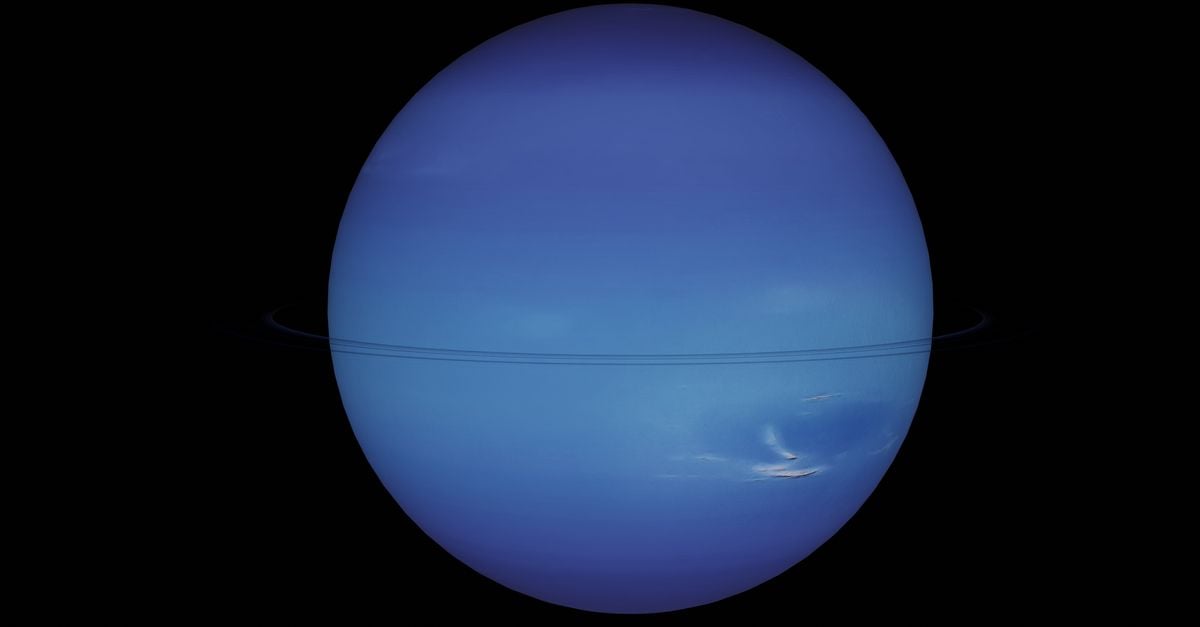
A planet called K2-18b, 124 light-years away in the constellation Leo, has become the most closely watched world in the search for life beyond the solar system. It may be a hycean world, a body wrapped in a thick hydrogen-rich atmosphere over a global liquid-water ocean. And in data from the James Webb Space Telescope, one team has twice reported tentative hints of dimethyl sulfide, a gas that on Earth is produced mainly by marine microorganisms.
That is where the excitement ends and the argument begins. Several independent groups, re-examining the same Webb data, have concluded that the gas may not have been detected at all. The disagreement is not really about whether the planet has life. It is about whether the molecule is even there.
The planet, and the ocean that might be there
K2-18b orbits a cool red dwarf star, within the zone where a planet could in principle hold liquid water. It is a sub-Neptune, bigger and heavier than Earth at around 8.6 Earth masses, and it does not fit neatly into any category we have from our own solar system.
The hycean idea, developed by Nikku Madhusudhan and colleagues at the University of Cambridge, is that such a planet could carry a deep ocean beneath a hydrogen atmosphere. In 2023, Webb gave the picture some support: its instruments found methane and carbon dioxide in the planet’s air, a combination that fits a hycean world reasonably well. It was real progress. It was also not proof of an ocean, and other readings of the same planet describe it instead as a gas-rich mini-Neptune with no habitable surface at all.
Why dimethyl sulfide is the word everyone noticed
The reason dimethyl sulfide, or DMS, drew so much attention is its origin story on Earth. Here, almost all of it comes from life, mostly from phytoplankton in the oceans. That makes it a candidate biosignature, a gas whose presence might point to biology.
Webb produced two tentative hints of it. The first came alongside the 2023 methane and carbon dioxide result, as a weak and uncertain signal. The second came in April 2025, when Madhusudhan’s team reported features in new mid-infrared Webb data that they said were consistent with DMS, or the related molecule dimethyl disulfide, at about three-sigma confidence. Three-sigma is suggestive. It is well below the threshold physicists usually demand before claiming a discovery.
The reanalyses that pushed back
Within months, other researchers ran their own analyses of the Webb observations and reached a more deflating conclusion.
One study by Jake Taylor applied a simple test for spectral features and found that the mid-infrared data were consistent with a flat line, meaning no strong signal of any molecule stood out. A team led by Luis Welbanks argued that the statistical method behind the claim did not, on its own, amount to a significant detection, and showed that other gases, including ordinary hydrocarbons such as propyne, could fit the data as well or better than DMS. A separate joint analysis of Webb’s near- and mid-infrared observations, published in the journal Astronomy & Astrophysics, concluded there was insufficient evidence for DMS or dimethyl disulfide. A NASA-led reanalysis by Renyu Hu and colleagues found the planet to be rich in water vapour but judged the DMS signal not statistically significant. One paper summarised the mood in its title, arguing that K2-18b does not meet the standards of evidence for life.
The common thread is not that these groups have ruled out DMS. It is that they do not think the data are good enough to say it is present. When a signal sits this close to the level of the noise, the answer you get can depend heavily on how the data are processed, and several defensible choices make the molecule disappear.
Two layers of doubt, not one
It is worth separating the uncertainties, because they stack.
The first question is whether DMS is in the spectrum at all, and that is the one currently in dispute. The second question would only matter if the first were settled: even a confirmed detection of DMS would not be proof of life. The molecule has been found in space in places with no biology, including around a comet, and can be produced by chemistry that has nothing to do with living things. On top of that sits the unsettled nature of the planet itself, since it is not agreed that K2-18b is a hycean ocean world rather than a gas-dominated one, and some recent work questions whether hycean worlds exist in the form proposed.
None of this means the original team is wrong to look, or wrong that K2-18b is worth the telescope time. It means the strongest version of the claim, a life-linked gas on an ocean world, rests on the weakest link in a chain of uncertain steps.
What would settle it
The way out is more and better data, and agreement on how to judge them. That means additional Webb observations to raise the signal above the noise, analyses run by independent teams using different methods, and a shared standard for what counts as a detection before the word is used in public.
In that sense the K2-18b episode is doing useful work even if the DMS signal evaporates. It is a live rehearsal for the harder announcements to come, a test of how carefully the field can handle the first plausible hint of a biosignature without racing past the evidence. For now the honest statement is narrow: Webb has seen something at K2-18b that might be dimethyl sulfide, several capable groups doubt that it is, and the planet keeps its secret a while longer.