

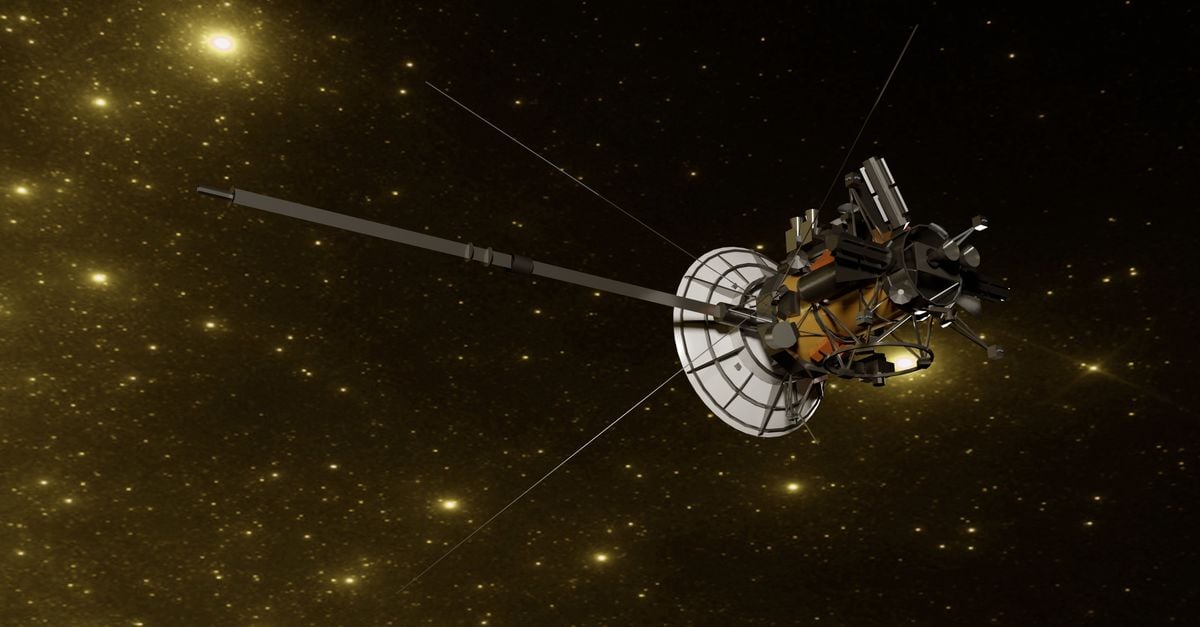
Six years and a good fraction of the solar system apart, NASA’s two Voyager spacecraft crossed the same invisible line. Voyager 1 passed out of the Sun’s bubble and into interstellar space in 2012, at 121.6 astronomical units from the Sun. Voyager 2 followed in 2018, at roughly 119. One astronomical unit is the distance from the Earth to the Sun, so the two crossings were within about two and a half of those units of each other, a near match across a gap of billions of kilometres.
That agreement is the puzzle. The two probes left through different parts of the boundary and at opposite ends of the Sun’s activity cycle, and by the leading models they should not have found the edge in nearly the same place.
What they crossed
The Sun blows a constant stream of charged particles, the solar wind, out in all directions. That wind inflates a huge bubble around the solar system called the heliosphere. Its outer skin, the heliopause, is where the pressure of the outgoing solar wind finally balances against the thin gas and magnetic field of interstellar space. Cross it, and you have left the Sun’s domain in a meaningful physical sense, even though you are still deep inside its gravity and far from the next star.
Neither Voyager can see this boundary. They feel it. As each spacecraft crossed, its instruments recorded a sharp drop in warm particles from the Sun, a jump in colder cosmic rays from the galaxy, and a change in the surrounding magnetic field. Voyager 2 had a working plasma sensor that Voyager 1 had lost years earlier, so its crossing on 5 November 2018 gave the cleaner measurement of the two, catching the density of the surrounding gas leap up as it passed into interstellar space.
Two crossings, two very different moments
The spacecraft did not leave the same way. Voyager 1 exited through the northern part of the heliosphere, Voyager 2 through the southern, so they sampled the boundary in different directions.
They also crossed at opposite phases of the Sun’s roughly eleven-year cycle of activity. Voyager 1 made its crossing in 2012, near a solar maximum, when the Sun is stormy and the solar wind pushes hard. Voyager 2 crossed in 2018, heading into a solar minimum, when the Sun is quiet and the wind eases off.
The strength of the solar wind is what holds the bubble open against the pressure outside. So a stronger wind should inflate the heliosphere and push the heliopause farther out, and a weaker wind should let it settle back in. Models of the heliosphere expect the boundary to breathe in and out over the solar cycle, moving by some astronomical units between a busy Sun and a calm one.
Why the match is a problem
If the boundary really breathes with the cycle, the two Voyagers should have caught it in different places. Voyager 1, crossing near solar maximum, might have met a heliopause pushed well out. Voyager 2, crossing near solar minimum, might have met one drawn well in. Instead they found it at almost the same distance.
Scientists at the Johns Hopkins University Applied Physics Laboratory, which built and runs one of the charged-particle instruments on both spacecraft, were the ones who flagged how odd this is. Stamatios Krimigis, who leads that instrument, called the coincidence “very strange,” precisely because one crossing happened at solar maximum and the other at solar minimum, and yet the distance barely changed. As the laboratory put it when the Voyager 2 results were published in 2019, the near-identical crossing distances did not fit the models, and the team could not yet explain why.
What it might mean, and what it does not
A couple of honest limits sit around this result. Two crossings, at two points on an enormous and lopsided surface, are a very small sample from which to judge the shape of the whole heliosphere. It is possible the timing worked out so that the boundary happened to be near the same distance on both occasions for reasons that have nothing to do with the solar cycle. It is also possible the crossings caught the boundary mid-motion.
The more interesting reading, and the one the surprise points toward, is that the position of the heliopause may simply be less tightly tied to the solar cycle than the models assumed. Something else, perhaps the pressure of the interstellar medium the Sun is currently moving through, or the way changes in the solar wind take time to travel out to the edge, may matter as much as the Sun’s immediate mood. That is a genuine open question, not a solved one, which is what the researchers said plainly.
Why there is no quick answer coming
The frustrating part is that the two Voyagers are the only craft to have made the crossing, and there will not be a third for a long time. Both are decades past their design lives and steadily shutting down instruments to conserve power, and no replacement is on its way yet, though mission concepts for a dedicated interstellar probe have been studied.
So for now the map of the Sun’s outer edge rests on two dots, set down six years apart, that landed almost on top of each other when the theory said they should not have. Whether that is a coincidence or a clue is one of the things the next mission to the boundary, whenever it flies, will be built to settle.