


Mike Fincke experienced a brief episode during his time on the International Space Station in which he had difficulty speaking. The incident, reported by CNN in May, sharpened a question that neuroscientists have been circling for a decade: what exactly happens inside an astronaut’s skull when the brain spends six months trying to build a coherent world without gravity to tell it which way is down?
The answer, drawn from fMRI and structural MRI scans of long-duration crew members, is stranger than simple fluid shift. The brain does not just swell upward in the skull. It quietly re-weights its own senses. The vestibular system — the tiny fluid-filled canals in the inner ear that in Earth gravity tell you which way you are tilted — goes largely silent in orbit, because otoliths that depend on gravity have nothing to weigh. And the visual cortex takes over, doing more of the work of orientation, spatial navigation, and even balance than it ever does on the ground.
By the time an astronaut has been aboard the ISS for half a year, they are, in a real neurological sense, seeing their way through the station rather than feeling it.
The organ that expected gravity
The human brain is a prediction machine calibrated by four billion years of a planet pulling down at 9.8 metres per second squared. Every reach for a coffee cup, every step down a staircase, every turn of the head is corrected in real time by signals from the inner ear’s semicircular canals and otolith organs — pebble-sized clusters of calcium carbonate crystals that shift under gravity and tell the brainstem which way is up.
In orbit, those crystals float. The signal they send becomes noise. This is the trigger for space motion sickness in the first days of a mission — the queasy, disoriented state that hits a majority of new arrivals as their brains try to reconcile eyes that say one thing with inner ears that say nothing coherent at all.
The nausea passes. The rewiring does not.

What the scans show
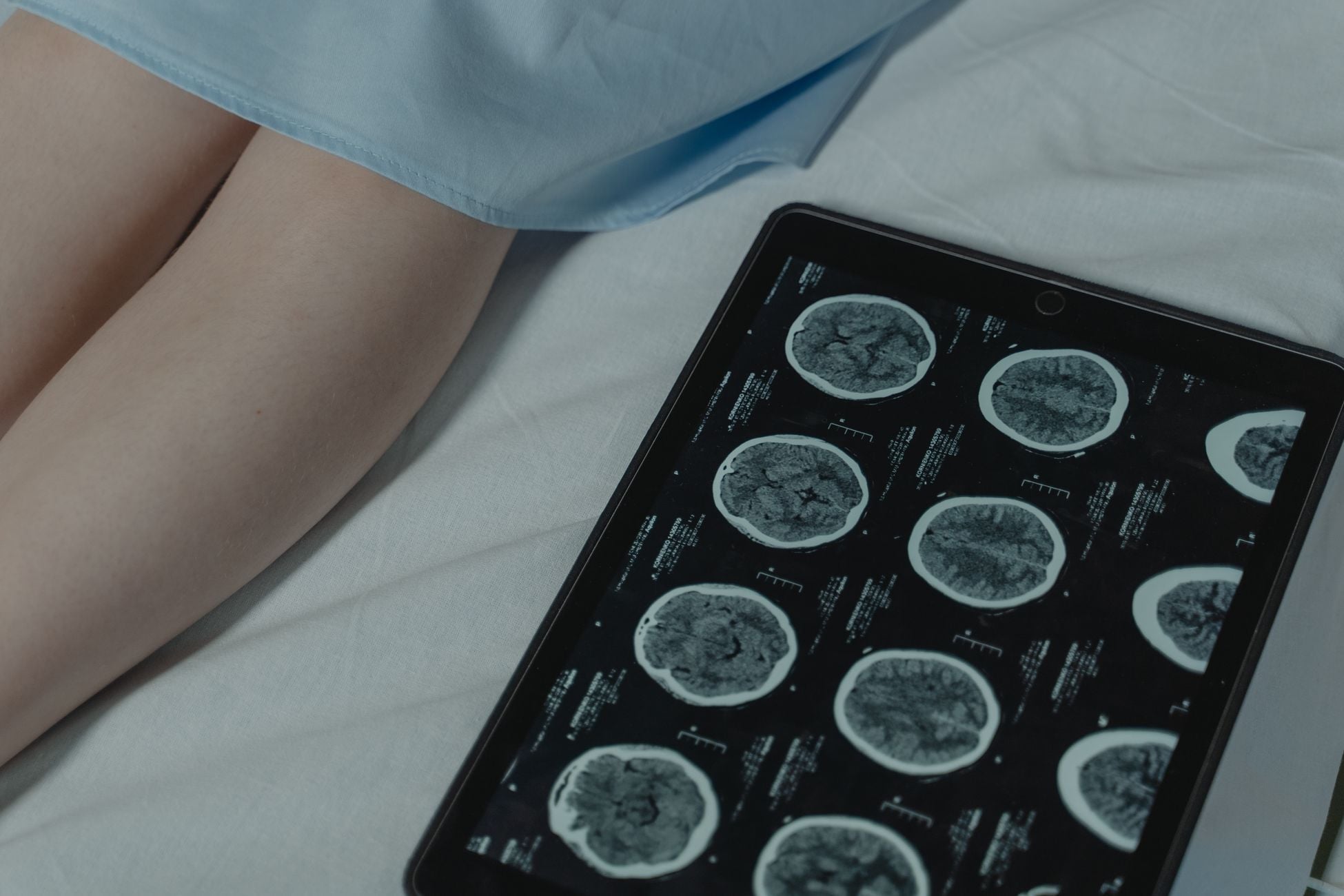
MRI scans of returning cosmonauts and astronauts, taken before flight, days after landing, and months later, show three consistent changes.
First, the brain physically shifts upward inside the skull. Without gravity pulling body fluids toward the feet, cerebrospinal fluid pools in the head. The ventricles — the fluid-filled cavities in the centre of the brain — expand significantly in some cases. The pituitary gland flattens. The optic nerves swell. Some astronauts return with measurable changes to the shape of their eyeballs, a condition NASA has named Spaceflight Associated Neuro-ocular Syndrome, or SANS.
Second, and more subtly, the functional connections between brain regions reorganise. Areas that handle vestibular input — the insula, the temporoparietal junction — show reduced activity. Areas that handle visual and motor integration light up more strongly. The brain has, in effect, downgraded a sense it can no longer trust.
Third, some of these changes persist. A 2026 JAMA case series found that ventricular enlargement and grey-matter shifts were still visible months after landing in astronauts who had flown a single long-duration mission. The same study offered a curious piece of good news: astronauts flying a second time did not, on average, show worse structural changes than astronauts flying their first. The brain adapts once, and holds.
A world built almost entirely from eyes
On the station, astronauts describe an odd cognitive tic: they cannot always tell whether they are upside down until they look. The walls, ceiling and floor of a module are visually distinguishable only by the equipment mounted on them. Crews adopt “local verticals” — treating whichever surface they happen to be facing as the floor — and the brain accepts this without complaint, so long as the eyes have something to lock onto.
Close the eyes, and the illusion collapses. Astronauts have reported that in total darkness they cannot say which way their own limbs are pointing. Proprioception, the sense of where your body is in space, degrades sharply when neither gravity nor vision is available to anchor it. The brain, deprived of two of its three main orientation inputs, essentially guesses.
This is why the visual system takes on such heavy lifting in orbit. It is the only sense left that reliably reports on the outside world. And the brain, with the plasticity that keeps stroke patients relearning to walk and blind readers turning visual cortex into a reading engine, obliges. Regions that on Earth split their attention between vestibular and visual input begin to lean overwhelmingly on the eyes.
The return, and the stumble
The problem is that Earth is still down there, waiting.
Footage of returning astronauts stepping out of Soyuz and Dragon capsules shows the cost of the adaptation. They are carried to reclining chairs. They cannot stand unaided. In one widely circulated video, NASA astronaut Christina Koch — fresh off Artemis 2’s lunar flyby — was visibly unsteady on her feet after splashdown, struggling to walk a straight line with her eyes closed. Long-duration ISS crew members typically need days to walk confidently and weeks to run. Some report a lingering sense that the room is tilting for months afterward.
The stumble is not muscle weakness alone, though bone and muscle loss are real. It is a brain that has spent six months treating vestibular signals as unreliable static, suddenly asked to trust them again while also integrating gravity’s pull on every joint and organ. The re-weighting has to happen in reverse. For most astronauts it does, cleanly. For some, subtle deficits in balance and dual-tasking linger.
Why Fincke’s silent minute matters
Fincke’s brief inability to speak, months into his ISS stay, is exactly the kind of anomaly flight surgeons watch for. Transient neurological events in orbit are rare but not unheard of, and they take on new weight as agencies plan missions that would put crews far beyond low Earth orbit — a nine-month transit to Mars, followed by surface operations, followed by another nine months home.
On the ISS, a medical emergency is hours from potential evacuation. On the way to Mars it would be months from any hospital. Understanding whether the brain’s fluid shifts, pressure changes, and sensory re-weighting create genuine risk of acute events — or merely leave astronauts feeling briefly strange over dinner — is one of the open questions of deep-space medicine. The crew aboard Tiangong is running its own set of neurological and cardiovascular experiments in parallel, part of an increasingly international push to map what long-duration flight actually does to the human head.
A brain that forgets which way is down
What is remarkable, across all this imaging, is how graceful the adaptation is. The brain does not fight microgravity. It concedes. It quietly demotes the sense that has become useless and promotes the ones still working. It rearranges its fluid, reshapes its ventricles, and rewires which cortex talks to which. It builds a world out of whatever inputs it has.
Astronauts describe the moment this becomes visible to them. After several weeks in orbit, the constant low-grade disorientation lifts. They stop bumping into things. They can find a floating pen without looking. They begin to move through the station the way a fish moves through a reef — three-dimensionally, without needing to know which way is up, because the question has stopped mattering.
The eyes have taken over. The inner ear has gone quiet. And the brain, having shifted inside the skull, has agreed to treat the walls, the floor, and the ceiling of the Destiny module as functionally the same surface.
Then the capsule comes home. Gravity reasserts itself. The otoliths shift, the fluid drains, the ventricles slowly contract. And for a few days, or a few weeks, a person who has spent half a year building a world entirely from what they could see has to remember how to trust what they can feel — a slow, private renegotiation between an organ and a planet it had briefly learned to live without. For anyone thinking about how humans might survive further out, that renegotiation is the crux of the whole problem.