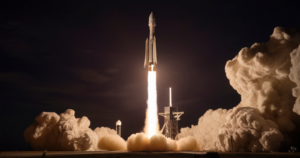
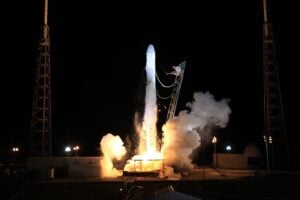
Space Travel NASA's Roman Space Telescope reaches Kennedy eight months ahead of schedule, with a Falcon Heavy launch now set for Aug. 30 By Space Daily Editorial Team · Jun 24, 2026
Space Travel A Russian cosmonaut named Sergei Krikalev has physically travelled further into the future than almost any other human being in history — across six spaceflights and 803 cumulative days at orbital velocity, Einstein's theory of special relativity has made him approximately 0.02 seconds younger than other people his age By Space Daily Editorial Team · Jun 23, 2026
Space Travel In 1970, the Soviet Venera 7 probe survived 23 minutes on the surface of Venus before the 475-degree heat and 90-atmosphere pressure crushed it, but in those minutes it became the first human-made object to transmit data from another planet, and engineers only realised they had the signal after rerunning the tape weeks later By Space Daily Editorial Team · Jun 23, 2026
Space Travel A spacecraft no larger than a small car, launched the year Star Wars came out, is still moving outward at 38,000 miles per hour far beyond the orbit of Pluto — and the radio signals it sends home, traveling at the speed of light, now take more than 23 hours to reach the engineers who built it, most of whom are no longer alive By Space Daily Editorial Team · Jun 23, 2026
Human Behaviour When Soviet cosmonaut Sergei Krikalev launched into orbit on May 18, 1991, he was a citizen of the Soviet Union — and when he returned to Earth 311 days later in March 1992, the country that had sent him no longer existed, his home city of Leningrad had been renamed St. Petersburg, and his spacesuit still bore the letters "USSR" and the red Soviet flag he had worn while the world below him quietly stopped existing By Space Daily Editorial Team · Jun 23, 2026
Space Travel Human beings have now lived continuously aboard the International Space Station since November 2, 2000 — more than 25 consecutive years without a single day when no human was orbiting above the planet — in the longest sustained off-world human presence in the history of the species By Space Daily Editorial Team · Jun 22, 2026
Space Travel In June 2025, a 65-year-old former NASA astronaut named Peggy Whitson became the oldest woman ever to orbit Earth — taking off aboard a SpaceX Crew Dragon as commander of the privately funded Axiom Mission 4 — and during her 18-day stay on the International Space Station, she pushed her career total past 695 cumulative days in space, the most of any American astronaut and the most of any woman who has ever lived. By Space Daily Editorial Team · Jun 22, 2026
Space Travel The reason no human being has walked on the Moon in more than half a century is not that humanity lost the capability to get there — it is that humanity lost the reason, in the moment the Cold War goal of beating the Soviet Union to the lunar surface had finally been accomplished and the political momentum behind Apollo evaporated By Space Daily Editorial Team · Jun 21, 2026
Space Travel Approximately 120 private civilians have now flown to space aboard commercial rockets — roughly one-sixth of all the human beings who have ever left Earth — and the rate at which citizens are reaching space is now accelerating faster than the rate at which national space programs are sending professional astronauts By Space Daily Editorial Team · Jun 20, 2026
Space Travel An eight-day mission to the International Space Station ended 286 days later in March 2025, when NASA astronauts Suni Williams and Butch Wilmore finally returned aboard a SpaceX capsule — abandoning the Boeing Starliner they had arrived in after it developed thruster problems too serious to fly them home By Space Daily Editorial Team · Jun 20, 2026
Space Travel The longest continuous spaceflight in history — 437 days aboard the Russian Mir space station, completed by cosmonaut Valeri Polyakov in 1995 — was specifically conducted to prove that a human being could survive a round-trip mission to Mars, in a piece of human endurance that has been waiting unused on a shelf for three decades By Space Daily Editorial Team · Jun 20, 2026
Space Travel NASA is on track to put humans back on the lunar surface for the first time in roughly 56 years by 2028— followed by the establishment of a sustained human presence near the Moon's south pole in the 2030s — in a civilizational shift that would mark the first time in human history that our species has lived continuously on another world, rather than briefly visiting and returning home By Space Daily Editorial Team · Jun 17, 2026
Space Scopes When the Soviet Venera 13 probe touched down on Venus in March 1982, it survived for 127 minutes in a 465-degree atmosphere that crushed it with the pressure of nearly a kilometre of ocean water, and in that time it scraped a soil sample, analysed it, and transmitted the first colour photographs ever taken from the surface of another planet. By Space Daily Editorial Team · Jun 16, 2026
Space Travel Breathable oxygen has now been produced on the surface of Mars — generated between 2021 and 2023 by a NASA experiment about the size of a toaster, riding inside the Perseverance rover — in the first time humans have ever made air on another planet, opening the door to bringing astronauts safely home one day By Space Daily Editorial Team · Jun 12, 2026
Space Travel It is impossible to burp in space, because in microgravity the human stomach cannot separate gas from the liquid and partially digested food it sits inside, and any attempt to burp expels a mixture of all three directly into the astronaut's mouth. By Space Daily Editorial Team · Jun 4, 2026
Space Travel Fossils found in Scotland just pushed back the origin of land-walking animals by 14 million years and placed them in a stretch of the fossil record where nothing was supposed to exist By Space Daily Editorial Team · Jun 4, 2026