

Spaceflight history often compresses a mission into two facts: it launched and the crew returned. That leaves little room for the seconds when a spacecraft was entering the atmosphere backwards, sitting on a burning rocket or relying on a piece of metal that had never been intended as a heat shield.
The title needs one qualification. Not all seven events were concealed in the same way. Soviet authorities suppressed or minimised several of them. NASA disclosed others, but the full engineering danger became clear only after landing or years later. What connects them is the distance between the successful public summary and the margin that actually remained.
Soviet triumphs with missing chapters
1. Voskhod 2, 1965
Alexei Leonov’s first spacewalk nearly ended outside the spacecraft. His suit expanded in vacuum until he could not fit back through the airlock. He reduced its pressure, accepting the risk of decompression sickness, and entered headfirst despite procedures calling for a feet-first return. The flight’s primary retrorocket then misfired, the service module did not separate cleanly and the capsule came down far from its recovery zone. Leonov and Pavel Belyayev spent a freezing night in a forest before rescuers reached them. The Soviet account celebrated the spacewalk; the full chain of failures emerged gradually.
2. Soyuz 5, 1969
Boris Volynov began re-entry with Soyuz’s service module still attached. The combined craft settled into the stable attitude it was least equipped to survive, with the lightly protected hatch facing the oncoming plasma instead of the heat shield. Seals smoked and the cabin filled with fumes before structural connections finally burned through. The descent module righted itself, then suffered a hard landing that injured Volynov’s teeth. TASS reported a successful flight and landing in the designated area. A NASA history of the Soviet lunar programme records that the life-threatening separation failure remained secret for about a quarter-century.
3. Soyuz 18a, 1975
Four minutes and 48 seconds after launch, only half the devices separating two rocket stages fired. The upper stage ignited while still partly attached, forcing an automatic abort after the escape tower had already been discarded. Vasily Lazarev and Oleg Makarov endured a ballistic descent peaking at 21.3 g. Their capsule landed on a snowy mountain slope and began sliding towards a precipice before its parachute lines caught on vegetation. The Soviet Union informed the United States because the Apollo-Soyuz flight was approaching, but the wider public account remained spare. NASA’s later account sets out the sequence.
4. Soyuz T-10-1, 1983
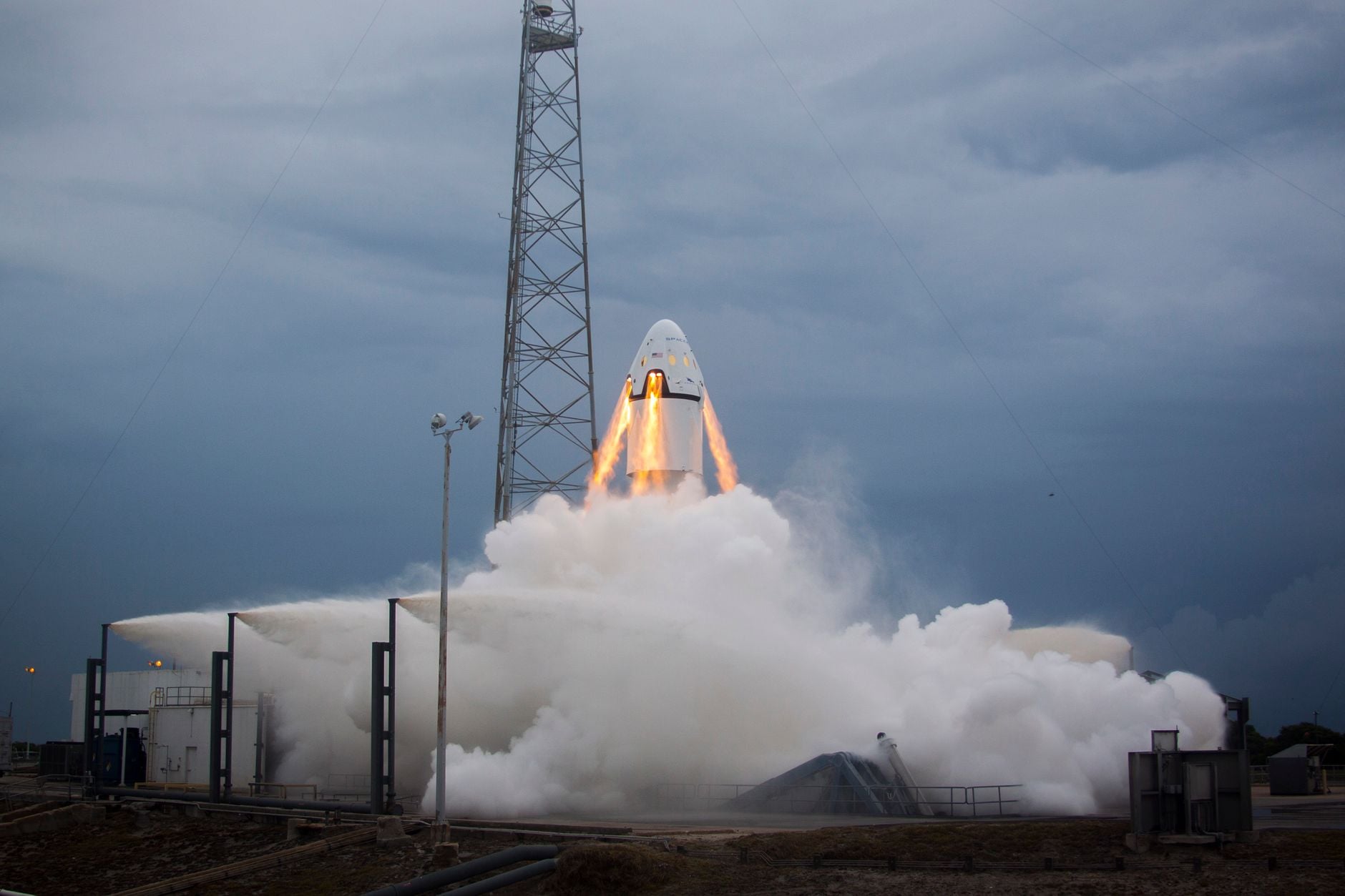
Ninety seconds before launch, fuel began spilling at the base of the Soyuz rocket and caught fire. Flames damaged the automatic escape wiring, and attempts from inside the capsule did not trigger the system. Ground controllers sent the abort command as the booster leaned and burned. The escape tower pulled Vladimir Titov and Gennady Strekalov clear shortly before the rocket exploded, subjecting them to severe acceleration but saving both lives. A NASA review of launch-abort systems describes it as the only crewed use of such a tower on the pad.
The Shuttle damage that looked manageable
5. STS-1, 1981
Columbia’s first orbital flight was also the first crewed flight of the entire Shuttle system. During launch, an unexpectedly strong overpressure wave from solid-booster ignition struck the orbiter. The crew could see missing thermal tiles once in orbit, although analysis found the hottest underside intact. Post-flight inspection counted 16 lost tiles and 148 damaged ones. NASA’s mission history records the overpressure damage and the subsequent modification of the pad’s water sound-suppression system.
6. STS-27, 1988
Atlantis was struck by ablative material from a solid booster about 85 seconds after launch. The crew’s own camera showed damage, but the mission was classified and encryption degraded the video sent to the ground. Engineers therefore saw less than the astronauts did. After landing, Atlantis had 707 damage marks, 298 larger than one inch, and one tile was completely gone. The exposed location happened to sit over a thick aluminium plate covering an antenna. The Columbia Accident Investigation Board later wrote that more severe heating, perhaps a burn-through, might have occurred without it.
Two ascent failures on STS-93
7. STS-93, 1999
Five seconds after Columbia lifted off with the Chandra X-ray Observatory, an electrical short disabled one controller on the centre main engine and the alternate controller on the right engine. Redundancy kept all three engines running. At the same time, a loose pin damaged cooling tubes in the right engine nozzle, producing a hydrogen leak that instrumentation did not identify during ascent. The resulting oxygen depletion caused an early engine shutdown and left Columbia about 16 feet per second short of its planned velocity. A NASA case study reconstructs the electrical and engine failures. Either event alone was manageable. Their coincidence is what narrowed the margin.
What the successful summaries leave out
None of these missions proves that survival was pure luck. Escape towers, redundant controllers, heat shielding and conservative structures existed precisely because failures were expected. In several cases, those systems worked.
But success can erase the sequence that produced it. A capsule lands, an orbiter rolls to a stop, and the account becomes cleaner than the engineering. The useful history is found in the parts that resisted that clean ending.