

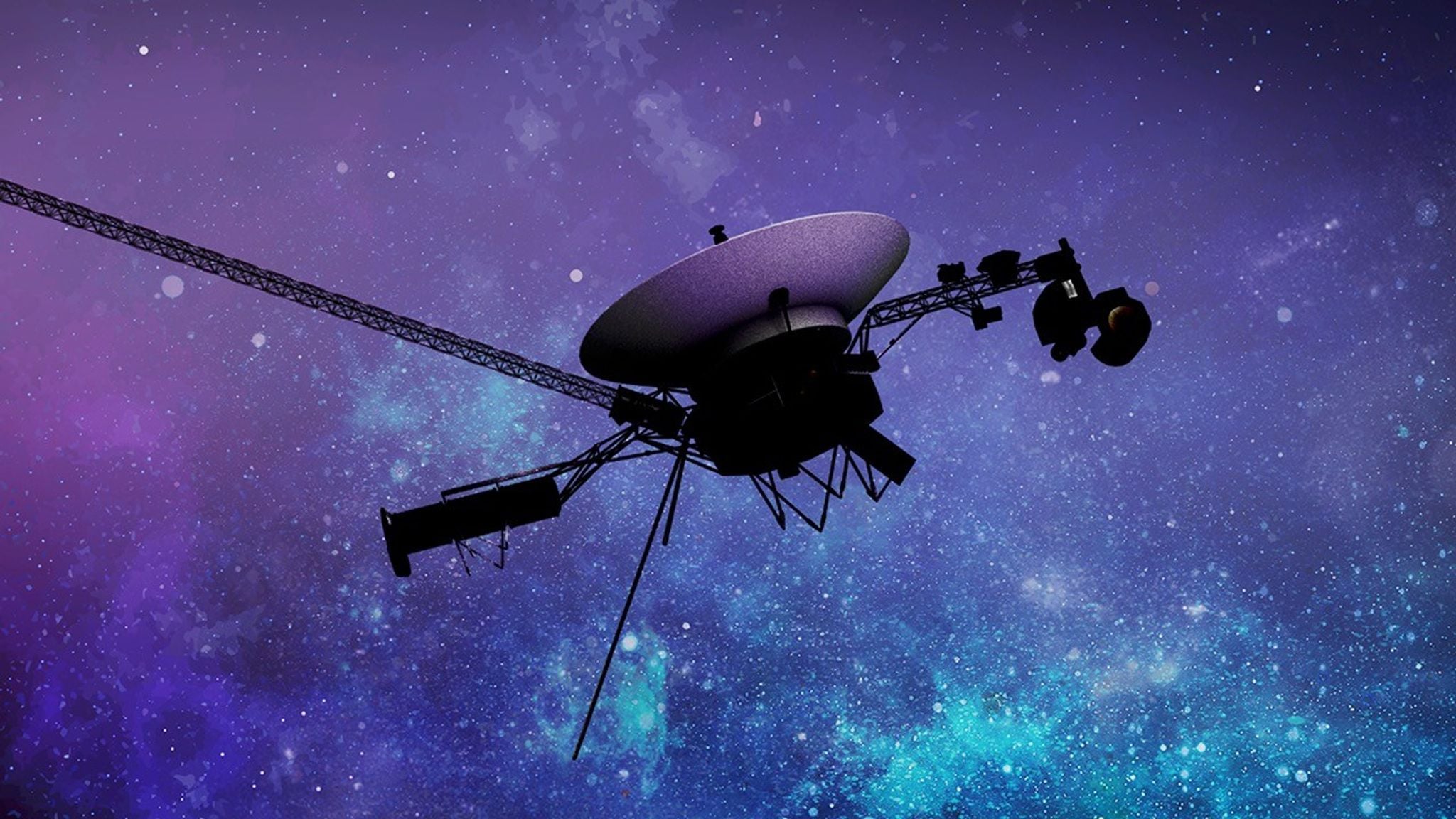
Voyager 1 is controlled by computers whose performance belongs to another technological era. A frequently repeated comparison puts their speed at about 8,000 instructions per second, against more than 14 billion for a smartphone.
The contrast is directionally right but technically untidy. Voyager does not have one general-purpose processor, and its three specialised computer systems do not all run at the same rate. The 14-billion figure also came from a comparison published in 2013, when phones were far slower than current flagship models.
The more remarkable fact requires no exaggeration. Hardware designed in the early 1970s is still accepting commands, maintaining a spacecraft and returning measurements from interstellar space almost 49 years after launch.
Voyager carries three kinds of computer
Each Voyager spacecraft was built with three computer subsystems, each duplicated for redundancy. The Computer Command System, or CCS, interprets instructions from Earth, runs stored sequences and responds to faults. The Attitude and Articulation Control System keeps the high-gain antenna pointed toward Earth and controls spacecraft orientation. The Flight Data System collects, formats and encodes scientific and engineering telemetry.
NASA’s Voyager technical FAQ lists two units of each type. The CCS and attitude computers use 18-bit words and 4,096-word memories, while the flight data computers use 16-bit words and 8,198-word memories. Across all six units, the total is about 68 kilobytes when expressed in familiar eight-bit bytes.
That arrangement is better understood as a group of purpose-built controllers than as a tiny version of a laptop. Each system has a narrow job, direct access to the hardware it manages and software written in assembly language for that exact architecture.
The 8,000 figure is a shorthand, not the whole spacecraft
The widely quoted rate of roughly 8,000 instructions per second describes the scale of Voyager’s slower command and control processors. It should not be presented as a single benchmark for every computer aboard the probe.
The Flight Data System was faster because it had to process instrument output in real time. NASA’s historical study Computers in Spaceflight gives its execution rate at about 80,000 instructions per second by launch, while handling science data rates as high as 115,000 bits per second during the planetary encounters.
Neither number is large by modern standards. The distinction matters because it reveals thoughtful division of labour rather than a single underpowered machine somehow doing everything.
The smartphone comparison needs a date stamp
The familiar 14-billion number came from a comparison published in 2013, when phones were much slower than they are now. A later Aerospace America review of resilient space processors likewise placed Voyager’s computers at about 8,000 instructions per second. Calling 14 billion a fixed measure of a modern smartphone understates present performance.
Instructions per second are also not a clean cross-platform unit. Voyager’s processors, a phone’s central processor and its graphics or neural accelerators use different instruction sets, word sizes and levels of parallelism. One complex phone instruction may do work requiring several operations on an older machine. Clock speed alone does not resolve the difference.
Even with those caveats, the order-of-magnitude contrast is enormous. A phone has vastly more memory and computational capacity. That does not make it more suitable for a 50-year unserviced mission through radiation, vacuum and extreme temperature changes.
Voyager succeeds by doing a short list of jobs
Voyager does not render video, run applications or respond to an unpredictable human user. Its onboard computers execute stored sequences, watch sensors, manage faults, point the antenna and package data. Navigation analysis and mission planning are performed by much larger systems on Earth.
The flight software is compact because the mission’s needs are compact. Interrupt-driven operation lets a processor wait until a timed event, command or fault demands attention. Redundant units and autonomous protection routines allow the probe to place itself in a safer state when communication with Earth is nearly a day away.
Reprogrammability has been equally important. Engineers have changed sequences, retired obsolete planetary-flyby routines and worked around damaged memory from billions of kilometres away. Low speed did not prevent adaptation because the architecture was designed to accept new instructions throughout the mission.
Longevity, not speed, is Voyager’s decisive benchmark
Voyager 1 launched on 5 September 1977, flew past Jupiter and Saturn, and crossed the heliopause in August 2012. NASA describes it as the most distant object created by humans. It remains the first spacecraft to enter interstellar space and is now more than 25 billion kilometres from Earth.
The limiting resource is electrical power, not processor throughput. Its radioisotope generators lose output each year as their plutonium fuel decays. In April 2026, engineers switched off another science instrument to conserve energy. NASA’s mission update says two science instruments remain active, measuring plasma waves and magnetic fields where no other operating spacecraft has travelled.
A smartphone would overwhelm Voyager in a benchmark and fail almost every requirement that has kept the probe alive. Voyager’s computers were not built to be fast by the standards of 2026. They were built to be sufficient, redundant, repairable through software and extraordinarily dependable. Nearly half a century later, that engineering choice is still executing.