Space, science, and the human mind. Since 1995.
Deep Field
A Space Daily column

Deep Field

Astronomy and cosmology

Deep Field covers astronomy and cosmology. Telescopes and what they find, planets near and far, and the strange physics of the deep universe, traced back to the journal papers and observatory data behind the headlines.

Science

Star formation across the cosmos has fallen by roughly 59 per cent in 4.5 billion years, yet its reservoir of neutral atomic hydrogen declined by only about 11 to 26 per cent—a mismatch that rules out rapid loss of atomic gas as the primary cause and shifts the mystery to how galaxies convert that gas into star-forming molecular clouds.

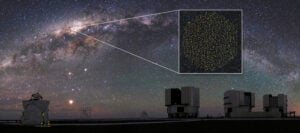
FAST and DESI data show that the universe retained most of its neutral atomic hydrogen while its star-formation rate fell by more than half, shifting attention to gas phase conversion and regulation.

Science

The AI boom is pushing data-centre emissions higher while simultaneously accelerating America’s solar buildout: data centres could generate nearly half of US electricity-demand growth through 2030, prompting tech companies and utilities to commission vast new renewable projects—even as natural gas supplies much of the power that solar cannot provide around the clock.

AI data centres can finance new solar farms while also making gas plants run more often. The outcome depends on timing, location, storage, grid queues and how clean energy is counted.

Moon Daily

Classic Moon-formation simulations treated the colliding proto-Earth and Theia as strengthless fluids, typically producing a debris disk that assembled later—but when Southwest Research Institute researchers added temperature-dependent rock strength, one canonical simulation produced an intact Moon in roughly five hours.

Adding temperature-dependent rock strength to a canonical giant-impact calculation changed how Theia deformed—and in one run left a coherent Moon-sized satellite within hours.

Venusian Heat

For nearly 50 years, Venus’s clouds have been understood as droplets of concentrated sulfuric acid—but a 2025 reinterpretation of data inadvertently collected by NASA’s Pioneer Venus Large Probe in 1978 suggests their aerosols may instead be about 60 per cent bound water by mass, locked largely inside hydrated iron and magnesium salts.

An accidental aerosol capture during Pioneer Venus's descent may have recorded hydrated salts and far more bound water than the standard sulphuric-acid cloud model allows.

Marsdaily

Scientists often model Mars’s interior as a set of uniform spherical layers, but 16 years of tracking data from three NASA orbiters reveals something radically uneven: the mantle beneath the southern highlands may be up to 720 degrees Fahrenheit hotter than beneath the northern lowlands—and researchers still don’t know whether persistent mantle upwelling, an insulating crust or the after-effects of an ancient giant impact created it.

Seasonal changes in Mars's gravity imply that the mantle beneath its ancient southern highlands is hundreds of degrees warmer than the north, but three origin stories remain.

Science

In 1925, 24-year-old Radcliffe graduate student Cecilia Payne calculated that stars consist overwhelmingly of hydrogen and helium. Princeton astronomer Henry Norris Russell called the result “clearly impossible,” prompting her to declare in her thesis that her own extraordinary finding was “almost certainly not real.” Four years later, Russell confirmed that she had been right.

Cecilia Payne's 1925 thesis found that hydrogen and helium dominate stellar atmospheres, then retreated from the result after Henry Norris Russell called it impossible.

Exo Worlds

Rocky planets were expected to become common only after generations of stars enriched the universe over billions of years. But simulations show that a powerful early supernova could seed a disk with several Earth masses of planetesimals just 100 million years after the Big Bang—less than one percent of the universe’s current age.

A simulated Population III supernova remnant produced enough concentrated solids for rocky-world precursors at cosmic dawn, but the calculation stopped well before a finished planet.

Exo Worlds

Astronomers can identify water vapour, carbon dioxide and even oxygen across light-years—but nitrogen, despite filling 78 per cent of Earth’s atmosphere, is exceptionally difficult to see because N₂ lacks the strong infrared fingerprint of most gases. Only the faint signal created when nitrogen molecules collide gives it away.

N₂ dominates Earth’s air yet lacks the strong infrared bands used to identify many gases. Its best remote clue is a pressure-sensitive absorption near 4.15 micrometres, created briefly when nitrogen molecules collide.

Marsdaily

Across Olympus Mons and three other giant Martian volcanoes, seasonal morning frost only about 0.01 millimetres thick disappears within hours of sunrise—yet collectively, approximately 150,000 tonnes of water, enough to fill 60 Olympic swimming pools, may cycle between the surface and atmosphere each cold-season day.

Water frost only about 10 micrometres thick appears for a few cold-season morning hours across four giant Martian volcanoes. Its vast coverage may exchange approximately 150,000 tonnes of water with the atmosphere each day.

Moon Daily

Moon dust may preserve a far longer record of cosmic history than Earth’s deep-sea deposits. A model validated against Apollo samples suggests metre-deep lunar soil could retain isotope signatures from supernovae and other stellar catastrophes dating back 80–100 million years, while the deep-ocean records currently used reach only about 10 million years.

A model tested against Apollo cores predicts that long-lived radioisotopes could preserve a readable lunar record reaching 80 to 100 million years, if future missions retrieve deep samples.