

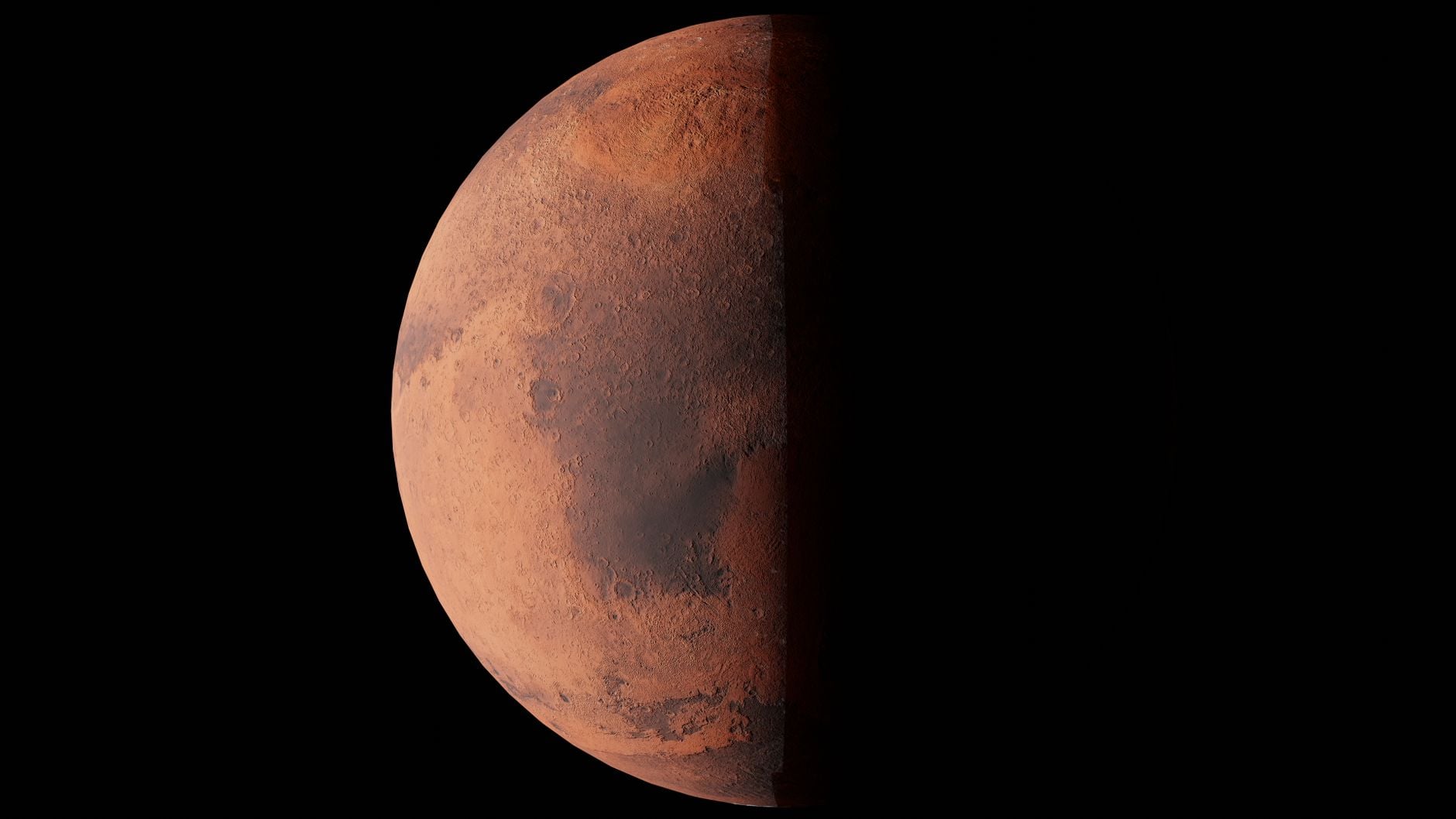
Mars has always presented two different faces. The northern hemisphere is dominated by low, comparatively smooth plains. The south is higher, older, more heavily cratered and underlain by thicker crust. A new analysis now suggests that this division reaches hundreds of kilometres below the landscape.
In a Nature study published on 26 August, Alexander Berne and colleagues report that the mantle beneath the southern highlands may be 200 to 400 degrees Celsius warmer than the mantle beneath the northern lowlands. Expressed as a temperature difference, that is 360 to 720 degrees Fahrenheit.
The result is an inference, not a direct temperature reading. No spacecraft carried a thermometer into the Martian mantle. Instead, the researchers used tiny changes in the motion of three orbiters to watch how Mars’s gravity responds when the Sun pulls on the planet through its seasons.
That distinction does not make the finding weak. It explains what kind of finding it is: a carefully constrained model of a hidden interior, assembled from a signal measured over 16 years.
The spacecraft became test masses
The observations came from Mars Global Surveyor, Mars Odyssey and Mars Reconnaissance Orbiter. Earth stations in NASA’s Deep Space Network transmitted and received X-band radio signals as the spacecraft moved around Mars.
A change in an orbiter’s speed shifts the frequency of its radio signal through the Doppler effect. Once navigators account for the known forces on the spacecraft, the residual changes reveal variations in the planet’s gravitational pull. In effect, the orbiters became test masses repeatedly falling through an uneven gravity field.
The NASA Planetary Geodesy Data Archive describes the underlying gravity solution as a 16-year record constructed from all three missions. It includes information about Martian tides, crustal thickness and the seasonal carbon-dioxide cycle.
That last correction matters. Each winter, carbon dioxide freezes onto a Martian polar cap, then returns to the atmosphere as the season changes. Moving that much mass around the planet alters gravity too. The team used a Mars atmospheric circulation model to separate this seasonal loading from the deeper tidal response it wanted to measure.
Why a seasonal tide can reveal a mantle
Mars follows a noticeably elliptical orbit and takes 687 Earth days to circle the Sun. The solar gravitational force therefore changes over a Martian year. The Sun raises a small tide in the solid planet, just as the Moon and Sun deform Earth, although nothing here resembles an ocean wave visible at the surface.
If Mars were built from perfectly uniform spherical shells, the shape of that response would be comparatively simple. Solar forcing is concentrated mainly in what geophysicists call degree two: the broad mathematical pattern of a body stretched along one direction and compressed along another.
The researchers detected seasonal changes in degree-three gravity coefficients as well. Those are finer, differently shaped components of the gravity field. One coefficient departed by about 300 percent from the value predicted for a spherically symmetric Mars after atmospheric loading was included.
The team’s method, tidal tomography, looks for the three-dimensional interior structure that could couple a degree-two solar tide into degree-three gravity. It is analogous in spirit to medical tomography, but the data are gravitational responses rather than X-rays and the resulting picture is much broader and less detailed.
The 720°F figure is a contrast, not a reading
The inversion points to a greater than 20 percent lateral difference in the mantle’s effective shear modulus, a measure related to how rigidly material responds. At the long period of the Martian year, laboratory models of olivine suggest that this rigidity is particularly sensitive to temperature.
By comparing the gravity-derived rigidity pattern with mineral physics, the researchers inferred that the southern-highlands mantle could be 200 to 400°C warmer than its northern counterpart. For a temperature difference, 400 Celsius degrees convert to 720 Fahrenheit degrees; the usual addition of 32 applies to absolute temperatures, not to a difference between two temperatures.
The fit also allows the southern mantle to contain as much as 5 percent more iron. Temperature and composition can both alter density and rigidity, which is why the paper evaluates them together. The overlapping ranges that satisfy both the gravity-inferred rigidity variation and Mars’s offset between its centre of mass and centre of figure favour heat as the dominant explanation, with composition contributing.
This is not a claim that the whole southern mantle has one known temperature or that an ocean of magma fills half the planet. The estimate averages over broad structure. The authors note that a warm region could encourage localized partial melting below the lithosphere, but seismic attenuation in the south is not as strong as expected for widely partially molten olivine.
Mars’s surface division may run deep
The result matters because it lines up with the Martian hemispheric dichotomy, one of the largest and oldest structures on any rocky planet. The southern highlands are heavily cratered, generally five to six kilometres higher and, under a common density assumption, underlain by crust roughly 30 kilometres thicker than the northern lowlands.
The north, by contrast, is lower, smoother and younger at the surface. Mars Global Surveyor also found that strong remanent magnetic fields are concentrated in ancient southern crust. The landscape, crustal thickness and magnetic record already divided the planet. Tidal tomography adds a possible mantle division beneath them.
Alignment does not establish cause. The crust could be thick because hot mantle built it, the mantle could have remained hot because thick crust insulated it, or both could be consequences of an earlier event. Planetary geology often leaves that direction of causation as the hardest part of the problem.
A warmer southern mantle could produce some melt. The paper suggests that buoyant melt might rise and stall within the crust rather than erupt, adding material and perhaps helping to explain crustal thickness and magnetisation. That is a mechanism to test, not evidence of active volcanoes across the southern highlands today.
Three very different histories still fit
The first candidate is a planet-scale pattern of mantle convection. A broad, degree-one upwelling could carry warmer material beneath one hemisphere, and some version of that asymmetry might have persisted for billions of years. A stagnant-lid planet without Earth’s mobile plates can preserve old internal patterns unusually well.
The second candidate reverses the emphasis. Thick southern crust could act as a thermal blanket, slowing the escape of heat from the mantle below. If that crust also contains more radioactive heat-producing elements, long-term internal heating could strengthen the difference.
The third begins with violence. A giant early impact may have excavated the northern lowlands and reorganised the interior. SpaceDaily reported in 2008 on simulations showing that an oblique collision by an object roughly 1,600 to 2,700 kilometres across could produce the northern basin without melting the entire planet.
That older work did not establish that a giant impact definitely made the dichotomy, and the new work does not settle it. Impact, convection and insulation can leave overlapping consequences. The gravity signal supplies an important new constraint, but it does not carry a label saying which ancient process created it.
Seismic waves provide an independent clue
The thermal pattern is consistent with evidence from NASA’s InSight lander. Although InSight’s seismometer sat in the northern lowlands, it detected marsquakes whose waves had travelled from different regions of the planet.
A 2025 analysis of low-frequency marsquakes identified a cluster in Terra Cimmeria in the southern highlands. Its estimated seismic quality factor, or Q, was about 481 to 543, compared with roughly 800 to 2,000 for Cerberus Fossae in the north. Lower Q means the waves lost energy more readily. Warmer material is one plausible reason.
The match is useful because gravity and seismic waves respond to the interior in different ways. It is not perfect confirmation. Mars had only one operating seismic station, quake locations are difficult to reconstruct, and attenuation can depend on material, cracks and melt as well as temperature.
SpaceDaily’s recent examination of possible water in Mars’s mid-crust showed the same underlying challenge. Seismic velocities can be fitted by a water-saturated fractured rock model, yet a later analysis found that the answer changes sharply with assumptions about mineral composition and pore geometry. Inverse problems reveal which interiors are compatible with measurements; they do not always identify one unique interior.
A first three-dimensional outline, not the final map
Scientists use spherical interior models because they are a sensible first approximation when data are scarce. A model with a crust, mantle and core arranged in radial layers can answer questions about average thicknesses, densities and elastic properties. It was never a guarantee that every latitude and longitude must be identical.
The new work shows that the approximation may now be too simple for some questions. A north-south change in mantle rigidity can affect the gravity response strongly enough to emerge from decades-old tracking once the data are combined and analysed for the right seasonal harmonics.
There are clear next tests. More seismic stations would compare wave paths without forcing a single lander to carry the whole inversion. Electromagnetic sounding could help distinguish isolated magma pockets from a more continuous conductive layer. Continued precision tracking could strengthen or challenge the small time-variable gravity coefficients on which tidal tomography depends.
Future studies will also need to ask how sensitive the result is to the atmospheric correction, reference mineral model and chosen depth structure. The Nature team deliberately inflated the formal uncertainties on the gravity coefficients by a factor of 15 to account for modelling errors, particularly unmodelled non-gravitational forces on the orbiters. That conservative step is a reason to take the signal seriously, not a reason to stop testing it.
For now, the strongest conclusion is also the simplest. Mars does not merely have a northern face and a southern face. Its deep interior appears to be divided too, with the ancient highlands sitting over a markedly warmer mantle. Whether that heat rose from below, was trapped from above or survives from the event that reshaped half a planet remains open.