
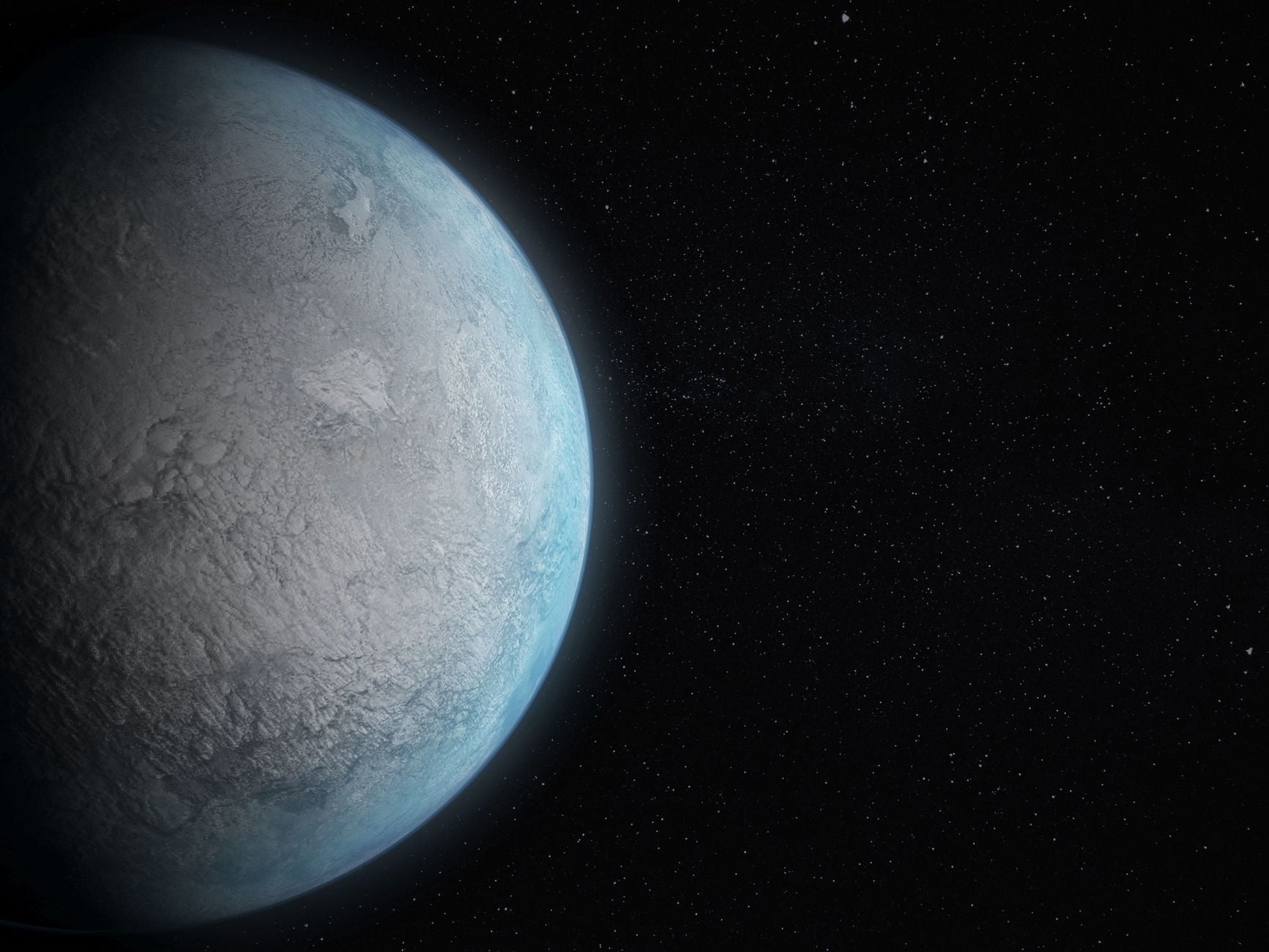
Imagine looking up from a rocky world and seeing another planet hang in the sky, not as a bright point but as a visible disk. It would be wider than two full Moons placed side by side, large enough for its changing phase to be obvious and close enough for its gravity to pull at the ground beneath you.
That is the extraordinary geometry of Kepler-36. The system contains two planets in neighbouring orbital lanes around an old, slightly evolved star in Cygnus. The inner world, Kepler-36b, is a hot, dense super-Earth. The outer one, Kepler-36c, is nearly Neptune-sized but unusually light for its volume. About once every three months, the faster inner planet catches the outer planet and the distance between them contracts to roughly 1.9 million kilometres.
NASA’s discovery-era material described the closest approaches as recurring every 97 days. From Kepler-36b, the agency said, Kepler-36c would then appear about 2.5 times the apparent diameter of our full Moon. The same close passage would raise a substantial tide in the rocky planet.
The view is physically grounded but still imagined. No telescope has photographed either planet as a resolved globe, much less watched Kepler-36c rise above the surface of Kepler-36b. NASA’s famous scene is an artist’s interpretation built from measured orbital periods, planetary sizes and a gravitational model. Keeping that boundary clear makes the real discovery more interesting, not less.
Two planetary years separated by only 2.4 days
NASA’s current catalogue gives Kepler-36b an orbital period of about 13.9 Earth days and an average orbital radius of 0.114 astronomical units. Kepler-36c needs about 16.2 days and follows a path at roughly 0.127 astronomical units. Their orbital radii differ by only about 10 percent.
For comparison, Venus travels about 72 percent farther from the Sun than Mercury does. The Kepler-36 planets are not separated by anything like that comfortable gap. At closest approach they pass within about 1.2 million miles, or 1.9 million kilometres, according to NASA’s description of the planetary pair. That is only around five times the average Earth-Moon distance.
The planets sit close to a 7:6 orbital commensurability. Loosely put, Kepler-36b completes nearly seven circuits in the time Kepler-36c completes six. They are close to that mean-motion resonance, but not locked neatly inside its exact mathematical ratio. A formation study published in the Monthly Notices of the Royal Astronomical Society described them as lying just outside it and explored how migration through a turbulent planet-forming disk might have pushed them into such an extreme arrangement.
Compact systems are no longer surprising in themselves. SpaceDaily’s earlier look at TRAPPIST-1 described seven rocky planets packed well inside the orbit Mercury follows around our Sun. Kepler-36 is striking for a different reason: two planets with sharply different structures occupy almost adjacent lanes.
Neighbours with densities more than eightfold apart
The original 2012 discovery analysis was titled “Kepler-36: a pair of planets with neighboring orbits and dissimilar densities.” That plain description remains the heart of the system.
NASA now lists Kepler-36b at about 1.5 Earth radii and 3.83 Earth masses. Its density indicates a body dominated by rock and metal. Kepler-36c is about 3.7 Earth radii across, close to Neptune’s size, while carrying only about 7.1 Earth masses. Neptune itself is more than 17 times Earth’s mass.
In the discovery-era solution, Kepler-36b’s mean density was about 7.5 grams per cubic centimetre while Kepler-36c’s was about 0.9. The precise values have shifted as the system has been reanalysed, but the contrast survives: the inner planet is more than eight times as dense as its outer neighbour.
That difference cannot be explained by making one planet slightly larger than the other. Kepler-36b is consistent with a compressed rocky interior containing iron and silicates. Kepler-36c must contain a substantial volume of low-density material, most plausibly a hydrogen-helium-rich envelope above a denser core.
Mass alone would not have disclosed that history. Radius turns mass into bulk density, and density constrains the mixtures a planet can plausibly contain. This is the same logic behind SpaceDaily’s coverage of the exceptionally dense GJ 523b, although Kepler-36 presents the comparison inside a single system. The two worlds formed from the same broad reservoir around the same star, yet one retained a large gaseous envelope and the other did not.
Why a Neptune-sized planet can fill the sky
Apparent size depends on two quantities: an object’s physical diameter and its distance from the observer. Kepler-36c is not enormous by giant-planet standards. At roughly 3.7 Earth radii, its diameter is around 47,000 kilometres. But a separation of 1.9 million kilometres is remarkably small for two full-sized planets orbiting the same star.
Put those rounded figures into the angular-size calculation and the result is a disk a little over one degree wide. The full Moon usually spans about half a degree from Earth, making NASA’s widely published comparison of roughly 2.5 lunar diameters reasonable within the uncertainties and rounding of the orbital model. The agency’s Kepler-36 discovery graphic gave both the 97-day interval and the 2.5-Moon comparison.
Diameter is only part of the visual effect. A circular disk 2.5 times wider covers 6.25 times as much apparent area. Kepler-36c would therefore occupy substantially more sky than the Moon does for us. It would not necessarily appear full at closest approach, and its true colour and cloud patterns are unknown, but it would plainly look like a world rather than a point of light.
The 97-day recurrence should be treated as an approximate discovery-era figure rather than an immutable timetable. Applying the simple synodic-period formula to the more precise published periods of 13.83989 and 16.23855 days gives about 94 days. The planets also perturb each other, so their orbital phases and transit times do not behave like two untouched clock hands. The important physical result is the recurring close conjunction, not a promise that every encounter occurs at an identical interval.
The tide would move rock, not merely water
A tide is a difference in gravity across an object. The hemisphere of Kepler-36b facing Kepler-36c would be closer to the outer planet and feel a slightly stronger attraction than the far hemisphere. The result is a tidal bulge aligned roughly toward and away from the passing world.
On Earth, the most visible result is the movement of the oceans, but the Moon also raises a solid-body tide in Earth’s crust and mantle. A rocky exoplanet can deform in the same way even if it has no ocean at all.
A back-of-the-envelope comparison helps establish the scale without pretending to know the exact geology. Tidal acceleration varies approximately with the disturbing body’s mass, the radius of the deformed world and the inverse cube of the separation. Using Kepler-36c’s current catalogue mass, Kepler-36b’s radius and the published closest distance gives a differential surface tide of the order of seven times the lunar tide across Earth.
That is an estimate, not a measurement of a mountain-high bulge. The actual deformation depends on Kepler-36b’s internal temperature, layering, viscosity and rigidity. Planetary scientists express part of that response through quantities called Love numbers. We do not have a Love number for Kepler-36b, nor have we detected quakes, lava or surface displacement there.
The host star complicates the picture. Kepler-36b orbits extremely close to it, so the star raises a stronger overall tide than Kepler-36c does. If the planet’s rotation has become synchronized and its orbit is nearly circular, however, much of that stellar bulge may remain relatively steady in the planet’s frame. The neighbour contributes a changing pulse as the two worlds draw together and move apart. Changing deformation is what can dissipate mechanical energy as heat.
SpaceDaily’s guide to tidal heating on Io, Europa and Enceladus follows the same broad physics: gravity repeatedly flexes a body, internal friction converts some of that motion into heat, and the heat can help drive geology or sustain buried liquid. It would be a mistake to carry the analogy too far. Kepler-36b is a much larger, far hotter planet in a different orbital setting. The available observations do not tell us whether its extra flexing produces widespread volcanism, modest heating or mostly elastic deformation.
Kepler weighed each planet with the other’s gravity
NASA’s Kepler telescope did not see the planets directly. It watched their star and recorded the slight dimming each time a planet crossed its face. Transit depth revealed planetary radius, because a larger disk blocks more starlight.
Mass was harder. If each planet had orbited alone, its transits would have repeated at nearly even intervals. Instead, Kepler-36b and c repeatedly tugged one another forward and backward. Their transits arrived early or late relative to a simple fixed-period schedule.
Those transit-timing variations contain dynamical information. Researchers fitted the light curve and the planets’ Newtonian interactions together, allowing the disturbance caused by one world to serve as a scale for weighing the other. The same gravitational closeness that makes the imagined sky spectacular is what made the planets’ bulk densities measurable.
This is also why the pair should not be described as two metronomes. Their average orbital periods are well measured, but individual conjunctions occur within an interacting system. The planets exchange small amounts of orbital energy and angular momentum as they pass, and the timing deviations accumulate into a detectable signal.
Chaotic does not mean doomed
Kepler-36 is dynamically sensitive. Numerical studies find that small differences in assumed starting positions eventually produce very different detailed orbital predictions. The characteristic interval over which that predictive memory is lost, known as a Lyapunov time, is only a few hundred years in many acceptable solutions. By Solar System standards, that is short.
In celestial mechanics, that behaviour is called chaos. The term does not mean the planets move randomly or that they are about to collide. A chaotic orbit can remain confined within a stable region for an enormous span of time. Modelling of Kepler-36 has found exactly that combination: rapid divergence between detailed forecasts, yet much longer-term survival for viable configurations.
The distinction is useful. Weather is chaotic in the sense that tiny uncertainties limit a detailed forecast, but Earth’s atmosphere does not consequently fly away after a fortnight. In Kepler-36, we may lose the ability to say precisely where each planet will be centuries from now while retaining confidence that both remain in bounded orbits.
The architecture nevertheless challenges formation models. Planets migrating through a young gas disk tend to become caught in wider resonances before reaching a configuration as tight as 7:6. The MNRAS study found that turbulence could supply stochastic kicks, sometimes allowing a pair to pass through those barriers and settle into a compact resonance. That is a plausible route, not a recovered video of what actually happened billions of years ago.
An observed system and an inferred landscape
Kepler-36b and c are far too close to their star to lie in the habitable zone. This is not a story about standing safely on an alien shore. The inner world receives intense radiation, and “rocky” describes its bulk composition rather than an Earth-like surface. It could have extreme temperatures, altered minerals, magma or an atmosphere unlike anything familiar. Present observations do not select one tidy landscape.
Several layers of certainty therefore belong in separate boxes. The transits were observed. The planets’ strong mutual perturbations were observed through their timing. Their masses, radii and orbital paths were inferred by fitting physical models to those data. The giant disk in Kepler-36b’s sky follows geometrically from those results. Tidal deformation follows from gravity, but its magnitude and geological consequences remain uncertain.
That hierarchy is more satisfying than treating the artist’s view as a photograph. A telescope measured minute losses of starlight from about 1,200 light-years away. From those dimmings and their irregular schedule, astronomers reconstructed two neighbouring worlds, distinguished rock from gas and calculated the outline one would draw across the other’s sky.
Our Solar System trained us to expect generous spaces between planets. Kepler-36 shows that nature can build on a more crowded plan. Two worlds can circle in adjacent lanes, pass within a few Earth-Moon distances, pull visibly on each other’s schedules and perhaps knead the interior of the rocky one, all without surrendering their sharply different identities.