

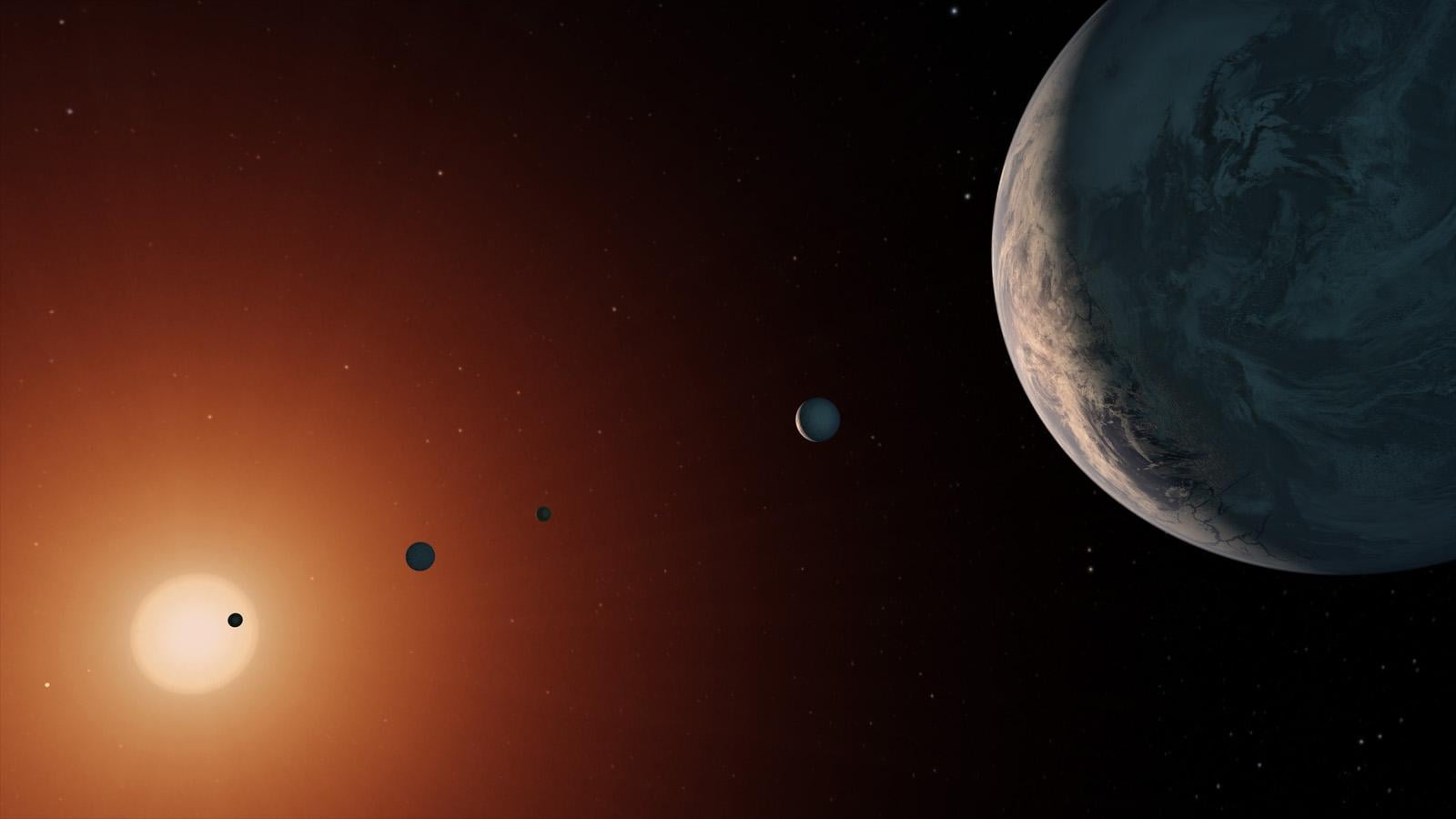
TRAPPIST-1 is not impressive by the usual standards of stargazing. It is too faint to see with the naked eye, far cooler and smaller than the Sun, and located about 40 light-years away in the direction of Aquarius. Yet it has become one of the most closely watched planetary systems beyond our own because its planets are not large, distant giants. They are small rocky worlds, packed into a compact arrangement around a dim red star.
The central fact is still remarkable, even after nearly a decade of follow-up: NASA’s TRAPPIST-1 overview describes seven rocky exoplanets orbiting the star, all in a system close enough for repeated observation by ground and space telescopes. Three of them, usually identified as TRAPPIST-1e, TRAPPIST-1f and TRAPPIST-1g, orbit in the star’s habitable zone, where temperatures could allow liquid water on a rocky surface if other conditions cooperate.
That last clause matters. The habitable zone is not a promise of oceans, biology or Earth-like weather. It is an orbital estimate. A planet in that zone receives a level of starlight that makes surface liquid water physically plausible under the right atmosphere, pressure, chemistry and cloud conditions. Without those, the same orbit could still describe a dry rock, a frozen world, or a planet with an atmosphere very different from Earth’s.
A small star with a crowded system
The seven-planet system was announced in 2017 after observations from the ground-based TRAPPIST telescope and NASA’s Spitzer Space Telescope. The discovery paper, published in Nature by Michaël Gillon and colleagues, reported seven temperate terrestrial planets around the ultracool dwarf star. It also noted the value of the system for atmospheric study because the planets pass in front of a relatively small host star from our point of view.
That transit geometry is part of why TRAPPIST-1 has become so important. When a planet crosses the face of its star, the dip in starlight gives astronomers a way to measure the planet’s size. Tiny timing variations between transits can also reveal how the planets tug on one another, which helps constrain their masses. Put those pieces together and the system becomes unusually information-rich for something so far away.
NASA’s photojournal entry for a TRAPPIST-1 artist concept notes that all seven planets are Earth-sized and terrestrial, and that their orbits sit very close to the star. This does not make them hot by default, because TRAPPIST-1 is so dim. Instead, the scale of the system is compressed: NASA’s TRAPPIST-1 page says all seven planets could fit well inside Mercury’s orbit around the Sun.
That compactness has consequences. The planets are likely tidally locked, meaning the same hemisphere may always face the star while the other remains in permanent darkness. A tidally locked planet is not automatically uninhabitable, but it changes the problem. Atmospheres and oceans, if present, would have to move heat between day side and night side. Clouds could cool the day side. The night side could trap volatiles. The details matter more than the simple label “Earth-sized.”
Why the three-zone claim needs care
The three planets most often placed in the habitable zone are e, f and g. They are not identical prospects. They receive different amounts of light, orbit at different distances, and may have different atmospheric histories. The phrase “liquid water could potentially survive” should therefore be read as a boundary condition, not as a description of confirmed surface conditions.
That distinction has only become more important with the James Webb Space Telescope. TRAPPIST-1b, the innermost planet, is too close to the star to be a habitable-zone candidate. But it has served as an early test case for what Webb can and cannot see in this system. A 2023 JWST study led by Thomas Greene measured thermal emission from TRAPPIST-1b and found the observations most consistent with little or no atmosphere redistributing heat from its day side.
TRAPPIST-1c, the next planet outward, has also been tested. A 2023 study led by Sebastian Zieba found no evidence for a thick carbon dioxide atmosphere around that planet. Those inner-world results do not settle the question for the outer planets. They do, however, show why the system must be treated as a set of physical environments rather than as seven Earth copies.
There is also a star problem. Red dwarfs are long-lived and common, which makes them attractive targets in the search for small planets. But many are magnetically active, especially earlier in their lives, and close-in planets can be exposed to high-energy radiation and stellar winds. For planets orbiting as tightly as the TRAPPIST-1 worlds do, atmospheric survival is one of the central unknowns.
What makes TRAPPIST-1 useful anyway
The careful reading is not the dull one. TRAPPIST-1 remains scientifically valuable precisely because it is both promising and difficult. It gives astronomers a natural laboratory: seven rocky planets around one small star, with orbits aligned so that they transit from Earth’s perspective. The planets formed in the same system, but their different distances from the star create a sequence of different heating and atmospheric possibilities.
A 2023 paper by Joshua Krissansen-Totton argued that atmospheric non-detections for the inner planets do not necessarily rule out atmospheres on the outer habitable-zone worlds. The inner planets may have experienced much harsher runaway-greenhouse and escape histories than planets farther out. That is a useful caution against turning early Webb results into a blanket verdict on the entire system.
At the same time, the burden of proof remains high. The existence of a habitable-zone orbit does not show that water exists there now. It does not show that an atmosphere survived. It does not show that biology is likely. It simply marks the worlds that deserve more careful atmospheric and climate study because, from the limited information available, they occupy the narrow orbital range where liquid water is not ruled out by starlight alone.
That is why TRAPPIST-1 has held attention without needing exaggeration. It is nearby by astronomical standards, its planets are small enough to compare with the rocky worlds of our own Solar System, and three of them sit in the zone where surface liquid water remains a live physical possibility. The system does not answer the question of life beyond Earth. It gives astronomers one of the better places to ask the question carefully.