Space, science, and the human mind. Since 1995.
Deep Field
A Space Daily column

Deep Field

Astronomy and cosmology

Deep Field covers astronomy and cosmology. Telescopes and what they find, planets near and far, and the strange physics of the deep universe, traced back to the journal papers and observatory data behind the headlines.

Science

On 13 April 2029, the roughly Eiffel Tower-sized asteroid Apophis will safely pass just 32,000 kilometres above Earth—inside the orbit of many geosynchronous satellites—and briefly become visible to the naked eye under clear, dark skies for around two billion people across Europe, Africa and parts of Asia, during a close encounter expected only about once per millennium.

Apophis will pass inside geostationary altitude in 2029 and enter naked-eye range for a vast potential audience, with no risk of impact.

Science

The icy Centaur 450P/LONEOS may preserve material left over from the Solar System’s formation, but a pass within 2.9 million miles of Saturn in 1992 abruptly shifted its orbit closer to the Sun; now Gemini and JWST have detected its returning coma, carbon-dioxide gas and rising dust production, giving astronomers a rare real-time view of a Centaur beginning its transition into a Jupiter-family comet.

A Saturn encounter shifted 450P/LONEOS inward; Gemini and Webb have now followed its growing dust coma and identified carbon dioxide as the likely driver of its distant activity.

Marsdaily

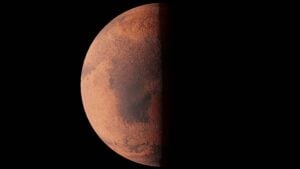
Mars has been called the Red Planet for centuries, but a 2025 study suggests its colour comes largely from ferrihydrite—an iron mineral that typically forms rapidly in cool liquid water. If the identification is correct, Mars did not rust only after becoming a desert: much of its famous red dust formed while the ancient planet was still wet.

A 2025 spectral and laboratory study points to hydrated ferrihydrite as the chief pigment in Martian dust, tying the planet's colour to its wetter ancient climate.

Science

Jupiter’s north pole is dominated not by one storm but by a central cyclone surrounded by eight others, each thousands of kilometres wide — and NASA’s Juno team revealed in April 2025 that they push against their neighbours and bounce around their positions like masses connected by springs, preserving a strange geometric formation unlike anything yet observed beyond Jupiter.

Juno tracking shows that nine immense north-polar cyclones preserve their rough octagon through competing vorticity forces that act like a spring system.

Outer Planets

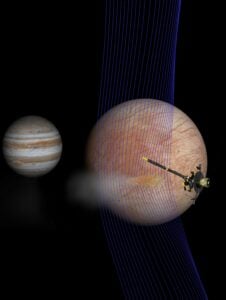
The same scientists who reported water erupting from Europa in 2014 have now reanalysed 14 years of Hubble data and cut their confidence from 99.9% to below 90%. The signal may have been statistical noise, leaving Europa’s famous geysers physically plausible—but never conclusively observed, and never proven to connect with the ocean below.

A 2026 reanalysis finds no localized Hubble signal requiring a Europa plume, weakening the original claim while leaving smaller or intermittent eruptions physically possible.

Science

In 1925, 24-year-old graduate student Cecilia Payne calculated that the Sun and other stars were composed overwhelmingly of hydrogen and helium—a result so contrary to accepted astronomy that senior astronomer Henry Norris Russell called it “clearly impossible,” leading her to write in her thesis that the enormous abundances she had derived were “almost certainly not real.” Four years later, Russell reached the same conclusion by another method and acknowledged that Payne had got there first.

Cecilia Payne's 1925 calculation found hydrogen and helium dominating stellar atmospheres. This companion piece follows the spectral method and Russell's 1929 confirmation.

Outer Planets

Europa may hide twice as much liquid water as all of Earth’s oceans combined, stirred by planet-spanning convective currents—but a 2025 model found that the magnetic field generated specifically by that moving saltwater would be weaker than one nanotesla, probably too faint for Europa Clipper or JUICE to isolate from the magnetic noise around Jupiter.

Europa's moving saltwater should generate a magnetic field, but a 2025 model puts that separate circulation signal below one nanotesla in Jupiter's noisy magnetic environment.

Science

Werner Heisenberg nearly failed his 1923 PhD oral because he could not explain the resolving power of a microscope—or even how a storage battery worked. Experimental physicist Wilhelm Wien wanted to fail him, but his mentor Arnold Sommerfeld defended his brilliance as a theorist, securing a mediocre cum laude—four years before Heisenberg used a microscope thought experiment to explain the uncertainty principle.

Heisenberg's near-failed 1923 doctorate exposed his weakness in experimental physics, then the microscope returned in his 1927 explanation of quantum uncertainty.

Science

Astronomers already knew the Milky Way’s magnetic field reverses near the Sagittarius Arm, but a new 2026 three-dimensional model revealed the boundary’s unexpected shape: not a vertical wall between spiral arms, but a tilted magnetic plane slicing diagonally through the Galactic disc and passing just above our own region of space.

A 2026 model replaces the familiar vertical boundary near the Sagittarius Arm with a tilted magnetic plane passing above the Sun in Galactic coordinates.

Earth News

In 2002, Idaho crushed almost 300 tons of bottles and jars into gravel-sized cullet and buried it in an 8-to-12-inch layer beneath roughly 200 feet of Highway 75 near Ketchum, using the glass as fill during a project that included a new 178-foot bridge

When Idaho's highway engineers faced a mountain of recycled glass, they didn't haul it to a landfill—they paved over it, burying 300 tons beneath a major road in an experiment that raises questions about infrastructure durability and waste reuse.

Marsdaily

Mars’s interior was long modelled as broadly symmetrical — but a Nature study published on 27 August found evidence that the mantle beneath its southern highlands remains 200 to 400°C hotter than the north and may be partially molten, an enormous thermal divide whose origin remains unexplained.

Sixteen years of orbiter tracking suggest a 200 to 400°C thermal excess beneath Mars’s southern highlands. The gravitational signal is strong, but heat, composition, partial melt and origin remain entangled in the interpretation.