

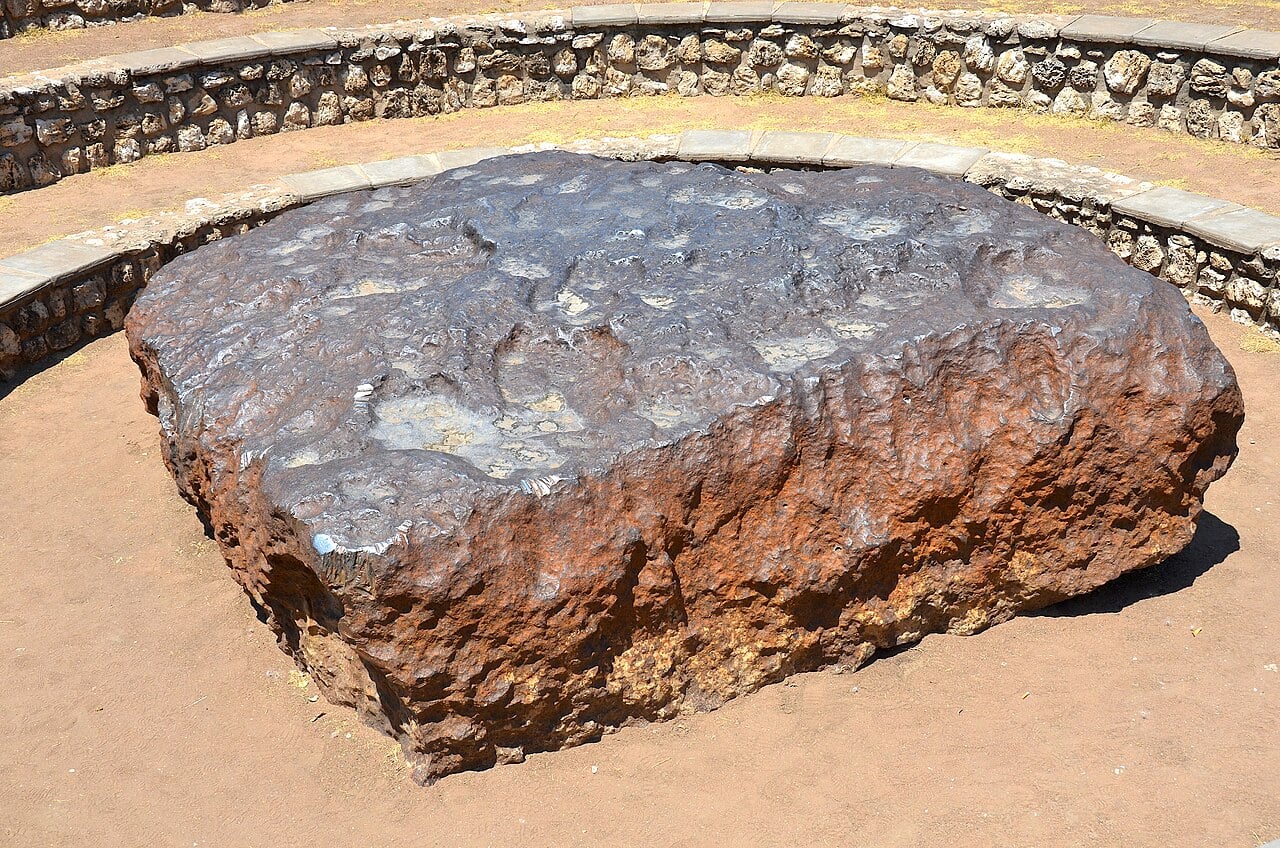
Hoba lies in an open-air enclosure on the farm where it was found near Grootfontein in northern Namibia, a broad slab of weathered iron almost as wide as a small room. At roughly 60 tonnes, it is the largest meteorite known to survive as one intact mass. It has been excavated around and sampled, but never hauled away.
No impact crater survives around Hoba. Its flat form may explain how the atmosphere removed most of its speed before impact. That is a plausible reconstruction, not an observed fact, because the fall probably occurred less than 80,000 years ago and no witness recorded it.
The plough story is famous, but not uncontested
The familiar account begins in 1920 with farmer Jacobus Hermanus Brits ploughing Hoba West farm. His ox-drawn plough struck buried metal, producing a scrape and an immovable obstruction. The object was uncovered and recognised as meteoritic iron. This version has been repeated for decades.
Archival history adds a complication. Physicist Peter Spargo’s reconstruction reports a first-person account attributed to Brits at Grootfontein Museum. He noticed an exposed rock while hunting and scratched it with a knife until metal appeared. The plough does not feature.
The discrepancy does not change the year, place or identity of the find. The plough strike should be recognised as the standard story, not an uncontested transcript. Hoba came to scientific attention in 1920 on the farm whose name it took, when Namibia was administered as South West Africa.
Sixty tonnes is a careful approximation
The Meteoritical Bulletin Database records Hoba as a 60-tonne iron meteorite in chemical group IVB. The figure is rounded: Hoba cannot be placed on a conventional scale, historical calculations differ, and pieces have been removed by sampling, souvenir hunters and vandalism.
Its main surfaces measure about 2.7 by 2.7 metres, while the slab is roughly a metre thick. Iron and nickel dominate. Its classification points to the differentiated interior of an ancient parent body, where metal separated from rock early in solar-system history.
“Largest intact meteorite” needs the final word. Some falls produced a greater combined mass across many fragments. Hoba holds the record for one surviving piece. The American Museum of Natural History describes it as roughly twice the mass of Ahnighito, the Cape York iron displayed in its hall.
Watch here: The Sahara has been moving south for decades, swallowing farmland, drying wells, and forcing families to leave. Here is what eleven African nations decided to do about…
The largest piece has stayed in place
Ahnighito offers a contrast. The 31-tonne Greenland mass reached New York in the 1890s after years of work. A SpaceDaily history of the Cape York meteorite describes that effort and the older Inuit relationship with its iron. Hoba, nearly twice as massive, remains where it landed.
“Never moved” refers to the main mass, not an untouched setting. Excavators exposed its sides and researchers removed samples. In 1955 the South West African administration declared it a national monument. Conservation work in the 1980s added the stone amphitheatre seen today.
Keeping Hoba in place preserves context that transport would erase. Its horizontal attitude, shallow burial and surrounding calcrete inform attempts to reconstruct its arrival. The visitor site surrounds the final physical evidence left by an unobserved fall.
No crater survives, but one may once have existed
No crater, raised rim or obvious impact disturbance is visible around Hoba. That observation is firm; the explanation is not. Popular summaries say the meteorite made no crater. The American Museum of Natural History is more cautious, noting that the reason for its absence remains uncertain.
Landscapes change. Soil accumulates, calcrete forms and erosion softens depressions over tens of thousands of years. An intact meteorite beside no visible crater shows that Hoba did not arrive at ordinary asteroid impact speed. It does not prove that the original impact excavated nothing.
A NASA conference paper on African meteorites notes neither a crater nor shock damage to the bedrock. Survival as one largely unshocked mass points toward a long atmospheric trajectory and greatly reduced landing speed.
The dropped-anvil picture is a model, not a film
Atmospheric drag depends partly on the area facing the airflow. Hoba’s broad faces give it an unusually tabular form. If the incoming mass maintained a stable broadside orientation on a shallow trajectory, the atmosphere could remove far more speed than if it arrived edge-first.
Martin Beech tested that scenario in a 2013 Earth, Moon, and Planets study. The model required low entry speed, shallow angle, maximum-area presentation and aerodynamic stability. It inferred a pre-entry mass near 500 tonnes and impact below a few hundred metres per second.
That is the useful meaning of the colossal dropped-anvil comparison. Hoba may have lost its hypervelocity character and fallen as a compact heavy mass rather than exploding like a typical cosmic projectile. It did not float gently down. Beech’s calculation still produced a possible crater about 20 metres wide and five metres deep, small enough in the model to be erased later.
“Less than 80,000 years” is not a landing date
The age estimate comes from radioactive isotopes in the iron, particularly nickel-59. A measurement reported in the 1960s placed the fall within roughly one half-life of that isotope, yielding an upper limit near 80,000 years. It did not identify a year, season or exact millennium. “Probably less than 80,000 years ago” is the appropriately limited claim.
That interval leaves room for substantial environmental change around the mass. It also separates the age of the fall from the age of the meteorite itself. Like other iron meteorites, Hoba’s metal formed during the early history of the solar system, billions of years before its comparatively recent arrival in Namibia.
The vocabulary helps keep those stages separate. Before it reached the atmosphere, the object was a meteoroid. Its luminous atmospheric passage was a meteor. What survived to the ground is a meteorite. A SpaceDaily guide to those terms explains why one object receives different names during its journey.
The evidence is impressive because it is incomplete
Hoba’s present mass, dimensions, composition and location can be measured. Its classification is secure. The fall itself was not seen, no crater remains to preserve the impact geometry, and even the discovery story survives in competing versions. Every reconstruction must therefore join physical evidence to assumptions about entry speed, orientation, erosion and lost material.
The most appealing explanation is also the one easiest to overstate. A broad iron slab could have met the atmosphere like an enormous brake, losing speed until its final impact resembled a dropped anvil more than an asteroid strike. The study shows that such a path is physically possible under narrow conditions. Hoba’s quiet setting does not reveal whether every condition occurred.
What remains is remarkable without turning probability into certainty: a 60-tonne iron meteorite rests at the site where it landed, the largest intact example known. The missing crater narrows the story of its descent but does not complete it. Hoba is both the answer left on the ground and the question that no surviving witness can settle.